Title Page
GOD’S WORD
IS NOT BOUND

Copyright & the
Stewardship of Scripture
God’s Word Is Not Bound: Copyright & the Stewardship of Scripture
Dedicated to the public domain, CC0. All of this publication may be shared, translated, sold, or copied freely without limitation and without permission. The price of this print edition only covers the cost of materials and does not generate profit for the authors. To learn more about why this book is freely given (Matt 10:8), please visit sellingJesus.org.
2026
For a free digital copy of this book, please visit sellingJesus.org.
ISBN 9798251073096
Epigraph
The law from your mouth is more precious to me
than thousands of pieces of gold and silver. – Psalm 119:72
Pray for us, that the word of the Lord may run and be glorified.
– 2 Thessalonians 3:1
For we are not like many who commercialize the word of God, but as from sincerity, as from God, in the sight of God we speak in Christ.
– 2 Corinthians 2:17
There have been a great many attempts to bind the Word of God…. It is not bound, because it is the voice of the Almighty. – Charles Spurgeon
But when her masters saw that their hope of profit was gone, they seized Paul and Silas and dragged them into the market place before the authorities.
– Acts 16:19
Introduction
―❖―
God’s word is not bound.
ὁ λόγος τοῦ θεοῦ οὐ δέδεται.
– 2 Timothy 2:9
As Paul sits in a Roman prison cell, he writes, “Remember Jesus Christ, risen from the dead, the offspring of David, as preached in my gospel, for which I am suffering, bound in chains as a criminal. But God’s Word is not bound” (2 Tim 2:8-9). Even though he may be imprisoned, God’s Word cannot be. Put all the preachers in chains, but the message of Christ remains free. Unshackled.
Little did Paul know that the schemes of the Enemy would one day shift from binding the hands and feet of Christians to binding the Word—with legal fetters. Evil emperors who cast saints into dungeons would be replaced centuries later by Christians who imprison the Word behind bars of jurisprudence. And no matter the stated reason for this imprisonment of Scripture, the outcome remains the same: the Word does not run freely.
The Church can no longer declare with Paul, “God’s Word is not bound!” Instead, followers of Christ cower before copyright claims, subservient to man’s restrictions on what God himself authored. It may be God-breathed, but men have arrogated it, threatening anyone who might want to unbind it and let it fill the earth as the waters cover the sea. Preachers call it “God’s Word,” but mere humans insinuate that it is theirs with the phrase “all rights reserved.”
In our modern Church, Paul might have said the opposite of what he wrote so long ago. Looking around at the Bible publishing landscape, he may have written, “Remember Jesus Christ, as I preached in my gospel, which I am free to proclaim. But God’s Word is bound in chains as a criminal.”
Of course, there is a sense in which what John Gill says is true: “The Word of God cannot be fettered and bound by men, though men may be fettered and bound for the sake of it.”1 But this book intends to address a present danger that was foreign to most of Christian history. In the words of Jon Here:
Scripture cannot be chained (2 Tim 2:9) yet publishers may well sue you if you share it in a way they don’t approve. They call it “God’s Word” but really believe it belongs to them. A handful of monetization strategists at these organizations decide how millions of believers can and can’t use God’s Word. We celebrate smuggling bibles into hostile countries and yet forbid anyone from copying and sharing Scripture with their neighbor. We say the Reformation put God’s Word back into the hands of ordinary believers, but it has once more been taken away by modern day publishers…. A future generation of Christians will look back and remember the 21st century as the time when the sharing of God’s Word was restricted by Christians themselves, and it was called “godly.” Even more perplexing will be why churches allowed it to happen in the first place.2
Accounts continue to surface across the globe. Bible societies decline to print additional copies of existing translations because they are not deemed financially viable, even as local churches plead for access. And copyright restrictions prevent others from meeting the need. Permissions are withheld for audio recordings in communities with low literacy, effectively rendering the Bible unusable for many. Distribution is deliberately constrained to maintain pricing structures, leaving warehouses full and the hands of believers empty. Rather than offer free digital downloads or use low cost print-on-demand alternatives, entire translations have been withheld for decades due to the inability to fund large print runs. In some instances, access has been so asphyxiated that communities have effectively stopped using completed translations and moved on as though they never existed. Digital distribution has likewise been prohibited in major languages, severely limiting reach, while other projects have been delayed or halted through legal pressure. The pattern recurs across Africa, Asia, and beyond.3
Meanwhile, the Muslims publish their Quran without the restriction “all rights reserved.”4 The question, then, presses itself upon the Church: Have we put ourselves in the position to be shamed by practitioners of false religions? Are we reflecting the true, most gracious Way, in which God has freely given his own Son, the Word who became flesh?
The Word has always been intended to be a shared family feast, enjoyed together as the Body without hindrance. But imagine a culture where food is sold or licensed at the home dinner table, and as you sit down to a lovely meal, you say to your rich brother, “Could you please pass the potatoes?” And he responds, “Pay me first.”
That is our present global condition. The spiritual food meant to nourish everyone gets legally strangled and packaged into products sold mainly to the privileged. Jesus did not command discounted ministry, or exceptions for the poor, or permission on request. He said, “Freely you have received; freely give” (Matt 10:8). The issue is whether the recipient of ministry is made a debtor to the minister. A restriction may burden the hearer even when no price is demanded. If the Word may not be copied or translated without permission from the copyright holder, then the gift has not been given in the manner Christ commanded. It has been handed over with strings attached. The recipient is not treated as a brother at the family table, but as a licensee under supervision.
Before proceeding, we wish to make one important clarification. Some readers may represent organizations that have already rejected traditional “all rights reserved” copyright in favor of open licenses such as Creative Commons Attribution (CC BY) or Creative Commons Attribution-ShareAlike (CC BY-SA). We warmly acknowledge this as a significant step in the right direction. Such ministries have recognized, far more clearly than many others, that God’s Word ought to be shared rather than tightly controlled, and we are genuinely grateful for every restriction that has been removed. Yet we believe the journey should not end there.
Attribution requirements and ShareAlike provisions still impose legally enforceable conditions upon what God has freely given, making recipients licensees rather than unrestricted stewards. The chapter “Copyright and Jesus’ Command to Freely Give” will argue at length why even these comparatively open licenses fall short of the biblical pattern and mandate, and why the public domain offers a more faithful alternative. Many have adopted these licenses as safeguards against misrepresentation or loss of attribution, but this is misguided.5 Our aim, therefore, is not to criticize those who have embraced open licensing as though no progress has been made, but to invite them to consider whether biblical fidelity ultimately calls us one step further.
Most Christians do not engage in this legal binding of truth out of nefarious motives. The majority do so with the best of intentions, or simply unwittingly. For example, Lane Dennis frames Crossway’s honorable motives as follows:
Crossway is responsible for shepherding and preserving the ESV Bible text, as a calling and commission from the Lord; to be undertaken in full consciousness of the fearful responsibility that this entails; which can be accomplished only in complete dependence on the Lord’s grace, mercy, strength, providence, and wisdom; for the glory of God alone…. We believe deeply that the translation and publication of the Bible is a sacred trust and unspeakable privilege, and we want to do all we can to steward this calling, before God, with the reverence and care that it deserves.6
Dennis invokes the idea of stewardship. In this book we will use the term stewardship to mean the faithful administration of another’s goods under delegated authority and in accountability to the owner. This is the controlling biblical image. In Titus 1:7, the overseer is described “as God’s steward” (ὡς θεοῦ οἰκονόμον): he is not master of the household, but a servant charged with ordering what belongs to God, and his office is expressly incompatible with self-will and shameful gain. Paul likewise calls ministers “servants of Christ and stewards [οἰκονόμους] of the mysteries of God,” immediately adding that what is required of stewards is faithfulness (1 Cor 4:1–2). Peter extends the same pattern to every believer: each is to use the gift he has received in service to others, “as good stewards [οἰκονόμοι] of the manifold grace of God” (1 Pet 4:10). The biblical idea includes reception, administration, service, and accountability; not authorship, possession, or sovereign control. This accords with the historic English sense of a steward as the guardian or manager of another person’s household or estate. Accordingly, the stewardship of Scripture is the Church’s duty to preserve, translate, teach, and transmit God’s Word faithfully according to the purposes of its Owner. It gives ministers responsibility for the Word, but no right to convert that trust into proprietary dominion, to make their permission a condition of its use, or to withhold from God’s household what the Master has given for its nourishment.
Yet this biblical and historical concept of stewardship has often been recalibrated to justify proprietary control for the sake of profit. This question cannot be settled by appealing to the sincerity of those who hold the rights. Many faithful Christians labor within Bible societies, publishing houses, translation committees, and ministries. Their work should not be despised, nor should their motives be carelessly impugned. Yet the presence of godly people inside an institution does not sanctify the institution and its methods. Scripture never teaches that good intentions can transform disobedience into stewardship, or that a system is righteous merely because some righteous people participate in it. Christian institutions remain vulnerable to the same temptations that afflict all human institutions: money, prestige, fear, control, self-preservation. Good people can be found inside the system; the question is whether the system accords with the law of Christ.
Thus, the question arises: What does it mean to steward the Word of God faithfully in an age of copyright restrictions and intellectual property? More precisely, can the modern legal and economic frameworks governing Bible translations, manuscript digitizations, and critical texts be squared with Scripture’s own teaching about the nature of divine revelation and the manner in which it is to be handled, transmitted, and shared? In the end, is God’s Word really God’s? And if so, what are the implications?
We believe these questions have not been sufficiently examined by Christians. While the Church has devoted considerable attention to issues of translation philosophy, inerrancy, and doctrinal fidelity, far less scrutiny has been applied to the moral and theological assumptions embedded in the systems that regulate access to Scripture itself. As a result, practices that would have appeared strange or even troubling to earlier generations of Christians are now widely accepted as normal, necessary, and beyond dispute.
At the center of the discussion stands a tension between two claims that are often held simultaneously, but rarely examined together. On the one hand, Scripture repeatedly presents itself as a priceless gift of God, freely given, entrusted to the people of God, and intended to circulate widely without restriction. On the other hand, modern Bible publishing and scholarship frequently operate under licensing regimes that treat biblical texts and their reproductions as their own controlled assets. The question is not merely whether such practices are legal, practical, or efficient, but whether they are theologically valid and biblically sound.
The biblical witness is unambiguous: God’s Word does not depend on human power structures for its preservation or efficacy. God is sovereign. Scripture portrays divine revelation as resilient, self-authenticating, and capable of flourishing under conditions of openness, redundancy, and even apparent disorder. Historically, the proliferation of manuscripts, translations, and copies (often produced without centralized control) was not a threat to the integrity of Scripture, but the very means by which God preserved it.
Against this backdrop, the emergence of modern copyright law and proprietary control over Scripture raises significant questions. Copyright is a relatively recent invention, designed to regulate creative expression in commercial contexts. Its extension to biblical texts, manuscript photographs, and critical editions assumes not only that Scripture can be treated analogously to ordinary intellectual property, but also that intellectual property itself is a valid moral category. Neither assumption should be granted without examination. The fact that the state calls something property does not make it property before God.
Property, according to the Bible, is grounded in God’s created order. Physical goods are scarce, conflictable,7 and capable of being taken from their possessor; therefore, boundaries around them preserve peace, order, and justice. Ideas, words, patterns, and truths do not function in the same way. When they are communicated, they are not lost by the speaker or consumed by the hearer; they are multiplied. To call them “property” falsely forces the metaphysical realm of knowledge into the realm of external, material things. This becomes still more serious when the knowledge in question is divine revelation. A Bible translator does not create the Word of God, the gospel, the events of redemption, or the truth being communicated. At most, he rearranges what God has already given. The question, then, is whether God has granted men a natural right to restrict the copying of such things, or whether copyright is a state-created perversion of justice that reaches beyond legitimate property and into the liberty of others.
While the Church has largely been complacent and apathetic about the issue, drifting with the current of an anti-Christian culture and assuming copyright’s legitimacy without biblical examination, the secular world has been busy thinking deeply and writing prolifically about whether intellectual property as a category or legal framework is valid or beneficial to society. Economists, legal scholars, historians, technologists, and political theorists have devoted substantial attention to the subject, asking whether copyright and patent systems truly promote creativity, innovation, justice, learning, and human flourishing. Empirical studies all point to the fact that patent and copyright law are deterrents to progress.8 Some have coined the term intellectual monopoly, arguing from vast historical evidence that it impoverishes culture, restricts speech, and hinders technology and societal advancement. Whatever one makes of their conclusions, the strength, gravity, and substantive nature of the inquiry is undeniable.9
This exposes a troubling failure of Christian reflection. Unbelievers have thought more carefully about the nature, legitimacy, and consequences of intellectual property than those entrusted with the oracles of God. The Church has too often asked merely whether copyright is useful for funding the work, preserving institutional control, or protecting organizational interests, while failing to ask whether it is a biblical category, whether it is a God-glorifying mechanism for ministry, or whether the Church may lawfully place legal restraints around spiritual things freely given by God. In this respect, the world has done the work of critical thinking, while most of the Church has merely baptized the legal machinery of the age in the language of “stewardship.”
Part of the problem is that many Christians have assumed that ministry resources will not be created unless they are incentivized by financial gain guaranteed via exclusive legal rights. Such a view says far more about the modern Church than it does about the nature of Christian ministry. For nearly two millennia before the advent of copyright law, believers translated, copied, preserved, taught, and distributed Scripture without exclusive rights, royalty payments, or government-enforced restrictions. The apostles, church fathers, scribes, missionaries, and Reformers labored because they loved God, loved their neighbors, and desired the spread of the gospel. They even endured loss and persecution in their quest to serve the Lord and edify his Bride. The suggestion that ministry cannot flourish without proprietary control would have struck much of church history as bewildering. It reflects a mindset that has come to view money as the primary engine of Christian labor, rather than faith, love, sacrifice, and the hope of eternal reward.
One of the most common objections to releasing biblical resources and bibles into the public domain is the fear of “copyright hijacking,” which is the concern that another party might republish a freely released work, falsely claim ownership, and then use copyright law against the original creator. While such concerns are understandable, they are based on misconceptions about how copyright law actually functions. Public domain dedications do not transfer exclusive rights to whoever claims them next, nor do they leave a work vulnerable to lawful appropriation by a third party. In fact, false assertions of ownership over public domain works have repeatedly been exposed as legally defective. Moreover, works protected by full copyright are themselves frequently subjected to false claims. Because this objection arises so frequently in discussions of Bible distribution and licensing, a full treatment of the legal and practical realities surrounding the misplaced fear10 of copyright hijacking has been included in part two for readers who wish to examine the matter in greater depth.
John Piper has voiced another widespread justification for restrictive licensing (notably void of his characteristic biblical and theological rigor):
I would say “Amen” to copyrighting a version of the Bible if that copyright is used to protect the version from distortion rather than to make anybody rich…. A Bible version, like the English Standard Version, ought to be copyrighted not because you’re going to keep paying translators or a committee. That’s not the point. The point is that unbelievable care, prayer, and energy goes into a translation’s accuracy, and you don’t want anybody taking it, saying it’s the ESV, and then changing the words to wrong translations. The safeguard we have in our culture to prevent such distortion is to copyright things.11
Few Christians would object to preserving the accuracy of Bible translations or ensuring that altered texts are not falsely represented as authentic. Yet this argument rests on a common confusion between copyright and trademark. Copyright principally governs the reproduction and distribution of creative works. Questions of identity, provenance, authenticity, and source belong to trademark law.12 Piper’s concern is fundamentally one of identity rather than copying, and thus copyright is irrelevant. Identity theft, brand impersonation, and fraudulent impersonation are still illegal whether a work is copyrighted or not. Bearing false witness and lying are also contrary to God’s law (Ex 20:16, Lev 19:11), but have nothing to do with copying words. If the central concern is ensuring that modified works are clearly distinguished from the originals, alternative mechanisms can accomplish this objective without imposing legal limitations on copying, sharing, translation, and distribution.
Piper also expresses the general fear of textual distortion. While the desire to safeguard accuracy is commendable, restrictive licensing is neither necessary nor uniquely effective for accomplishing that goal. In fact, copyright does little to prevent aberrations. At most, it provides a legal basis to sue, but only after damage has been done. The possibility of a lawsuit may deter some, but it fails to stop distortions completely, and does not guarantee that copyright holders will even become aware of them. In practice, the people most constrained and impeded by copyright are usually those who seek to act with integrity, rather than those willing to disregard the license. Because this concern is both important and common, the question of textual integrity and the preservation of Scripture will be treated at length in this volume.
We are not the first Christians to raise concerns about the binding of God’s Word. Though past objections have not formed a sustained movement, and have been scattered, brief, unsystematic, or ignored, they bear witness that this concern is not new. In 1996 Maurice Robinson presented a paper at the Evangelical Theological Society titled “The Bondage of the Word: Copyright and the Bible.” He said the following:
[F]or nearly a century, copyright legislation has been subtly but effectively applied, misused and abused in regard to the word of God in order to chain the Bible to a new pulpit, differing in kind but not in essence from the restrictive practice so loudly decried in the Middle Ages. While the contemporary difference can be described in terms of dollars and cents, the net effect is identical: the free and unhindered access by God’s people to the revealed truth of His word is restricted once more, this time not by the ecclesiastical hierarchy, but by the chains of copyright and financial ransom as demanded by the proprietary publishers. Has God’s word all of a sudden ceased to be the “intellectual property” of God’s people? Must it now remain under the peculiar control of executives, scholars and lawyers?13
In a 2009 article called “Copyrighting the Holy Spirit’s Words, Then Living off the Profit...” David and Tim Bayly wrote,
That something is legal does not make it right or godly…. No one should use copyright to protect the wealth of men, their corporations, or their non-profits when it’s the Word of God inspired by the Holy Spirit now two thousand years or more old that’s the source of that wealth. And the fact that we’ve all become inured to this recent development in Bible publishing makes it no less shameful.14
John Frame and Vern Poythress have raised similar concerns regarding copyright more broadly. Frame argued that copyright is often treated in Christian circles as though it were a straightforward moral obligation, when in fact its biblical basis is far from obvious and its chief defense is usually one of utility rather than principle.15 Poythress pressed the matter further, arguing that Christians must ask whether copyright laws themselves are just, rather than merely assuming that existing legal categories define righteousness. He observed that copying is not theft in the biblical sense, since it does not deprive the original possessor of what he owns, and he warned that the language of “property,” “theft,” and “piracy” can beg the very question that needs to be examined.16 Though neither Frame nor Poythress offered a full treatment of Bible publishing, their arguments underscore the same neglected point: Christians must not merely inherit the legal assumptions of the age, but must test them by Scripture. To our knowledge no one has yet answered these concerns with assiduous attention to biblical principles, thorough exegesis of relevant passages (such as 2 Cor 2:17), and a firm grasp of publishing history and copyright law. Accordingly, this work seeks to renew and amplify these protests against the binding of Scripture, and to urge their implications upon the modern Church.
The chapters that follow pursue several lines of inquiry. First, they examine the biblical prohibition against commercializing the Word of God, most notably articulated in 2 Corinthians 2:17. Second, they trace the historical development of Bible societies and publishing institutions, highlighting how economic expediency gradually reshaped distribution models that were initially grounded in charitable and theological commitments. Third, they analyze claims of ownership over physical manuscripts, digital reproductions, and critical texts, assessing both their legal validity and their moral legitimacy. Fourth, they consider whether copyright and licensing actually serve the purposes often attributed to them, such as protecting textual integrity or ensuring responsible stewardship. Fifth, they consider whether intellectual property can be justified according to Scripture and natural law, or whether it represents an artificial monopoly imposed upon realities that cannot truly be owned. Sixth, they examine whether the assertion of copyright over spiritual things imposes a burden of reciprocity on the hearer or reader that is at odds with the biblical pattern of freely giving. Finally, they examine the incentives, corruptions, and misplaced trust that have marked the modern Christian publishing industry, asking whether such institutions should be treated as safe guardians of proprietary control over God’s Word.
Throughout, the argument advanced is not that labor should go uncompensated, nor that scholarly or translation work lacks value. Scripture affirms that those who labor are worthy of support.17 The issue, rather, is the mechanism by which that support is obtained. There is a fundamental difference between freely giving the Word of God while trusting God to provide through the generosity of his people, and placing legal or financial barriers between people and Scripture as a condition of access, use, or transmission.
The theological framework underlying much of this volume is what Conley Owens has termed the dorean principle. The name comes from the Greek word δωρεὰν (dorean), meaning “freely” or “without payment,” used in Jesus’ command, “Freely you have received; freely give” (Matt 10:8). The principle is that in the context of gospel proclamation, accepting support as anything other than an act of co-labor compromises the sincerity of ministry. In other words, ministers of the gospel should be supported by co-labor—that is, people choosing, under no compulsion, to work with the minister in a shared mission under God. This also means that ministers should not be funded by reciprocity, or a reciprocal exchange that says, “You give me ministry if I give you money, services, or some other benefit.” This distinction resolves the apparent tension between Christ’s command to “freely give” and his affirmation that “the laborer is worthy of his wages” (Matt 10:10): ministry should be supported, not sold.
The dorean principle is not opposed to money, compensation, or the generous support of Christian laborers. It does not require ministers to always finance their work personally, nor does it deny that physical goods and services involved in ministry have real costs. Rather, it concerns the relationship between ministry and its recipient. The recipient must not be made a debtor or required to provide something in return as a condition of receiving, using, or transmitting ministry. This means that translators, scholars, and publishing organizations may be generously supported by Kingdom co-laborers, but they should not place a price, license, or legal obligation upon the Word as the means of obtaining that support. Those who give should do so because they are serving God and participating in the work, not because access to Scripture has been conditioned upon satisfying a debt.18
One of the recurring themes of this book is the danger of confusing prudence with faithfulness. Appeals to necessity—whether economic, institutional, or technological—have often been used throughout church history to justify practices that later generations recognized as compromises. The purpose here is not to impugn motives, but to insist that good intentions do not exempt practices from biblical evaluation. Scripture itself must remain the final arbiter.
This work also seeks to recover a sense of reality. The Word of God is priceless, and it is not fragile. It has survived persecution, censorship, and corruption attempts without the aid of modern legal frameworks. To suggest that its preservation now depends on restrictive licensing or centralized control risks underestimating both God’s providence and the historical evidence of how Scripture has been transmitted.
Ultimately, this book is an argument for reexamining assumptions that have become invisible through familiarity. It calls readers to consider whether current models of stewardship reflect the nature of the gift they are meant to serve. If Scripture is, as the Bible itself claims, freely given by God for the life of the world (Isa 55:1-3, John 6:63, Deut 8:3), then the Church must ask whether it has unwittingly adopted practices that obscure that truth.
These chapters do not claim to settle every question, but they do aim to clarify the stakes. We seek to “unbind” the Church’s thinking about the issue as much as possible. The arguments developed in this volume build upon the biblical framework presented more fully in Conley Owens’s The Dorean Principle.19
Herein the reader will also find an invitation to respond by signing a public statement of conviction regarding the stewardship of Scripture in the modern world. This can be done at copy.church/statement. The statement affirms that the Word of God is a gift entrusted to the Church, rather than a commodity to be owned and chained by the traditions of men. Scripture is given to be copied, translated, and shared without human restriction.
Readers are encouraged to engage with the statement thoughtfully. Those who find themselves in substantial agreement may wish to sign it publicly and invite others to do so. One’s signature signals a commitment to approach Scripture’s stewardship in a way that prioritizes biblical principle over economic or institutional convenience, as well as a desire that Bible gatekeepers unshackle the versions they hold. It is our hope that this statement may serve as a small but meaningful step toward aligning contemporary practice more closely with God’s explicit desires (e.g. Matt 10:8).
Part one of this volume represents the proceedings of Doreancon 2025, a conference hosted by Silicon Valley Reformed Baptist Church in Sunnyvale, California. Recordings of the presentations can be viewed at sellingJesus.org. Find out more about future Dorean conferences at doreancon.org.
God has indeed spoken. His Word is a gift to his people and a great light to the nations who walk in darkness. He is the sovereign, eternal, omnipotent Author who gives it to all without restriction. We have been entrusted with it only for a short time in our pilgrimage through this vale of tears, and our calling is to break down any wall that might stand in its way, carrying it faithfully and spreading it to the ends of the earth.
The Church must labor to make Paul’s declaration in 2 Timothy 2:9 unmistakable, removing every human fetter from the Word, opening every gate we have closed, and sending it forth freely to every people. We may be bound by many things—the cares of this world, mortal weakness, indwelling sin, and this cultural moment. But for all of our earthly frailties we can refuse to lay our own chains upon the Word.
PART ONE
The Proceedings of Doreancon 2025
Debate: Is Selling Licenses to Bible Translations a Sin?
―❖―
The following debate took place October 6, 2025 at Silicon Valley Reformed Baptist Church in Sunnyvale, California. The transcript has been lightly edited for readability.1
Affirmative Opening Statement: Conley Owens
I am taking the affirmative position that selling licenses to Bible translations is a sin. I want to present a simple syllogism. A syllogism has a major premise, a minor premise, and a conclusion. The classic syllogism is: all men are mortal; Socrates is a man; therefore, Socrates is mortal.
My syllogism is this:
Selling the Word of God is a sin.
Selling licenses to Bible translations is selling the Word of God.
Therefore, selling licenses to Bible translations is a sin.
In 2 Corinthians 2:17, Paul says, “For we are not like so many, peddlers of God’s Word, but as men of sincerity, as commissioned by God, in the sight of God we speak in Christ.” Paul clearly states that it is wrong to peddle the Word of God.
The word translated “peddlers” refers to selling. Older translations like the KJV sometimes render it as “corrupt,” but the term is consistently used in commercial contexts.2 In chapter 11, he says that he did nothing wrong by preaching God’s Word free of charge, and then afterwards mentions that this is what he will continue to do in order to distinguish himself from the super-apostles. So there he is saying that he is not like so many who would sell. Rather, he distinguishes himself. It makes it clear that he is of a different sort.
In addition, he uses the phrase, “in the sight of God we have been speaking in Christ,” in chapter 12. Just before that, he was talking about the duty of parents to save up for their children, not the children for their parents. So even there, he is talking about not financially burdening them.
Beyond that, we must consider 1 Thessalonians 2. There is a very similar set of verses to 2 Corinthians 2 that shows he is addressing the same sort of thing. But in 1 Thessalonians 2, he speaks of his sincerity as being demonstrated by the fact that he is not financially burdening the Thessalonians. So that’s what peddling is. Peddling is simply selling.
What is the Word of God? The Word of God is the message of the Bible. It is the message that was given to Paul and to the apostles, in whatever format it is given. So it is the message, but it is also as expressed in words.
For example, if I gave you a classified document and said that it would be illegal to sell this information to any foreign entity, and you went and changed all the words but it still contained the same message, and you sold it to a foreign entity, you would still be found guilty of having sold that confidential information. This is how you should be thinking about the Word of God. The Word of God is not necessarily the particular words. The term refers to the message, even as it is found in those particular words. So sometimes it is talking about the particular words, but regardless, it is always expressed in particular words.
Now what about sin in this statement: “Selling licenses to Bible translations is a sin”? Sin is any transgression of, or want of conformity unto, the law of God. A lot of people would wonder why I would call this a sin. It is not an option whether or not we are sincere. It was not an option for Paul. So he is plainly saying that this is something sinful. It would be sinful to be insincere. That is not an option for the Christian. Therefore, it is sinful to sell the Word of God.
Now the next part of the syllogism, the minor premise: selling licenses to Bible translations is selling the Word of God. First of all, translations are the Word of God. Maybe this is obvious to you. You have always read your Bible in English and thought you were reading the Word of God. Indeed, you are reading the Word of God. You do not have to wonder, “Am I really reading the Word of God?” like a Muslim might. In Islam, you have to be reading it in Arabic for it truly to be the Qur’an. In Christianity, God’s Word is the message as captured in those words, even as translated.
To quote the translators’ preface to the King James Bible: “We do not deny, nay, we affirm and avow, that the very meanest translation of the Bible in English, set forth by men of our profession... containeth the word of God, nay, is the word of God.” “Meanest” here means the least or poorest translation. So translations are the Word of God.
And to sell licenses is to sell translations. You might not really know what a license is, but a license is basically a contract from someone guaranteeing that they are not going to sue you for a particular thing. So if they were to sell you a license for access to a Bible translation, they would be selling you the ability to read it. Now that is obviously selling a translation.
In addition, a lot of people would observe that most of these Bible translations are not actually selling licenses for access. They give access for free, but they do sell licenses for redistribution rights and adaptation rights. These are likewise selling the translation itself.
If you look at Westminster Confession of Faith 1.8 or Second London Baptist Confession 1.8 (they are identical at this point, and these are, Jonathan, our respective confessions), they motivate Bible translation and legitimize it on the basis that the Word of God must dwell plentifully, or richly, in all. You may recognize that phrase from Colossians 3:16: “Let the word of Christ dwell in you richly, teaching and admonishing one another in all wisdom.” The Word of God is meant to be shared.
If translation can be motivated by the need for the Word to dwell in us richly, it is also motivated so that we can share it. It is not sufficient to have access to Scripture merely to know it, but also to share it and to adapt it. The rest of that verse says, “singing psalms and hymns and spiritual songs, with thankfulness in your hearts to God.” In other words, Colossians 3:16 is telling us that the Word of God needs to dwell in us richly. You must have access to the Word of God, but you also must have the ability to reshare and adapt it—to be able to sing it and present it to others, so that it would dwell richly in them. That is necessary in order to have full access to the Word of God in the way the Bible intends, and as the authors of our confessions have alluded to in their use of that verse.
So, in summary, selling licenses to Bible translations is not merely a matter of what is going on in the heart, such that someone could engage in the exact same activity and, so long as they are not greedy about it, it would be acceptable to sell the Word of God. Selling the Word of God definitionally demonstrates insincerity. If you have two people who have approached you for teaching, and you give a translation to one but not to the other because one is willing to pay you and the other is not, you are definitionally demonstrating an ulterior motive other than simply the desire for the Word to go forward.
To repeat the syllogism: selling the Word of God is a sin; selling licenses to Bible translations is selling the Word of God; therefore, selling licenses to Bible translations is a sin.
Cross-Examination: Melin questioning Owens
Melin: When Paul uses the phrase ton logon tou theou, meaning “the Word of God” in 2 Corinthians 2:17, what does he mean?
Owens: As I said, it’s the message, but that message can take various forms of expression. So it includes any kind of medium in which it is expressed.
Melin: Okay, so is your claim that Paul doesn’t charge for the Word of God, meaning his message from God about Christ, but the Bible is also the Word of God, including that same message, and therefore we shouldn’t charge for the Bible?
Owens: I’d say that’s fair. One analogy that I’ve used with you as we’ve talked about this is that it’s like being told you’re not supposed to sell paint, and then going and making a painting and selling that painting because you’re selling paint in the process. There’s no way of disentangling or separating the message from the words in which it is given.
Melin: Well, do you realize that by switching the definition of the Word of God mid-argument in your syllogism, you’re committing a fallacy of equivocation?
Owens: No, I don’t realize that. I understand that it would be if I were switching it, but I am showing that there are implications to selling the message. Selling the message in any medium is a problem.
Melin: Okay. Well, the Sunnyvale Statement on the Stewardship of Scripture states:
We affirm that the sixty-six books of the Old and New Testaments are the inspired Word of God, and that all forms thereof, whether autograph, apograph, recension, translation, or adaptation, retain a divine quality that necessarily entails certain liberties for those to whom they are entrusted.
So who gets to decide how much of a divine quality exists in a translation as compared to the original autographs?
Owens: Ultimately, it is up to God to decide in the end. Now, often the opposition to this position is very focused on the fact that there is not a hard line. Imagine taking the Bible and replacing the words one by one. At what point have you replaced enough words with random words—let’s say random words from the English dictionary—that it is no longer a Bible? I can’t tell you that. This is the Ship of Theseus paradox. The fact that you can’t tell exactly when it stops being a Bible does not mean that it wasn’t a Bible to begin with, or that it remained a Bible at various points along the way despite some changes.
Melin: But wouldn’t the divine quality lessen across various translations the further you get into a paraphrase?
Owens: Sure, you can talk about the purity of the message as it is being given.
Melin: So is the ESV a valid translation of the Bible?
Owens: Yes.
Melin: What about The Message?
Owens: Yes. I would say that, in line with what the translators of the King James said, it is the Word of God.
Melin: Okay. What about an emoji Bible?
Owens: There we’re getting to the point where I’m not sure anymore. But once again, I don’t feel that I have to define a particular point in order for this to be a problem. For example, Supreme Court Justice Potter Stewart famously dealt with visual obscenity and said, “I can’t define when something is pornography, but I know it when I see it.” It is still the case that something obviously does become pornography. Even if you can’t define it with an exact millimeter mark, that doesn’t mean there isn’t a point where something becomes immodest or becomes completely corrupt.
Melin: But you’re unsure whether an emoji Bible would have divine quality.
Owens: Yes.
Melin: What’s the difference between the ESV and an emoji Bible in terms of that divine quality?
Owens: It would simply be further along that spectrum. When I say “divine quality,” I’m talking about authority and power. Authority refers to inspiration—the fact that it has come from God as its author. If you have truly derived something from what God has given, he remains, in some sense, the author of that. Power has to do with its ability to convert souls. So I’m very skeptical that an emoji Bible would have the power to convert souls. But you could imagine our society becoming hieroglyphic in the way we read emojis, such that someone could actually obtain the true message from them. I’m not ruling that out, but I am skeptical.
Melin: So if the divine quality is absent in that emoji Bible—or so lacking that it is essentially absent—is it no longer a sin to sell a license?
Owens: Yes, that’s right. It would no longer be a sin. If it is so corrupt that it is no longer the Word of God, then yes.
Melin: So that divine quality you claim exists in a translation is subjective?
Owens: I don’t know what you mean by “subjective.” It’s objective. God is the judge. I might have difficulty reading something and assessing at what point it has become so corrupt that you could no longer call it the Word of God, but that doesn’t make it subjective.
Melin: But if the degree of divine quality is subjective across translations—from the ESV to an emoji Bible—and you’re not sure where the line is, isn’t the most logical option that the originals possess a divine quality that is distinct from all translations?
Owens: There’s certainly a greater purity there. But no, I would affirm with the translators of the King James that translations are the Word of God. Likewise, I would affirm with the Second Helvetic Confession, which says that the preaching of the Word of God is the Word of God. As long as the message is being faithfully relayed, it is the Word of God.
Negative Opening Statement: Jonathan Melin
First, I would like to thank Pastor Conley Owens for allowing me to come and debate him on this important topic. I would also like to thank Silicon Valley Reformed Baptist Church for hosting the debate, everyone who has come to listen, and those watching online. I would also like to thank my wife and children for their support in traveling here with me.
To briefly follow up on the introduction, I am from Virginia. I was born and raised in a Christian home in Georgia and later pursued degrees in biblical studies and Bible translation, with the intention of entering Bible translation work. Over time, my plans changed, as they often do under God’s providence, and I eventually moved into software engineering. I now live with my wife and four children near Richmond, Virginia, where we are part of a church plant in the Orthodox Presbyterian Church.
I want to make one clarification at the outset. Though Conley is a pastor, I am not ordained, and I am not representing my denomination in any official capacity in this debate.
The reason I decided to defend the negative position is that I think my opponent is in grave error in his bold accusation that many of his brothers and sisters in Christ are explicitly or implicitly sinning because of how they treat the Word of God as it relates to finances and licenses. His accusations of sin are potentially even slanderous if applied more specifically.
I believe that my opponent’s position is actually in violation of what the Westminster Confession of Faith teaches in chapter 20 regarding Christian liberty and the liberty of conscience. He attempts to bind the consciences of believers unnecessarily, whether they have sold licenses to Bible translations themselves or have gone along with what he alleges is a sinful and corrupt system. My opponent goes beyond the words of Scripture to call something sin that is merely an issue of conscience.
To be more specific, I’d like to present three main reasons why it is not a sin to sell licenses to Bible translations. First, it is not a sin to sell licenses to Bible translations because there is no evidence from Scripture that it is a sin to do so. Thus, it falls into the biblical categories of conscience and wisdom.
For the purposes of this debate, I also accept the Westminster Shorter Catechism’s definition of sin, which my opponent mentioned: “Any want of conformity unto, or transgression of, the law of God.” So that is what we are considering to be sin. In my opinion, it is a tall order to prove that something is a sin when it is not directly addressed in Scripture.
There is a bit of a paradox when my opponent claims that the Bible teaches about itself, as it is being written, that it is a sin to charge licensing fees thousands of years into the future for translated versions of itself. How is it possible that Paul, for example, would be indirectly communicating to us two thousand years later about how translations of his words, as he is writing them down, should not be licensed? It is nonsensical to claim that the Bible speaks to whether licenses for translated versions of itself may be sold.
My opponent is therefore forced to perform dubious exegesis of 2 Corinthians 2:17 in an attempt to persuade us that Paul was somehow addressing the manner in which we obtain access to translated versions of his words thousands of years into the future. In so doing, he binds the consciences of believers, making them think they are somehow transgressing the law of God by doing something that is not actually addressed in Scripture. We have no choice but to conclude that the manner in which we provide access to translated versions of God’s Word is an issue of conscience and wisdom.
Now, is there room for discussing the way various publishers restrict the use of their translations, and whether those decisions are wise or unwise? Certainly. Do we say that publishers are failing to conform to, or are transgressing, the law of God by developing a business model that pays their workers for translating and transmitting a specific translation of God’s Word? Of course not. The Bible itself doesn’t address the issue.
My opponent claims there is a “dorean principle” at work that extends to licensing issues, as you heard him describe, but his logic is flawed. Can we truly say that his principle—which has been virtually unknown throughout Christendom for centuries—is so clear that it should dictate the manner in which publishers decide to provide access to the work they themselves created? No.
Second, it is not a sin to sell licenses to Bible translations because translations are inherently different from the original autographs. For the sake of argument, let’s suppose that it actually is a sin to charge licensing fees to gain access to copies of the original autographs—or even, hypothetically, to the originals themselves, if we had them. We are still dealing with a different category when we move to translations of the originals, because translations are essentially creative works or interpretations of the original autographs. As such, they are not subject to exactly the same treatment. Publishers are therefore free to sell licenses to their translations.
The Westminster Confession of Faith, chapter 1, paragraph 8, which has already been mentioned, states:
The Old Testament in Hebrew (which was the native language of the people of God of old), and the New Testament in Greek (which, at the time of the writing of it, was most generally known to the nations), being immediately inspired by God, and by his singular care and providence kept pure in all ages, are therefore authentical; so as, in all controversies of religion, the church is finally to appeal unto them.
My opponent would argue that there is a divine quality in a translation that requires it to be treated in the same manner as the original autographs—namely, that it should be freely given, and that it is a sin to charge a licensing fee for its use. However, we must treat translations as distinct from the original autographs. Translations are not the same as the originals. Why else would the Westminster divines say that the originals are authentical, and that the church must appeal to them in all controversies of religion?
Now, there certainly is a quality or essence in faithful translations that closely matches the originals and allows us, as the Westminster Confession states, to worship God in an acceptable manner. But every translation is ultimately an interpretation and does not carry the same divine quality as the originals. Why do you think we have hundreds of English translations? Everyone and his brother seems to think he has a better way to translate the original languages. Even I’m guilty. There are translation decisions here and there with which I disagree.
We’ll never be able to capture every nuance, every subtle detail, of the originals. Some of us—many here, perhaps—have studied the original languages and have tried to arrive at a greater understanding of what the text says. But we’ll always be at a disadvantage, since those languages are not our native tongues. We translate into our own languages so that we can understand what God’s Word says to us as well as we are able. But translations are not immediately inspired, according to the language of the Westminster Confession. The original texts were God-breathed, but translations are not.
The moment we treat them the same, we have to claim, practically speaking, that translations have the same immediate inspiration as the originals—or, if there is no real distinction between the two, we would have to claim that the originals were not immediately inspired at all. But since translations are substantively different from the originals and do not share the same divine quality, the publisher of a Bible translation is free to develop a business model for providing access to its version of what the text says.
Lastly, it is not a sin to sell licenses to Bible translations because Leviticus 27 demonstrates a principle of assigning monetary value to possessions meant for sacred use, thereby contributing to a biblical principle of valuation that would allow something like a Bible translation to be licensed for commercial use for a reasonable fee. In Leviticus 27, values are assigned to people, animals, and property in the context of special vows made to the Lord. For example, in verse 3 we read that “the valuation of a male from twenty years old up to sixty years old shall be fifty shekels of silver, according to the shekel of the sanctuary.” And in verses 14–15 we read:
When a man dedicates his house as a holy gift to the LORD, the priest shall value it as either good or bad. As the priest values it, so it shall stand. And if the donor wishes to redeem his house, he shall add a fifth to the valuation price, and it shall be his.
Admittedly, these valuations are categorically different from licensing fees for the commercial use of a Bible translation. However, we can see from Leviticus that it is not inherently sinful to assign value to property that has been set apart for serving and worshiping the Lord. Not only does the Bible fail to address the licensing issue for translations, but it actually provides a positive case, as we see here, for assigning value to a possession that is meant to be used in the worship of God. This principle ties in perfectly with what I mentioned earlier from the Westminster Confession. We translate into the language of every nation so that we may worship him in an acceptable manner. When we seek to possess a translation of God’s Word so that we may serve and worship him correctly, or help others do the same, it is reasonable and acceptable to pay a price to do so.
You should now see that, for multiple reasons, it simply is not a sin to sell licenses to Bible translations. My opponent is attempting to persuade you that verses like 2 Corinthians 2:17 prove that it actually is a sin to do so. However, when I address that specific verse in more detail shortly, you’ll find that his logic breaks down immediately and that he ultimately fails in his attempt to bind your consciences unnecessarily.
Cross-Examination: Owens questioning Melin
Owens: What is the relationship between the original writings in Hebrew and Greek and translations? Would you say that translations contain the Word of God, or that they are the Word of God? What verb or preposition would you use to describe that relationship?
Melin: I am comfortable saying they are the Word of God.
Owens: And who does 2 Corinthians 2:17 apply to now? Does it apply beyond Paul? Is he condemning any kind of activity that still exists today, or was that only possible at that time? Is there anyone who could be guilty of peddling the Word today, or is that something that was only possible at that time?
Melin: There’s probably two answers to that. One, that’s clearly a specific scenario where he was referring to these super-apostles who were motivated by greed, and so forth. But sure, today there are greedy ways of working with the Bible, which gets into the issue of wisdom.
Owens: Would it be appropriate if the super-apostles in 2 Corinthians did the exact same things in selling, but did them with a heart that was not greedy? Would that have been acceptable?
Melin: Potentially. I don’t think we can necessarily know from that verse that, if they had made money in some way, they would actually have been sinning by doing so.
Owens: Right. I guess my question is whether it would be possible for someone to engage in the exact same activity without it coming from an insincere or greedy heart.
Melin: The exact activity meaning what?
Owens: Peddling the Word of God. He says, “I preach the gospel free of charge.” He’s going to continue doing so in order to distinguish himself from these men and make it clear that he is not the same.
Melin: Yes. I think the distinction he’s making is about their motive, not necessarily about a financial exchange, because Paul has other financial exchanges throughout Scripture—or at least appeals to a right to these exchanges.
Owens: So is he simply going above and beyond in order to demonstrate this?
Melin: I think he is trying to be above reproach in his situation with the Corinthians because of the way they viewed what he was doing. They thought he didn’t love them, that he was working with his hands when he shouldn’t, and things like that.
Owens: Is it acceptable to sell the preaching of the gospel? For example, “If you pay me money, I’ll tell you what the gospel is.”
Melin: I wouldn’t simply say yes or no. We have plenty of examples throughout history, even today, where someone needs to be supported while traveling and preaching. I’m not necessarily sure that we have an exact biblical model for how that should be handled.
Owens: Okay. So, once again, you don’t really see this as something that can necessarily be applied to anyone today?
Melin: Just from 2 Corinthians, I’m not so sure, because it is a very unique situation involving Paul, who was an apostle. We don’t have apostles today, and he also didn’t have the completed Bible then as we have it today.
Owens: Do you believe it would have been wrong for Paul to have sold his message?
Melin: I lean toward yes for Paul, because he took a specific approach.
Owens: Right. But it would not necessarily be wrong for us to sell that exact same message?
Melin: We don’t have the exact same message. Paul had another letter to the Corinthians that we don’t have.
Owens: Right, but we do have 2 Corinthians. Could you sell 2 Corinthians to someone? Would that be acceptable? That is his message.
Melin: Yes. We could sell 2 Corinthians. We do. People do.
Owens: Right, but that would be acceptable, even given Paul’s prohibition on himself against selling his message? He’s just binding himself; he’s not binding others?
Melin: I don’t agree that it is the exact same thing to speak of his preaching message and what we call the Bible. They are two different things. They’re obviously related, and there is overlap, but they are distinct in the way we talk about them.
Owens: Is it possible to sell the words of Scripture without selling the message?
Melin: Could you distinguish between the words and the message?
Owens: I mean, maybe this is a moot point at this stage because you’re saying it is not necessarily even wrong to sell the message itself. But if the prohibition is on selling the message and not necessarily the words, is there a way to sell the words without selling the message?
Melin: Again, with the way you’re using the term message, there is a distinction between Paul’s message about Christ—which is what that phrase I asked about earlier is referring to—and what we consider the Bible. It’s back to that same point about overlap.
Owens: One of the passages that I mentioned, and I think we’ve discussed—though I don’t know if I’ve heard your response to this one—is 2 Corinthians 12. When he uses that phrase again, “speaking in the sight of God,” what is he referring to when he says that it is a father’s responsibility to save up for his children, and not the children for their parents?
Melin: When he’s talking about that, again, I don’t think it has anything to do with a universal rule for all people, for all time, about how we should treat a text that hadn’t even been completed yet. He has a specific situation that he’s addressing.
Affirmative Rebuttal: Conley Owens
Jonathan gave us three points, and I once again want to thank Jonathan for being such a gracious opponent. He and I walked through each other’s arguments before this, so much of what follows is something I’ve already had the opportunity to think through and write down in a clear way beforehand.
He began by saying that there is no evidence from Scripture that selling licenses to Bible translations is a sin. Psalm 119:96 says, “I have seen the limit of all perfection, but your commandment is exceedingly broad.” We should not take a narrow view of Scripture that says, “Unless the Bible explicitly condemns x, then x is not a sin.” We must read the full implications of Scripture.
For example, when Jesus spoke with the Sadducees, he was willing to hold them accountable for understanding the implications of God’s words, “I am the God of Abraham, Isaac, and Jacob.” He reasoned that God is not the God of the dead, but of the living; therefore, there is a resurrection. He said, “Have you not read...?” We have to be willing to follow the text all the way to its implications. Likewise, when Paul describes peddling the Word of God as something insincere, we have to be willing to follow that implication, even though he does not explicitly say that selling licenses to Bible translations is a sin.
Once again, if he is condemning the selling of paint—the Word—then any medium in which that Word is embodied, including the words themselves, would likewise be wrong to sell. If he says you can’t sell paint, then you certainly can’t sell a painting that contains that paint. Jonathan also pointed out that there is an inherent difference between the original languages and translations. I believe what he is trying to say is that, even if such a prohibition existed, the implication would not extend to translations.
I certainly concede that the Hebrew and Greek originals are immediately inspired, as our respective confessions state. They are immediately inspired. But the fact that the authors of the confessions use that adverb indicates that they still understood the translated Word to be inspired in another sense, even if it is not immediately inspired without any mediation.
Francis Turretin describes this by saying that Scripture in translation is not formally authentic (authentic meaning authoritative), but it is materially authentic. He also says that it is inspired in its things, even if it is not inspired in its words. So it is still the inspired Word of God, even if the words themselves are not the precise words originally written by the apostles and prophets.
To treat translations as something entirely different, and to suggest that God’s authority or power does not reside in them in any significant sense—I know Jonathan concedes that it does, that they are authoritative and powerful—but to separate them into such different categories that commands about the Word of God would no longer apply to translations, seems to me clearly mistaken.
He also addressed Leviticus 27, which speaks of things that have been vowed to God and later redeemed. You could imagine all kinds of situations that are similar to this which might be reasonable—or perhaps not reasonable—but are not necessarily contrary to Scripture. For example, if a church had a pledge drive and said, “If you back out on your pledge, we still expect you to give ten percent of it,” something like that. That’s the kind of thing being described in Leviticus 27: something that has been vowed and then redeemed, with a fee associated with its redemption. There is nothing in that passage that says it is permissible to sell holy things, especially things that God has specifically said are not to be sold. It’s not merely that Scripture, because of what it is, cannot be sold—that is true—but specifically that God has commanded us not to sell it. That is not true of the various things that might be vowed in Leviticus 27 for example.
There’s a great quote from Augustine on this topic. He is speaking of Christ as the Word of God, but he moves back and forth between talking about the Bible and talking about Jesus Christ. You could call that equivocating, but I think Augustine is exactly right here:
For any purchasable thing is either equal to the price, or it is below it, or it exceeds it. When anyone procures a thing for as much as it is worth, the price is equal to the thing which is procured. When for less, it is below. When for more, it exceeds it. But to the Word of God nothing can either be equaled, or in exchange can anything be below it or above it.
You cannot compare the Word of God to anything else. It is too priceless to be compared with anything, which is precisely what happens when you sell the Word of God.
This is true of Christ. It is true of the revelation of Jesus Christ. Paul offered his preaching freely. He did not charge for it. Therefore, we should not charge for the message, regardless of the medium—whether it is the translated Word or the preached Word. It ought not to be sold. Once again, this comes down to a basic matter of sincerity. Can you, in any meaningful sense, say that your motive is sincere—if the purity of motive we are supposed to have is to honor the Word by giving it freely—when you give it to the one who pays you but not to the one who does not?
Negative Rebuttal & Closing Statement: Jonathan Melin
In an attempt to prove that selling licenses to Bible translations is a sin, my opponent appeals primarily to 2 Corinthians 2:17. In the ESV, the verse reads: “For we are not, like so many, peddlers of God’s word, but as men of sincerity, as commissioned by God, in the sight of God we speak in Christ.” The key question is: What is “God’s word” in this context?
At first glance, it seems like a slam-dunk verse for my opponent’s view. Our minds immediately think that “God’s word” means the Bible. Of course, Paul would be against licensing Bibles for commercial use—that would be peddling the Word of God. But hold on a second. Paul isn’t talking about the New Testament as God’s Word, and he’s not even talking about the Old Testament.
The phrase ton logon tou theou (“the Word of God”) is used multiple times in the New Testament, and the UBS Translators’ Handbooks repeatedly explain that, in these passages, it refers to the message that comes from God, not to God’s own spoken words—that is, not to the Old Testament, and certainly not to the New Testament. Concerning the two occurrences of the phrase in 2 Corinthians, the handbook says that the reference is to “the message from God, especially the message about Christ.”
Properly understood, then, Paul is saying that he does not proclaim the message of Christ for profit, as others were doing. The heart of the issue is motive. It has nothing to do with how a Bible publisher funds translation work by selling licenses two thousand years later—unless we strictly limit the discussion to a publisher’s motive. But in that case, the sin would not necessarily be the act of selling a license; the sin would be greed. Since we cannot know the hearts of every Bible publisher, we cannot make the blanket statement that they are all in sin for selling licenses, especially when passages such as this one are clearly about motive and certainly not directly about the Bible itself.
Additionally—and I think this is the important point to understand—the entire basis for my opponent’s position that 2 Corinthians 2:17 applies to selling licenses to Bible translations today is built on a fallacy of equivocation. The argument is structured like this:
Paul doesn’t charge for the Word of God, meaning his message from God about Christ.
But the Bible is also the Word of God.
Therefore, we shouldn’t charge for the Bible, and more specifically, for licenses to use the Bible.
The first two claims are valid. Paul doesn’t charge for his message, and of course the Bible is the Word of God. I don’t think we would necessarily disagree about those two points. But when you jump to the third claim—that we therefore can’t charge for the Bible—the fallacy comes into play. “The Word of God” in this verse is clearly not referring to the text of the Bible itself. Therefore, you can’t shift the meaning of the phrase in a way that leads to a fallacious conclusion. Paul simply isn’t speaking about how we should handle licenses for Bible translations.
Ultimately, my opponent’s treatment of this verse requires multiple illogical leaps in order to reach his conclusion. It’s not nearly as simple as the syllogism he presented.
First, we’d have to agree that it is actually a sin to charge for God’s message. Second, we’d have to agree that the phrase “the Word of God” in 2 Corinthians 2:17 applies anachronistically to the completed Bible. Third, we’d have to extend that principle to translations of the Bible, even though they do not share the same divine quality as the originals. My opponent himself admitted that it is difficult to know where that line of divine quality lies. Finally, we’d have to extend the principle further still to the sale of licenses for those translations, which in reality is simply a matter of conscience regarding how a publisher chooses to provide access to its property.
My opponent’s position requires too many assumptions, and therefore it is an error to claim that selling licenses to Bible translations is a sin. His entire argument hinges on 2 Corinthians 2:17 meaning that selling the Word of God is a sin. But I have shown that it is logically fallacious to claim that Paul is actually talking about the text of the Bible itself.
In closing, I want to reiterate that my opponent is attempting to bind the consciences of believers unnecessarily by claiming that it is a sin to sell licenses to Bible translations. And I don’t think this is motivated by malice. I think there is a good-hearted motivation behind this position. But I have demonstrated that it is not actually a sin, because the Bible does not directly address it. Rather, it is an issue of wisdom and conscience.
I have also explained that it is not a sin to sell licenses to Bible translations because, even if it were a sin—for the sake of argument—to sell licenses to copies of the original text itself, translations belong in their own category as interpretations, and we must always appeal to the originals in any theological controversy. Additionally, I have given an example from Scripture of assigning value to a possession meant for serving and worshiping God. There is thus a biblical principle of valuation that would allow a publisher to charge a reasonable licensing fee for a Bible translation.
Beyond presenting strong evidence that selling licenses to Bible translations is not a sin, I’ve explained how my opponent’s key verse doesn’t actually mean what he requires it to mean. When Paul says that he is not a peddler of God’s Word, he is certainly not talking about the text of the Bible itself, much less about translations produced thousands of years later. He is speaking about motive, namely the greed that can accompany the proclamation of the gospel of Christ. I hope you can now agree with me, if you didn’t already, that it is not a sin to sell licenses to Bible translations.
Affirmative Closing Statement: Conley Owens
Jonathan has argued that even if it were wrong to sell the message of the gospel, it would not necessarily be wrong to sell the words of Scripture. I don’t know how you could sell the words without selling the message. These are indissolubly joined together. They are so bound together that you cannot sell one without selling the other.
He also spoke about the difficulty of identifying the point at which something becomes so corrupt that it is no longer the Bible. Our confessions speak of this as well. Actually, this may only be my own confession, now that I think about it. It says that churches can become so erroneous that they become synagogues of Satan. I forget whether that’s in the Westminster Confession, but it doesn’t define the line. It states the principle in such a way that you cannot know exactly where the line is. It’s difficult to say at precisely what point a church accumulates so much error that it ceases to be a true church. It’s difficult to discern, but that doesn’t mean there aren’t true churches and false churches. They exist, even if it’s very hard to define exactly where the line lies.
When I mentioned the Ship of Theseus, I was referring to the idea of taking a ship and replacing all of its parts. As you replace the parts, at what point does it cease to be the same ship? This is something Greek philosophers discussed, and people still talk about it today. It illustrates the difficult questions that arise when discussing these kinds of issues. It doesn’t mean there was no ship to begin with or that there is no ship at the end. Rather, it demonstrates the difficulty of defining the precise point of change.
At the heart of all this is the matter of motive. Like Jonathan said, I agree that ultimately this is about motive. The question is whether the fruit demonstrates the tree. We are to judge the tree by its fruit. If the fruit is the sale of the gospel, then Paul has instructed us that it demonstrates insincerity. All sins are like this. You could say, “It’s not really about whether or not someone murders; it’s about whether there was anger in his heart.” Well, if someone murders, it demonstrates that there was anger in his heart. You could say, “It’s not about adultery, but about whether there was lust in the heart.” Well, adultery demonstrates that there was lust in the heart. Likewise, when it comes to selling the Word of God, it is indeed a matter of the heart. But the sale of the Word of God demonstrates a heart of greed.
Now, it may be a very misguided form of greed that could be easily corrected. I understand that this is a very common situation in our world today, where even many of my own heroes are selling their teaching and selling translations of Scripture. But that does not change the fact that we are called to judge the tree by its fruit and to bear good fruit. Paul tells us what the heart behind this is. Out of insincerity comes the sale of the gospel.
Jonathan has spoken of translations as being the property of the translators. In an earlier segment, he also referred to them as the creations of those translators. Now, I know he recognizes, as he has already said, that a translation is the Word of God. So some of these ways of speaking are inappropriate, because they describe a translation as though it were merely the creation of a human being, rather than a human adaptation of God’s Word. It remains of divine authorship, even though it has become joined with human authorship. Like the immediately inspired text, it is thoroughly divine and thoroughly human; with a translation, it is additionally mixed with the work of a human translator. Yet it remains the Word of God. It still must not be sold. To sell it demonstrates a heart of insincerity.
The Pricelessness of the Word
―❖―
The law from Your mouth is more precious to me
than thousands of pieces of gold and silver. – Psalm 119:72
Paragraph six of the first chapter of the London Baptist Confession of Faith states something important about the Word of God:
The whole counsel of God, concerning all things necessary for His own glory, man’s salvation, faith, and life, is either expressly set down or necessarily contained in the Holy Scripture, unto which nothing at any time is to be added, whether by new revelation of the Spirit or traditions of men.
We want to keep in mind this phrase: “expressly set down or necessarily contained.”
This was effectively the topic of the debate above: the idea that when you adapt the Word of God—when you take what God has said and restate it in other words—there is a sense in which you are still communicating the same thoughts of God that He has revealed in His Word. If it is a doctrine that we can prove is necessarily contained in the Word of God, then we can rightly say that it has some of the same qualities as the Word of God. That is what I intend to prove in this chapter.
Premise: The Word of God Is Priceless
I want to show that the Word of God is priceless. I will demonstrate this in two ways (although there may be more). One will be by reviewing several Scriptures about the Word of God itself—the Word testifies about itself. Believer, you are indwelt with the Holy Spirit, and the Holy Spirit will bear witness with your spirit as to what He wants you to believe about His Word, namely that it is, in essence, priceless.
I will also demonstrate the Word’s pricelessness by showing that attributed to the Word of God are qualities that are the same attributes we ascribe to God Himself. We must all agree that God cannot be bought or sold. Therefore, the Word of God—possessing those same attributes—likewise cannot be bought or sold. There is a theological argument here, and I want your Christian spirit to understand this as true because the Holy Spirit reveals it to you through His Word.
Let’s begin with Psalm 119 and see the ways that the Bible describes itself. In Psalm 119:72, the Word is of more value than some other things (namely: two precious metals). There is a comparison being made here: “The law from Your mouth is more precious to me than thousands of pieces of gold and silver.” “Thousands of pieces of gold and silver” is a reference to abundant wealth. David (who I think almost certainly wrote this) had that kind of wealth, and he acknowledges that the Word of God is more precious to him than even great wealth.
Next, in Psalm 119:127 David says, “Therefore I love Your commandments more than gold, even the purest gold.” This is the most valuable material on earth, and David writes that he loves God’s commandments more than gold, even the purest gold.
At this point it should be noted that precepts, commandments, testimonies, statutes, and law (when used in the Bible, especially in Psalm 119 and Psalm 19) are references to God’s Word. They are not necessarily meant to be thought of as sharply distinguished categories.
In Psalm 138:1-2 we see another comparison. David says,
I give You thanks with all my heart; before the gods I sing Your praises. I bow down toward Your holy temple and give thanks to Your name for Your loving devotion and Your faithfulness; You have exalted Your name and Your word above all else.
God has exalted His Word above all else, alongside His name—His name being synonymous with His person and His works.
Proverbs 8 continues this theme. Solomon says, “Receive my instruction instead of silver, and knowledge rather than pure gold. For wisdom is more precious than rubies, and nothing you desire compares with her” (Prov 8:10-11). Wisdom—God’s instruction—is of more value than silver; it should be desired more than wealth. Desiring God’s Word and God’s instruction above even great wealth demonstrates its pricelessness.
In Psalm 19:10 David describes the words of Yahweh: “They are more precious than gold, than much pure gold; they are sweeter than honey, than honey from the comb.” The things we need, the things we value, the things that are sweetest to us—none of them compare to God’s Word.
This establishes our first point: the Word of God is of more value than everything else.
The Word Is Eternal
The Word of God proclaims itself in such a way that it is equated with eternity. Psalm 119:89 says, “Your word, O Yahweh, is everlasting; it is firmly fixed in the heavens.” God’s Word is everlasting. It is from before creation, and it is firmly fixed and established. There is something about God’s Word that is unchanging. And there is no other being besides the true God.
In Psalm 119:96 David says, “I have seen a limit to all perfection, but Your commandment is without limit.” There is an infinitude to God’s Word. There is an eternality to it, an expansiveness beyond limit. It is unfathomable. You cannot plumb its depth. That does not mean you cannot understand God’s Word; it means you can never fully comprehend it. A helpful phrase from Reformed theology is that God can be “apprehended but not comprehended.” You can understand true things about God, but you will never wrap your mind around Him. That is an attribute of God. He is infinite and limitless. When God’s Word describes itself as limitless, in contrast to David seeing a limit to all perfection, it is explicitly claiming attributes of the Word that only God can have.
In Psalm 119:144, David says, “Your testimonies are righteous forever; give me understanding that I may live.” God’s testimonies are forever, and they are life-giving. We must understand them in order to live. Again, “Long ago I learned from Your testimonies that You have established them forever” (Psalm 119:152).
We have now seen two truths about the Word. God’s Word is of more value than the most valuable things people can buy, and the Word is ascribed the quality of eternality.
God Word is Truth
God’s Word is also equated with truth. Jesus is the way, the truth, and the life. If Jesus describes Himself as the truth, then anything God’s Word describes as truth should be taken seriously. One of the most wicked men in history, Pilate, said, “What is truth?” With that statement he testified that truth can stand directly in front of someone and still not be seen.
If you are not a follower of Christ, I want to exhort you: you must be born again. While I am writing mainly to Christians, remember that when these things are difficult to grasp, spiritual rebirth is necessary for illumination. Even though God’s Word is plain and clear, it still requires the Spirit’s work (see chapter 1 of the Baptist Confession).
Psalm 119:138 says, “The testimonies You have laid down are righteous and altogether faithful.” To be faithful is to be truthful. In Psalm 119:142, David adds, “Your righteousness is everlasting, and Your law is truth.” Then he says, “You are near, O Yahweh, and all Your commandments are true” (Psalm 119:151). Finally, “The entirety of Your word is truth, and all Your righteous judgments endure forever” (Psalm 119:160).
The Word is of more value than anything. It is equated with eternity. It is equated with truth. Therefore, it possesses attributes of God, and anything possessing attributes of God is, by definition, priceless.
The Word of God Is Sanctifying & Necessary to the Believer
The Word of God is essential to God’s children. The Word sanctifies us. Jesus said, “Sanctify them by Your truth; Your word is truth” (John 17:17). This comes from the high priestly prayer, where Jesus intercedes for His people. If the Word is the instrument of sanctification—if it is what actually changes, cleanses, and helps us—then by its very nature it cannot be bought or sold.
Psalm 119:9 asks, “How can a young man keep his way pure?” and answers, “By guarding it according to Your word.” I am a salvation-by-grace-through-faith-alone preacher. But part of the Christian life is evangelical obedience. Many Christians recoil at the word obedience, equating it with legalism. Scripture does not hesitate to command God’s children to obey. We honor Christ by trusting Him as our propitiation and by actively fighting sin. How do we fight sin? By guarding our lives according to God’s Word. God’s Word defines sin and provides the remedies. It discerns the thoughts and intentions of the heart. It is sharper than any two-edged sword (Hebrews 4:12).
Psalm 119:11 provides another example of how to fight sin: “I have hidden Your word in my heart that I might not sin against You.” Memorize Scripture. When you memorize Scripture, it becomes available to you at the moment of temptation. God ordinarily sanctifies His people through His Word dwelling richly within them. Memorization forces meditation. Repetition embeds truth. Think on it day and night.
Again, Psalm 119:24 reveals, “Your testimonies are indeed my delight; they are my counselors.” God’s Word counsels His people. Verse 38 says, “Establish Your word to Your servant, to produce reverence for You.” If we truly revered God, we would never sin. In the moment of sin, we are always breaking the first commandment along with whatever other commandment we are breaking. “The unfolding of Your words gives light; it informs the simple” (Psalm 119:130). If you hate darkness, why would you not regularly unfold God’s Word?
The Word is essential to God’s children for sanctification. Because it is essential, it must be free. If something is necessary for spiritual life, how can it be withheld until payment is made? And why would you want to withhold it from someone?
The Word Contrasted to Worthless Things
David prays, “Turn my heart to Your testimonies and not to covetous gain” (Psalm 119:36). Then he makes this request: “Turn my eyes away from worthless things; revive me with Your word” (v 37). This is closely related to the earlier point about value, but here David explicitly contrasts God’s Word with worthless things. Scripture teaches us that there are things in this world that are worthless, and God places His Word in direct contrast to them. His Word revives.
God’s Word Is Expected to Be Proclaimed
God’s Word is also meant to be on our lips.
“With my lips I proclaim all the judgments of Your mouth” (Psalm 119:13).
“Never take Your word of truth from my mouth, for I hope in Your judgments” (Psalm 119:43).
“I will speak of Your testimonies before kings, and I will not be ashamed” (Psalm 119:46).
The Word of God is not meant for private Christian use only. Christians are commanded to speak to one another in psalms, hymns, and spiritual songs, to let the Word of Christ dwell richly among them, to exhort one another, to correct, to train, and to instruct in righteousness so that the man of God may be equipped for every good work. How can we do that with one another if access to the Word requires payment and can be restricted?
If the Word is meant to be on our lips, it must be unrestricted and freely shared.
The Word Is Wisdom
The Word itself is wisdom. Job 28 helps us see this. Speaking of wisdom, Job 28:15 says, “It cannot be bought with gold, nor can its price be weighed out in silver.” Wisdom is beyond purchase. Jesus is wisdom personified, and Scripture establishes wisdom as priceless as early as Job.
At the end of the chapter, we see that God looked at wisdom, appraised it, established it, and searched it out. Then He said to man, “Behold, the fear of the Lord—that is wisdom, and to turn away from evil is understanding” (Job 28:28). Wisdom is tied to the fear of the Lord. In our context, that fear is fulfilled in coming to Christ. In the Old Testament, it was trusting in the coming Messiah.
Proverbs repeatedly reinforces this connection of the fear of Yahweh to wisdom. “Better is a little with the fear of Yahweh than great treasure with turmoil” (Proverbs 15:16). And again: “How much better to acquire wisdom than gold; to gain understanding is more desirable than silver” (Proverbs 16:16). God consistently teaches His people that there are things better than wealth. We are naturally covetous in Adam, and even after regeneration we fight indwelling sin. God teaches us how to value rightly.
How Valuation & Pricing Work
Commenting on the incarnation of the Word in John 1, Augustine says, “How without price is that which surpasses all things? Any purchasable thing is either equal to its price, below its price, or exceeds it.”1 You either pay what something is worth, get a bargain, or overpay. Then Augustine argues that nothing can be equated to the Word of God, nothing can be above it, and nothing can be below it, because all things were made through it. None of these categories work for the Word. Why? Because the Word created everything. You cannot use “stuff” (money, gold, land) to buy the creator of “stuff.” There is nothing in the universe equal to or greater than the Word to use as currency.
So, how do you “buy” something that is literally priceless?
He then adds that “The price for procuring the Word is the procurer himself.” That is, the price of the Word is the person who wants it. Normally, when we buy something, we give something outside of ourselves—such as money—and receive something we did not previously have. The payment leaves us, and the object comes to us. But with the Word of God, “whoever would procure it must not seek anything outside himself to give, but must give himself. And when he does, he does not lose himself.”2 Unlike ordinary purchases, where what you give is gone, giving yourself to the Word results in finding yourself. You do not lose your identity; you receive your true identity in Christ.
This reinforces the point: the Word of God has no exchangeable value. It cannot be bought or sold. It requires self-surrender, not payment.
Jesus Is the Word
Revelation 19 makes Christ’s identity unmistakable. John sees heaven opened and a white horse. Its rider is called Faithful and True. He judges and wages war in righteousness. His eyes are like blazing fire. He wears many crowns. He has a name known only to Himself. He is clothed in a robe dipped in blood, and His name is the Word of God. Jesus Christ is the Word of God incarnate. He is the truth. He is eternal. He sanctifies His people by His Spirit.
Because Jesus is the Word, and because Jesus cannot be bought or sold, the Word that reveals Him cannot be bought or sold either.
Conclusion
The Word of God is priceless—not because it lacks value, but because nothing can be exchanged for it. Nothing we could produce, even hypothetically, can compare to it. Even if we were completely holy, we could not make anything comparable to God’s eternal Word. How much less can those of us still carrying the stain of sin offer anything of equal worth?
The Word of God is not merely words on a page. Everything expressly set down and contained in Scripture is the thought of God revealed to His people by His Spirit. These thoughts are meant to be on our lips, to sanctify us, to edify one another, and to testify to the Son of God who humbled Himself, became man, died for sinners, and was exalted above every name. The Word that teaches us Christ is worthy of reverence. Its pricelessness is established both by explicit testimony in Scripture and by sound theological and logical reasoning.
Who Owns the Manuscripts and Critical Texts?
―❖―
Who owns the Bible? By “the Bible,” I’m not speaking of the English translation you might typically use; I’m speaking of the Hebrew Old Testament and the Greek New Testament. Even then, the question may not be clear because the text of the Bible comes to us in different stages.
Autographs of Scripture are the original writings of the prophets and apostles.
Apographs of Scripture are copies of autographs; in an ancient context, these are manuscripts (MSS) written by copyists.
Digitizations of manuscripts of Scripture are digital photographic reproductions that capture the text in a way that is easily shareable and may be studied by multiple scholars at once or even made accessible to the public.
Critical texts of Scripture are recensions of manuscripts into a single text in an attempt to reconstruct the original writings.
Since the autographs of Scripture are generally regarded as nonextant (no longer existing), any debate over their ownership can only be theoretical. However, the question of ownership remains for apographs, digitizations, and critical texts.
We will answer this question by way of survey, considering the landscape of claims made on manuscripts, digitizations, and critical texts. Afterward, we will consider who should be regarded as the owner of each. While often considered critical to the reconstruction of the original text, we will not address ancient translations of Scripture such as the Septuagint (LXX) or the Peshitta.
Physical Manuscripts
Before the invention of the printing press, the Bible was hand-copied in manuscripts: the word “manuscript” literally meaning “hand writing.” Many of these have been preserved or rediscovered, and are possessed by public authorities or various private collections.
Given the quantity of manuscripts and artifacts containing Scripture, just determining the matter by count is unhelpful. For example, using the fairly exhaustive catalogue available on Wikipedia, we could visualize the ownership by country in the following chart:1
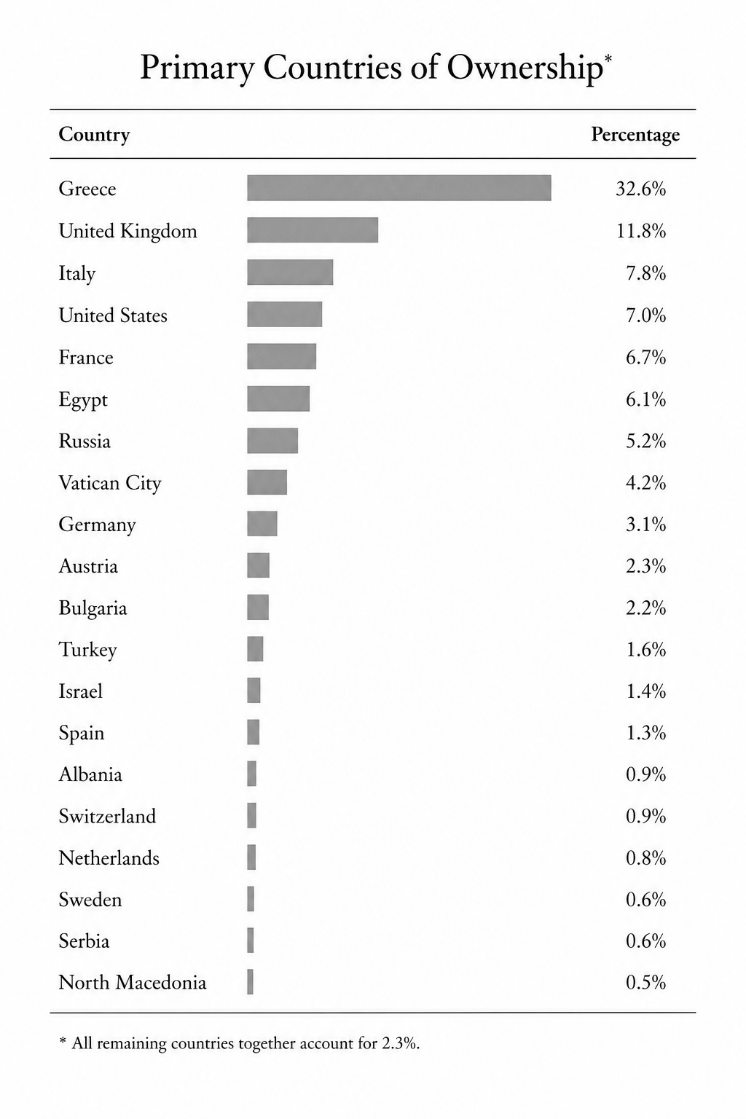
Countries of Ownership for NT MSS and Artifacts
Instead, it is best to assess the matter by focusing on the most significant manuscripts used by scholars.
Old Testament Manuscripts
The Dead Sea Scrolls (DSS) are the oldest existing collection of Old Testament manuscripts. Primarily gathered between 1946 and 1956, these were housed in what was then called the Palestine Archaeological Museum in Jerusalem. After the six-day war in 1967, Israel gained control of the museum and consequently the DSS. Almost all of these scrolls now exist in the Shrine of the Book in the Israel Museum in Jerusalem. While the Israel Antiquities Authority (IAA) is now in control of the DSS, because of the timing of the discovery and the nature of their acquisition, Jordan and the Palestinian Authority dispute this claim.2
The two primary manuscript codices of the Old Testament are the Aleppo Codex and the Leningrad Codex. The former is owned by the State of Israel and kept in the Israel Museum along with the DSS. The latter is owned by Russia and housed in the National Library of Russia in Saint Petersburg.
Many other Hebrew manuscripts exist in public collections in London, Oxford, and elsewhere. Private collections also exist, one of the largest being the Museum Collection in Washington, D.C., which is owned by Hobby Lobby.
New Testament Manuscripts
The Papyri of the New Testament are owned by various public and private institutions. The more notable ones include the John Rylands University Library in Manchester, the Chester Beatty Library in Dublin, and the Bodmer Library in Cologny, Switzerland.
The two primary codices are Codex Sinaiticus and Codex Vaticanus. The former is owned by the British Library in London. The latter is owned by the Vatican and housed in the Vatican Library.
Manuscript Digitizations
A number of technologies developed between the era of hand-written manuscripts and digital photography, not limited to the printing press and film photography. Regardless, artifacts from earlier eras of copying are relatively unimportant for our purposes. The wealth of manuscripts and their subsequent preservation is so great that artifacts from these intermediary methods—printed books, film reproductions, etc.—are not worth our consideration here. Rather, we may skip ahead to the state-of-the-art reproductions captured through digital photography.
So who owns the digitizations of the manuscripts of Scripture?
Hebrew Old Testament Digitizations
When the DSS were acquired by the Israel Antiquities Authority (IAA), they maintained a policy of keeping the scrolls unreleased until research could be completed on them, including the construction of whole texts from fragments. However, this research dragged on for years, until by the 90s, less than 50% of the scrolls had been published. The remaining scrolls had been photographed and kept for safekeeping in various places, including the Huntington Library in California. Herschel Shanks—the founder of a Biblical Archaeology magazine—had access and released the facsimiles. Though he was successfully sued for this, it put a dent in the monopoly on access.3
In more recent years, the DSS have become more accessible through partnerships between controlling authorities and Google. Along with the IAA, Google developed the Leon Levy Dead Sea Scrolls Digital Library.4 This digital archive contains a standard copyright statement:
All rights reserved. This material may not be reproduced, displayed, modified or distributed in any form, with the exception of single copies for private use, without the express prior written permission of the Israel Antiquities Authority, and in compliance with the stipulated terms of use. For information on licensing content from this site, please contact us.5
A complementary set of DSS digitizations were published by Google and the Israel Museum in the Dead Sea Scrolls Digital Project,6 which contains a number of significant manuscripts like The Great Isaiah Scroll. The copyright page includes this straightforward prohibition on use:
Copyright in the digital images of the manuscripts, created by the Israel Museum and displayed on this site, is held by the Israel Museum. Reproducing these digital images in any manner other than for research or private study requires prior permission or licensing.7
Additionally, the website contains some comment interactions from the museum reasserting these restrictions:8
Elijah:
In a presentation I am making soon, I want to comment on the potential that Isaiah 52:7 may be the beginning of a section that continues through the end of Isaiah 53. May I take a small screenshot of this section to share in a PowerPoint to show the paragraph break at 52:7 as well as the mark in the margin? The screenshot would not be distributed beyond the presentation. If you can’t grant permission for this, I understand, but I thought I’d at least ask!
Israel Museum (moderator):
I’m sorry, but I can’t authorize any copying of the contents of the site.
David Lawrence:
Where are the other scrolls? Why can I not download the images? Seventy years have passed since their discovery; surely you have had enough time...
Israel Museum (moderator):
Other scrolls can be accessed at the Israel Antiquities Authority. The site content is copyrighted and not available for download.
Angel Grabovieski:
Is it possible to get the text of the Great Isaiah Scroll in text format?
Israel Museum (moderator):
Sorry, but not from this site. Copyright restrictions.
Both of these sites use viewing widgets that make the images difficult to download, although screenshotting cannot be prevented and a clever web user could figure out how to fetch the assets and stitch the images together.
Masoretic manuscripts remain a bit more accessible, although photographers and museums likewise assert copyright on their digitizations. For example, the color scans of the Leningrad Codex appear with “© Bruce E. Zuckerman” on every page.9 The Ben Zvi Institute in Jerusalem claims copyright on the best digitizations of the Aleppo Codex, photographed by Ardon Bar Harma in 2002.10 The Bodleian library has a number of Hebrew manuscripts they have made available online, asserting a Creative Commons Attribution-NonCommercial license on each.11 The British Library also has a large collection of digitized MANUSCRIPTS under the same terms,12 although the original page that collated these is no longer available.13 The Cambridge University Library (CUL) has collections that include notable OT MANUSCRIPTS.14 Unlike other sites, the CUL’s viewer widget offers a downloading feature, but still warns that the library owns the copyright and republication requires express permission.15
Some of these manuscripts and others are available through the National Library of Israel’s Ktiv project. Each collection has its own terms of use, but prohibition of any copying without permission is typical.16
Greek New Testament Digitizations
The Codex Sinaiticus Project has digitized Codex Sinaiticus (א). According to the website:
This electronic version of Codex Sinaiticus is provided only for non-commercial personal and educational use, by the British Library, Leipzig University Library, St Catherine’s Monastery at Sinai and the National Library of Russia.17
It goes on to clarify, distinguishing between the physical asset and electronic copy:
The original item itself is in the public domain in most jurisdictions and therefore not protected by copyright under applicable laws. However rights in the electronic copy and certain associated metadata are owned by the holding institutions. If you wish to make use of this electronic copy or its metadata other than for non-commercial personal or educational use, you must first obtain the written permission of the relevant institution.18
The Vatican Library (Biblioteca Apostolica Vaticana) publishes images of Codex Vaticanus (B).19 These are all displayed with an imposing “ALL RIGHTS RESERVED” watermark, and the metadata contains the following notice: “Free use of this image is only for personal use or study purposes. Rights must be requested for any use in printed or online publications.”
The Center for the Study of New Testament Manuscripts (CSNTM) run by Daniel B. Wallace has the largest collection of NT MS digitizations, many of their own production, some being sourced from other collections.20 CSNTM requires explicit permission be granted for any and all use of material found on the site. Interestingly, their published terms of use include not only assertion of copyright, but also a justification for this assertion and threat of litigation for those who would fail to comply.
Current U.S. copyright law protects any and all works produced by any individual or institution at the moment of production, whether published or unpublished. Therefore, all material produced by CSNTM (defined as including all original works of creative, expressive and/or intellectual works without limitation to texts, pictures, graphics, movies, audiovisual pieces, sound recordings, photographs, images, website content, et al) is under copyright protection.
…
CSNTM may bring legal action against such offenses. These proceedings would seek, but are not limited to, injunctions to stop the usage of CSNTM copyrighted material and, if necessary, monetary damages (including court costs) from the offender.21
The Cambridge University Library has a number of NT MANUSCRIPTS available as CC BY-NC,22 and the British Library has some labeled as being in the public domain or being in the public domain outside of the UK.23
Critical Texts
Manuscripts are collated and then rescinded into critical texts. Variations between different manuscripts—spellings, word order, omissions, inclusions—are all weighed to make a judgment on the likely shape of the original text. These are often published alongside a critical apparatus, records of textual variants, often presented as footnotes to the critical text.
While similar to critical texts, diplomatic editions of Scripture do not seek to reconstruct the original texts, but uncritically reproduce a single manuscript. These are often published alongside a critical apparatus.
Hebrew OT Diplomatic and Critical Texts
The German Bible Society publishes the Biblia Hebraica Stuttgartensia (BHS), which is a scholarly edition of the Leningrad Codex containing a critical apparatus.24 The Biblia Hebraica Quinta (BHQ), still incomplete, is the fifth edition in this series, drawing from a wider range of sources.25 The former is accessible online while the latter is not. In either case, the German Bible Society (Deutsche Bibelgesellschaft, Stuttgart) claims copyright.
The Open Scriptures Hebrew Bible (OSHB, sometimes OHB) is a text based on the Westminster Leningrad Codex.26 The text itself is public domain, although the lemma and morphology data are available under a Creative Commons Attribution license (CC BY). Similarly, the Open Hebrew Bible is released under the Creative Commons Attribution-NonCommercial license (CC BY-NC).27
On the other hand, the Hebrew University Bible Project (HUBP) is designed to reproduce the Aleppo Codex along with a critical apparatus.28 This work is incomplete, but what exists is copyrighted by HUBP.29
The Hebrew Bible: A Critical Edition (HBCE)—formerly known as the Oxford Hebrew Bible (OHB)—is another incomplete critical text that attempts to restore the original text.30 Copyright is held by SBL press.31
Greek New Testament Critical Texts
Among those critical editions that employ an eclectic methodology, the Nestle-Aland (NA) and United Bible Societies (UBS) editions of the New Testament are identical in text, while the former contains a more extensive critical apparatus. This text is available online, but the German Bible Society (Deutsche Bibelgesellschaft, Stuttgart) holds the copyright. Similarly, the Tyndale House Greek New Testament32 may be accessed online, but Tyndale House holds the copyright.33 The Society of Biblical Literature’s Greek New Testament (SBLGNT) is available under the Creative Commons Attribution license (CC BY).34
Older eclectic critical editions are available in the public domain by virtue of their age. These include the Nestle 1904 edition35 as well as the 1881 Westcott-Hort (WH) text.36
Even older textual traditions likewise exist in the public domain by virtue of age. These include the 1550 Stephanus Textus Receptus (TR),37 Scrivener’s TR,38 and Tischendorf’s Greek New Testament.39
Maurice A. Robinson and William G. Pierpont published a Majority Text version of the New Testament first in 1979. While a copyright notice is presented at the opening of the book, the custom dedication releases it into the public domain.40
Using all of the above with a base of the Nestle 1904, the Berean Standard Bible has published an interlinear Bible,41 dedicated to the public domain.42
The Questionable Legitimacy of Copyright Claims on Digitizations and Critical Texts
Despite all these claims to copyright, there is a significant reason to doubt them all: Most jurisdictions reject sweat of the brow doctrine. “Sweat of the brow”—named after the idiom of Genesis 3:19—is a copyright doctrine that regards labor as sufficient grounds for copyright.43 For example, is a listing of facts, like a telephone book, subject to copyright? In a sweat of the brow jurisdiction, the answer would be “yes,” in a non-sweat of the brow jurisdiction, the answer would be “no”. In fact, the court case that most clearly established the US rejection of this doctrine centered around this very issue: Feist Publications v. Rural Telephone Service.44 It doesn’t matter how much labor someone puts into a work, for copyright to be applicable, it must be an original work, having “at least a modicum of creativity.” The purpose of copyright in its legal definitions is, after all, to promote creativity, not to reward labor.
The United Kingdom has likewise abandoned using skill and labor as criteria for determining copyright infringement.45 Much of this had to do with their membership in the EU. For example, the EU has a Directive on Copyright in the Digital Single Market that states that reproductions of works of visual art that are in the public domain cannot be subject to copyright or related rights. This rejection of sweat of the brow doctrine has been upheld in a post-Brexit UK with THJ v. Sheridan.
Israel likewise has no sweat of the brow doctrine, but the bar for originality is minimal. In Qimron v. Shanks the Israeli Supreme Court upheld copyright on a reconstructed Dead Sea Scrolls text.46 Operating in the US, Hershel Shanks released a reconstructed text and was successfully sued by the Israeli researcher who had assembled it. While the court decided to apply Israeli legal standards in determining originality, perhaps in a different instance of international copying, US law could be applied.
Manuscript Digitization Copyrights
What does this mean for manuscript digitization? In any of the major jurisdictions of concern—the US, the UK, the EU, and Israel—these simply aren’t subject to copyright. In the US, this has been demonstrated most directly with Bridgeman Art Library Ltd. v. Corel Corp (1999) where color transparencies of public domain paintings were concluded to be ineligible for copyright protection under either US or UK law. Such claims to copyright are simply claims. For these institutions, there is little to no downside with making these claims, and the upside is substantial. One legal reviewer frames the motive this way: “asserting copyright ownership will allow museums greater control of their collections and create lucrative revenue streams.”47
Of course, there may be other strategic motivations as well. In 2014, the present author had an opportunity to attend a Daniel B. Wallace presentation on the text of the New Testament and I asked about this afterward. The conversation went something like this:
CO: Why do you assert copyright on the digitizations produced by CSNTM?
DW: The manuscripts themselves may not be under copyright, but the photographs are.
CO: There is court precedent indicating those claims aren’t legitimate.
DW: Well, we can’t release them under different terms because we have contracts in place with these institutions and need to uphold them to continue working with them.
CO: <hands card> Please contact me if you’d like help with releasing these more freely. I’d love to see the Word of God in the hands of the people of God.
Critical Text Copyrights
What does this mean for critical texts and diplomatic editions? If a work purports to restore some original, what grounds is there for a claim to copyright? Critical texts ought not be artistic works of creativity, but exercises in scientific rigor. For example, the Robinson/Pierpont Majority Text is not much more than an exercise in variant counting, albeit an intensive one. On one hand, their public domain dedication is most laudable; on the other hand, their assertion of copyright to make such a dedication is most laughable.
More eclectic approaches to textual criticism might have more grounds by which to argue originality, “a modicum of creativity.” Perhaps one might say the editorial choices involved are artistic in nature or that the use of medieval characters and punctuations make them necessarily derivative. However, the degree to which one concedes true derivation is the degree to which they concede failure in the task of scientifically restoring the original text.
In fact, if one has done the task of textual criticism perfectly, he would arrive at the original work, a public domain text. At this point, the ground for originality is error. Maybe one would be so bold as to argue this without irony, but would such a claim even be legitimate? The notion of creativity relies on some notion of intent; would these be intentional errors? If so, how could the recipient of the work be aware of this? Of course, we are offering more questions than answers, but the absurdity of the situation should be evident.
While the originality of such works has been upheld in Israel, at least one case in France has concluded that editing a critical edition does not generate a copyrightable work. In the US and UK, there should be even less ground for such an assertion.
A Biblical View
Having surveyed the ownership of manuscripts and critical texts, we ought to step back and ask who should own the manuscripts and critical texts.
Physical Ownership of Manuscripts
Biblically, there can be no objection to various MANUSCRIPTS being owned by various individuals and organizations. The legitimacy of property was established with the command to take dominion and reinforced with the ninth commandment. While the original autographs may be labeled as a gift of God made directly to the church that cannot be owned, physical copies cannot be labeled similarly.
However, the ownership of antiquities is frequently complicated by patrimony laws. For example, in “United States of America vs. Approximately Four Hundred Fifty (450) Ancient Cuneiform Tablets; and Approximately Three Thousand (3,000) Ancient Clay Bullae”, Hobby Lobby was forced to forfeit a number of artifacts and MS fragments to Egypt and Iraq because of a lack of provenance.48 In other words, the law in many jurisdictions permits the state to claim ownership over antiquities independent of any real possession. While this may match modern sensibilities on preserving heritage, it is difficult to establish any justification for this from the Scriptural notion of property.
Ownership of Manuscript Digitizations
Given that the Bible does not treat ideas as property, and that copyright is relatively novel, being an 18th-century invention, there are reasons to reject the legitimacy of copyright altogether.49 However, because the laws of relevant nations almost—if not completely—universally regard mechanical reproductions of public domain works as being in the public domain, we may concede this point for the sake of discussion.
However, even apart from actual copyright, the claims to copyright impose a serious chilling factor on profitable uses of MS digitizations. At a minimum, it prevents archivists from republishing these digitizations for the public. Anyone who spends some time exploring the available data will frequently run into outdated information and HTTP 404 errors. One website that displays early papyri, earlybible.com, lacks 𝔓66 because the purveyor was repeatedly threatened with legal action.
One substantial barrier to progress in this area is that there is rarely any penalty for falsely asserting copyright on that which cannot be copyrighted. The law of Moses contained the following protection for innocent parties:
If a false witness testifies against someone, accusing him of a crime, both parties to the dispute must stand in the presence of the LORD, before the priests and judges who are in office at that time. The judges shall investigate thoroughly, and if the witness is proven to be a liar who has falsely accused his brother, you must do to him as he intended to do to his brother. So you must purge the evil from among you. Then the rest of the people will hear and be afraid, and they will never again do anything so evil among you. You must show no pity: life for life, eye for eye, tooth for tooth, hand for hand, and foot for foot. (Deuteronomy 19:16-21)
Because false accusation attempts to commit real property harm toward neighbor, it would be just to have a similar provision in our own law. Museums and other institutions should not be able to claim copyright on public domain images and litigate without penalty.
Critical Texts
If critical texts purport to actually restore the words of the prophets and apostles, then clearly it cannot be subject to human ownership. The Word of God was given as a gift and cannot be owned or sold50 (2 Cor 2:17). Even measures of inaccuracy in the restoration do not change this reality. Even claiming a right to attribution goes beyond what can be biblically granted, as in the case of the SBLGNT.
Likewise, truth itself is not something that can be owned. Even those organizations that make minimal claims on associated metadata to critical texts make too much of a claim. For example, Open Scriptures claims that the lemma and morphology data they publish alongside the OSHB is licensed under CC BY, but these are merely factual assessments of syntax and grammar, not creative works.
Conclusion
The manuscripts and critical texts of Scripture constitute a complex landscape of ownership. While it is appropriate to treat physical manuscripts as property, Scripture itself should not be subject to ownership. The Word of God should not—and cannot—be bound (2 Tim 2:9).
The Rise of the Bible Societies and the First Copyrighted Bible in America
―❖―
The rise of the modern Bible-society movement begins with the story of a “sweet Welsh maiden” who keenly desired a Bible of her own. The earliest account reads as follows:
[T]here was a young girl of some fourteen or fifteen years of age, called Mary Jones, of Cwrt Aberganolwyn: she very soon learned to read, and it appears that her heart was opened by the same divine grace that opened the heart of Lydia to receive the Word of Eternal Life. But she had no Bible herself. There was a copy in the house of a relative two miles off, and there she used to go very often, in order to slake her thirst for the Water of Life. Presently she began to yearn for a copy of her own, and inquired would it not be possible for her to get a Bible somewhere. She had collected a little money to buy one, but knew not where to turn her face for a copy. Somebody told her that the likeliest place for her to find a Bible would be at Mr Charles’s, at Bala, and that it was possible that he could get her one. The little maiden determined that she would not sleep before she reached Bala and ascertained if she could get a Bible there. She had a long distance to go, something like twenty-eight miles, but she walked it cheerily, her young heart sustained by the hope of finding at the end of her journey the long-yearned-for treasure.
When she reached Bala, she inquired for the house of Mr Charles. When she found it, she was told that Mr Charles had gone to rest, for it was his custom to retire early, and to rise about five o’clock in the morning to prosecute his multifarious and most important labours. She was taken, after she had told her errand, to the house of a worthy man there, David Edward, an elder with the Calvinistic Methodists.... Between five and six the next morning, David Edward and the little girl were in the street, and on their way to Mr Charles’s. Yes, as usual, the light was in the window of his study; the indefatigable man was already hard at work in the service of his blessed Master. They knocked, and were received in. David Edward introduced the little girl, and her story was told. “Really,” said Mr Charles, “I am very sorry that she should have come from such a distance, but I fear indeed that I cannot spare her a copy, Bibles are so very scarce.” This was too much for the poor girl: she wept as if she would break her heart. And that again was too much for Mr Charles: he said that she should have a Bible. He reached her a copy, she paid him the money, and there the three stood, their hearts too full for utterance, and their tears streaming from their eyes: the girl now weeping sweet tears of unutterable joy; Mr Charles shedding tears of mingled sorrow for his country’s famine for the Word of God, and of holy sympathy with that young disciple who so rejoiced in the possession of the great treasure; while good David Edward was overpowered with the scene before him, and he also wept like a child. What a subject for a grand painting, that scene in Mr Charles’s study by candle-light at six o’clock in the morning! When Mr Charles was able to speak, he said, “Well, David Edward, is not this very sad, that there should be such a scarcity of Bibles in the country, and that this poor girl should thus have walked some twenty-eight or thirty miles in order to try to get a copy? If something can be done to alter this state of things, I will not rest till it is accomplished.” 1
Why were bibles so scarce at the time? Thomas Charles had been struggling to obtain enough Welsh Bibles since the 1780s, while his circulating schools and the evangelical revivals were creating an ever-growing population eager to read the Scriptures for themselves. The principal charitable source of Welsh Bibles was the Society for Promoting Christian Knowledge (SPCK), but by the end of the 1780s its stock had been nearly exhausted. After years of inadequate supply, the SPCK finally commissioned a new edition at Oxford in 1799: 10,000 Welsh bibles, of which Charles obtained only about 700. Mary’s own Bible came from this edition. Yet even this substantial printing proved woefully insufficient for the pent-up demand. Thus, when Mary arrived at Bala in 1800, Charles’s scarcity was quite literal: thousands of newly literate Welsh men and women wanted copies of the Scripture, while the existing machinery for printing and distributing them could not keep pace.2
In December 1802, Charles laid the desperate need for Welsh Bibles before a committee of the Religious Tract Society. According to the traditional account, Joseph Hughes responded: “Surely a society might be formed for the purpose; and if for Wales, why not for the Kingdom; why not for the whole world?” 3 This was the start of the British and Foreign Bible Society (BFBS), which worked to make bibles available and affordable to many in Great Britain and all around the world.
Behind this immediate shortage lay a larger problem in the British Bible trade. Bible printing was not an open market. The right to print the Authorized Version was governed by the royal printing prerogative, commonly attacked in the nineteenth century as the “Bible monopoly,” which was established in the 1500s under the Tudor monarchy.4 By the period in question, the Authorized Version could lawfully be printed in England only by the King’s Printer and the privileged university presses of Oxford and Cambridge. And as with all monopolies, it inevitably drove prices higher. People like John Campbell decried this monopoly as a “gigantic leech,” a “literary leviathan,” and an “abomination.”5
In 1804, Thomas Charles, William Wilberforce, and others helped found the British and Foreign Bible Society. Its stated object was “to encourage a wider circulation of the Holy Scriptures,” distributing them “without Note or Comment.”6 In other words, get God’s Word into people’s hands, plain and pure, with no doctrinal footnotes, and make it available to the rich and poor alike.
In the 1816 book by John Owen The History and Origin and First Ten Years of the British and Foreign Bible Society we read one of their founding purpose statements:
The reasons which call for such an Institution chiefly refer to the prevalence of ignorance, superstition, and idolatry over so large a portion of the world; the limited nature of the respectable Societies now in existence, and their acknowledged insufficiency to supply the demand for Bibles in the United Kingdom and Foreign Countries; and the recent attempts which have been made on the part of infidelity to discredit the evidence, vilify the character, and destroy the influence of Christianity.
The exclusive object of this Society is to diffuse the knowledge of the Holy Scriptures, by circulating them in the different languages spoken throughout Great Britain and Ireland; and also, according to the extent of its funds, by promoting the printing of them in foreign languages, and the distribution of them in foreign countries. …
In the execution of the plan, it is proposed to embrace the common support of Christians at large; and to invite the concurrence of persons of every description, who profess to regard the Scriptures as the proper Standard of Faith.7
From this statement, can we conclude that they were establishing a ministry? I have argued elsewhere that a biblical definition of Christian ministry is Spirit-empowered service specifically and directly for the edification of the Body of Christ.8 They say that their exclusive object is to “diffuse the knowledge of the Holy Scriptures.” Is that specifically and directly for the edification of the Body of Christ? Yes. Is it Spirit-empowered service? This is where it may be a gray area. The administration of distributing bibles does not necessarily require Spirit-empowerment. Would it be valid to err on the side of calling it biblical ministry under certain conditions? I think so. But the Society did some things to ensure that the Spirit was left out as much as possible. In essence, they intentionally undermined any spiritual aspect that might accompany their mission.
However, the founders of the Bible Society sometimes alluded to the idea of offering the water of life “without money and without price,” in the words of Isaiah 55:1. And they often spoke of what they were doing in biblical language as though it were a spiritual mission from heaven. Nevertheless, they did not want to be seen as a mission or ministry, but rather as a commercial enterprise with good intentions: to make bibles cheaper. So, from the beginning, their motivation and philosophy were full of apparent contradictions. In her book Cheap Bibles, Leslie Howsam writes,
The ‘fundamental principle’ of distribution without note or comment was based upon the premise that the BFBS was not a religious society. As one person said, ‘It is a society for furnishing the means of religion, but not a religious society.’ This was a crucial distinction. Denominational differences made it impossible for Dissenters and Anglicans to combine together in their religious characters to distribute the scriptures. The publication of notes and comments would have raised disagreements over interpretation. So the members met as lay persons, agreeing to disagree about doctrine. It was a distinction between content and process: the scriptures themselves were religious, of course, but the process of distribution had to be a commercial one, stripped of all religious trappings, if squabbles over doctrine were to be avoided…. The tension between spiritual ends and commercial means, embedded in the constitution because of contemporary political realities, was to shape the policies of the Bible Society throughout the nineteenth century.9
From the beginning the BFBS was not interested in giving away bibles. Their goal was only to subsidize the price of bibles through a subscription system, much like modern services such as Patreon today. Someone would sign up to regularly support them, and depending on how much they gave, they would receive different “perks.” Some of those came in the form of discounts. Megadonors were granted the privilege to vote on the board’s decisions. In 1821, Dudley published a 600-page book detailing the system of the Bible Society, explaining how and why things worked. In it he gives the reason the Society’s policy rejected the idea of simply giving bibles instead of subsidizing their cost:
In every instance gratuitous distribution should, as much as possible, be avoided; and the people be induced to purchase the Scriptures, which are generally valued and read in direct proportion to the expense or trouble which they have cost in obtaining them.10
In other words, people only value what they pay for. In fact, this is the earliest expression of this mentality by a Christian that I have yet to come across. This way of thinking was already widespread in early nineteenth-century England.
What is conspicuously absent in the documentation of the Society is thorough scriptural support for their decisions, namely the decision to charge for bibles instead of giving them away. And interestingly, when an appeal is made to the idea of partiality or favoritism found in James 2, it is applied as giving the poor equal opportunity to donate along with the rich. In other words, they had very cheap subscription tiers that even the poor could afford, so they believed they were doing well in terms of not showing partiality. Also, the verse “It is more blessed to give than to receive” (Acts 20:35) is used to exhort people to give money to the Society, rather than to exhort the Society to give away bibles. Finally, Matthew 10:8 is mentioned (“freely you have received, freely give”), but their interpretation at the time seemed to be restricted to the idea of diminishing obstacles, not fully removing them. They also interpreted the command to freely give as an exhortation to others to give money liberally to the Society itself. So, it appears that they believed they were obedient to this command because they were making bibles much cheaper, that is, removing the obstacle of high cost, although removing the obstacle of cost altogether was out of the question. “Freely” was understood in terms of wider access and liberality/generosity of spirit, not necessarily free of price.
Completely eliminating the cost barrier between people and the Word was dismissed because of a folk-psychological belief not found anywhere in the Bible: the idea that people don’t value what they don’t pay for. This is, at best, a shallow generalization from certain consumer contexts, and at worst, a dangerous distortion when applied to matters of faith. Value cannot be reduced to price, empirical evidence undermines the universality of the claim, and the example of Jesus giving his life to offer salvation freely shows the folly of this misconception that has infected the Church. To predicate appreciation of Scripture on financial expenditure is to misunderstand the nature of value itself. Even worse, it stands as an insult to the Author.
This lack of diligent seeking of scriptural principles by which to operate is unsurprising, considering the ecumenical nature of the Society. They were so set on being non-sectarian that preaching, sharing the gospel, or praying when representing the Bible Society were strongly discouraged. They also suffered some controversies. The first and most severe was a debate in the 1820s over whether British funds should be used to print bibles containing the Apocrypha for continental Europe, leading to a rift that saw most Scottish branches split from the parent organization.11 From this affair discontent began to build. Tensions culminated in May 1831, when a second major dispute erupted over the society’s non-denominational rules, which allowed non-Trinitarians, specifically Unitarians, to hold leadership offices and voting membership. When the BFBS voted overwhelmingly against adopting a Trinitarian test or opening meetings with formal prayer, conservatives broke away. In December 1831, over two thousand supporters gathered at Exeter Hall in London to establish the Trinitarian Bible Society.12
Even so, in spite of this strict adherence to an almost secular approach in practice, people still wrote about the Society in this kind of language:
This Institution is one of the noblest monuments of Christian zeal that the world has ever beheld. It is the cause of God and of man; it is the cause of truth and of mercy; it is the cause of the everlasting Gospel. Can you hesitate to promote it? Can you remain indifferent, while thousands are perishing for lack of knowledge, and while the means of salvation are within your power to impart? ‘Freely ye have received, freely give:’ if you acknowledge for yourselves the blessed influence of divine revelation, invite others to partake of it. The light of heaven is streaming, in all its effulgence, above and around you: O, let not the beams be intercepted! Open for it a free passage into the dwellings of the poor! Be the means of conducting it into the darkest recesses of human ignorance and error! It will enter them with healing on its wings; and the wilderness shall be glad, and the desert shall rejoice and blossom as the rose.13
Now, there was a second reason for the policy of not giving away bibles. Howsam writes that the leaders of the Society
were no doubt influenced by contemporary concerns about the degenerating effects of charity upon the poor. To charge a small price for a cheap Bible, even to the poorest customer, would avert the danger that philanthropy might cause moral decay. It seems unlikely that working-class subscribers understood or cared about the subtle distinctions between the portion of the book they received that was paid for by voluntary donations and the part that they paid for out of their own pockets. But they almost always had to pay something. In Dudley’s opinion, which was shared by the Committee, ‘a gratuitous distribution could not satisfy the minds of those who wished to counteract the degrading influence of Pauperisim, to check the progress of Infidelity, and to extend the empire of Religion and Morality.’
The Committee could not forbid its subscribers or Auxiliary leaders to make free gifts of Bibles, but such gifts were hedged around with warnings.14
Let us examine more closely the Society’s concern that the free distribution of bibles might foster “pauperism” and “infidelity” and contribute to what it perceived as the broader moral degradation of the poor. There was a widely shared conviction among elites, officials, and many Christians of the time that free, unconditioned giving corrupted the poor by taking away the driving force of necessity. It would erode work-habits and foster dependence. The term “pauperism” meant more than just poverty. It carried a bundle of moral, economic, and political connotations that are easy to miss if we read it through modern eyes.
First, “pauperism” connoted a condition of legal dependence, living off state charity rather than one’s own labor. Second, it was associated with idleness, vice, drunkenness, and sexual immorality. To be “pauperized” was to have one’s moral fiber corroded. Third, many feared the creation of a permanent dependent underclass, resentful of the wealthy. This “pauper class” was imagined as volatile, a seedbed for crime, disorder, and even political radicalism. Fourth, Christians feared that pauperism eroded humility and gratitude to God, replacing it with a spirit of entitlement and discontent. Politicians were afraid of pauperism breeding radicalism and infidelity: the dependent poor might be more open to revolutionary ideas, blaming their condition on social injustice. Fifth, it was a fiscal drain on the wealthier classes who funded relief through higher taxes levied on each parish. Landowners grumbled that they were being taxed to support idleness. Around £8 million per year was being spent on poor relief in England back then, which would be about $1 billion in today’s money.
So, by making even the poor pay something for bibles, the Society reassured the higher classes that their project would not foster more pauperism and create another tax-like burden on the wealthy. If you are trying to court the donations of the rich for your society, the tendency is to tailor your methods to their liking; and in that era, many of the rich would not have been happy to see you giving away bibles completely free of cost.
Dudley shares an anecdote of the sort of ideal they may have had in mind: the desire for a Bible being the motivation for poor people to industriously find creative ways to earn money. He tells the story of Mary Smith, a little girl of ten years of age:
This interesting child had been long very anxious for a Bible; but her parents, who are honest but extremely poor cottagers, were unable to afford the money. Mary often brought the Collector sixpence at a time, and once brought a shilling. On being asked how she had obtained so much, it appeared that she rose every morning by five o’clock, in order to collect violets and other early spring flowers, which she made up in bunches and sold in the market. This was her own spontaneous act, suggested by her earnest desire to obtain a Bible, which will be doubly valuable as the reward of her early industry.15
To clarify, the meaning of the word “infidelity” (in the quote above about what the Society feared as a consequence of giving free of cost) had to do with religion and politics. It was the fear of the spread of unbelief, deism, and radical politics among the poor. They believed that if they just gave bibles away for nothing, the poor might take the Bible lightly, ignore it, or fall prey to “infidel” ideas.
And there was also a third reason the Society avoided giving bibles as gifts. Howsam writes that it was “the possibility that generosity might be exploited by the unscrupulous. There was a constant risk that poor people might pawn their Bibles.”16 It is here that we begin to see a common thread: letting fear (not faith) drive practice.
Nevertheless, God has used this initiative tremendously. Hundreds of millions of people have gotten access to Scripture through the Society’s efforts all around the world. Even during the World Wars they were untiring in their devotion to getting bibles into the hands of soldiers and prisoners in hard-to-reach, risky places. In WWI alone they distributed more than nine million copies of Scripture, in over 80 languages. And they have been instrumental in translating the Bible into many languages.
The Rise of the American Bible Society
In America, Bible societies began to spring up in the early 1800s. The hope of building a Protestant republic by flooding the nation with Scripture drove many of these societies. In his book The Bible Cause, John Fea describes their way of thinking:
If everyone had access to a Bible, “prejudice” and “narrowness of education” would be overwhelmed by a patriotic and unified spirit of self-sacrifice. The word of God was the only way for the nation to heal itself of the wounds it had suffered from decades of self-interested factionalism.17
Other leaders in the movement believed that they were ushering in a new era of moral improvement for the world, and that the mass distribution of Scripture would usher in the Second Coming. It’s also important to understand that the emergence of these societies went hand-in-hand with the Second Great Awakening. And their work often served as a catalyst for local revivals.18
In contrast to the BFBS, early American Bible societies sought to give bibles away for free. In those first decades, charity was their identity. In the words of one historian,
Their goal was not profit, and their strategy not market-driven. They imagined their work to be in the market but not of it, for they believed that ultimately their business was not books at all; it was benevolence.19
The Americans were more likely to see themselves first and foremost as ministries. The foundational writings are full of the language of freely giving, using Isaiah 55 as a guiding principle: “without money and without price.” While the BFBS stressed payment and moral discipline, the American Bible societies stressed charity and grace.
By 1816, over 130 local Bible societies had formed in the U.S. These local societies, often organized by churches in various cities and states, shared the conviction that no one should be denied a Bible because of cost. They described their goal as distributing the Bible “among persons who are unable or not disposed to purchase it.”20 For those who could afford to pay even a little, the societies would offer bibles at a very low price: sometimes just the cost of printing, sometimes even less, subsidized by donations.
To coordinate this growing movement, leaders felt a need for a national organization. In May 1816, delegates from 28 of these local societies met in New York City and founded the American Bible Society (ABS), which “would become one of the largest and most influential Christian organizations in American history.”21 From the start, the American Bible Society echoed the ecumenical principle of the British society: to distribute Scripture “without note or comment.”
As a brief aside, the following example illustrates their strict adherence to their non-denominational policy. In 1835, the British Baptist Mission in Calcutta, India, appealed to the ABS for help in funding a translation of the New Testament into Bengali. The ABS refused to fund the project because the translators of the Bengali Bible translated baptizo (the Greek word for “baptism”) in a way that communicated the Baptist practice of immersion, as opposed to sprinkling. They reminded the British Baptist Mission that they were not interested in promoting “local feelings, party prejudices” and “sectarian jealousies.”22 And throughout much of its history, the ABS measured success not in terms of conversions or changed lives, but in terms of the number of bibles distributed around the world each year.
In the early 1800s, printing was undergoing a revolution. Traditional printing with movable type was labor-intensive and expensive. But a new method called stereotype printing emerged, and the Bible societies eagerly embraced it. This new technology involved creating a permanent metal plate for each page of a book. Using a mold, printers would cast a whole page of type in one piece of metal. This plate could then be used to print thousands of copies without needing to reset any type. The upfront cost of making the plates was high, but once you had them, each additional copy was cheap and easy to print. It also ensured consistency and fewer typos across all copies.
The American Bible Society and its auxiliaries became pioneers in this technology, and invested heavily in printing infrastructure. By the 1820s, they were producing bibles on a scale previously unimaginable. And because of the efficiencies of stereotyping, the cost per Bible decreased over time. But this required a large amount of capital upfront to fund. Their sense of urgency and ambition drove them to make a fateful decision: get more money to print more bibles by becoming a commercial enterprise. In other words, more money, more ministry. So, money had to be obtained—whether that be through sales or donations. And like the BFBS, this decision was not made based on scriptural principle but rather expedience, pragmatism, and economic logic. The leadership of the ABS wrote, “The Managers deem it expedient to renew their recommendation to the Auxiliaries to sell the Scriptures at cost or at reduced prices, in preference to distributing them gratuitously.”23
The societies developed a form of differential pricing. There were premium editions for the trade, cost-covering prices for general buyers, subsidized rates for auxiliaries, and free copies for the indigent.24 By the end of the 1820s, the ABS had become one of the largest publishing houses in the country, nearly holding a monopoly over the production of inexpensive bibles in the U.S.25 They, along with the American Tract Society and the American Sunday School Union had become national publishing corporations, indistinguishable in business methods from secular enterprises.26
Critics began to accuse them of hypocrisy. One insider wrote An Exposé of the Rise and Proceedings of the American Bible Society, arguing that selling Scripture “mocked the claim of publishers to furnish Scripture ‘without money and without price’”27 (Isa 55:1). He pointed out that the societies had accumulated vast wealth in stereotype plates, real estate, and buildings, enriching themselves while claiming to serve the poor. The author wrote:
The community had zealously assisted their spiritual teachers in the formation of this Society, on the supposition that it would dispense their charities collectively, to those who needed them, to much better advantage than they themselves could do individually. But in this the public were to be deceived. The benefit of the suffering community—suffering for the want of spiritual food, was of very minor consideration when compared with “the best interests of this Society.” Contributions and donations were pouring in from every section of this vast republic, for the purpose of gratuitously furnishing the destitute with that which the benevolent said they most needed, viz. the Bible, when the Managers very gravely passed the following “Resolution,” which they unblushingly promulgated.
“Resolved, That in ordinary cases occurring within the United States, it is inconsistent with the best interests of this Society to distribute the Bible gratuitously, except through the medium of Auxiliary Societies.”28
He then explains: “At a cursory view of this ‘Resolution,’ it may appear to some that this institution still furnishes the Scriptures gratuitously, though it may be through the medium of Auxiliary Societies. But such is not the fact.”29 Furthermore, he predicted that this new commercial approach would eliminate all competition.
Other critics shared this concern about the impact on commercial publishers. By using charitable donations to subsidize low-cost bibles, the societies were distorting the market and crowding out honest competition. A man named Herman Hooker wrote a booklet titled An Appeal to the Christian Public, on the Evil and Impolicy of the Church Engaging in Merchandise, in which he said, “What business have Christians to give their charity to do that which business enterprise and capital would do, if let alone, quite as well and cheaply?”30
Even within the societies, some leaders came to recognize the problem. They admitted that under the sales model, Scripture flowed primarily to those with money and undermined the charitable nature of their mission. Nord writes, “Ironically, the turn to retail sales, which was designed to produce universal circulation, not profit, had entrapped the societies in market forces they had been founded to resist.”31
A periodical called The Reformer also consistently attacked the ABS. It was run by men who were zealously opposed to both Calvinism and what we would call parachurch organizations today. John Fea writes,
Its readers included…men and women who felt that their liberty was threatened by the attempts of benevolent societies to exert ecclesiastical and cultural power over America through the establishment of a Christian nation…. Its authors challenged the notion that Christianity—particularly Presbyterianism—must become the official religion of the nation. …
The editors of The Reformer argued that the ABS reports on the Bible needs of the United States were heavily exaggerated. Gates [one of the lead editors] questioned ABS assertions that there were “whole neighborhoods in which there was not a single copy of the Bible.” He found this hard to believe, since, as he put it, “almost every storekeeper in the country keeps Bibles to dispose of, and no one that valued the Bible more than all his property would long be without one.” According to Gates, such reports were published to convince unsuspecting Christians to donate more money to the ABS, which, in turn, would empower them further to infiltrate the government and establish a Presbyterian nation.32
Copyright and Proprietary Control
Amid this growing entanglement with market mechanisms, the question of intellectual property arose. Early Bible societies operated in a legal gray zone. The text of the King James Bible, their main version, was not protected by American copyright law, even though it remained under the perpetual copyright of the Crown in the United Kingdom. This empowered any American to print the text of Scripture—a luxury the British did not have. But the publishing of copyright-free bibles would soon go the way of all flesh.
The Revised Version (RV or ERV, 1885) led to the advent of the first copyrighted Bible in the U.S. Published initially by the British, the RV was the first major revision since the 1769 Blayney revision of the 1611 King James. It took a long time to convince the right authorities in England that such a revision was possible and desirable, and that it wouldn’t ruin the revered and loved KJV. Once enough people were persuaded, the Oxford and Cambridge presses funded the revision, spending what would be millions of dollars in today’s money over the course of 12 years to pay the team of scholars who worked on it. Oxford and Cambridge were guaranteed the same monopoly on printing and selling the new version, so it was a small investment in comparison to the profits they would earn when it was released. It was suggested that they invite input from American scholars on their work, and everyone was in agreement that it was a good idea. So, under the direction of Philip Schaff, two American committees were formed in 1871—one for each testament. Members were drawn from multiple denominations and included eminent scholars. The Americans followed the same rules as the English, but their role was advisory. Drafts produced in England were sent to them, they reviewed and annotated them, and their suggestions were considered in subsequent revisions. Although they had no decisive vote, their influence was real, and a record of the preferences the British decided not to follow was eventually published as an appendix in American editions.
Philip Schaff highlighted the cooperative spirit across the Atlantic, noting that the project symbolized unity of faith among English-speaking Protestants. The Americans financed their own work through voluntary donations. A Historical Account of the Work of the American Committee of Revision of the Authorized English Version of the Bible documents the detailed process, including how the project was funded and who the donors were. The British project did not help fund the Americans’ work, and all of the American scholars worked as a labor of love, receiving no salary from the project funds. The voluntary donations that supported the project instead served to cover travel, clerical help, office space, printing, and books. By the end of the 12-year project, the total amount donated was $47,561, and, after expenses, they were left with a balance of a little over $9,000 for further expenses and gift copies for donors. Today, that figure would be around $1,400,000. So their operating costs came out to be about $120,000 per year (in dollar value from the year 2025).
When the New Testament debuted, it was a hit. In May 1881, the Chicago Tribune printed it in its entirety in a single Sunday newspaper, and sold 107,000 copies.33 The Tribune freely used the biblical text from the British publishers, since at the time, no international agreement had been made to enforce copyright laws across national borders.34 Rival papers did likewise. American book publishers also sold bound copies, and over a million copies of the RV sold within months. This frenzy highlighted the possible profits that might be gained by copyrighting the text in America to ensure a monopoly on sales. American publishers were paying attention. The stage was set for a shift in the stance of Bible publishers towards copyright.
Although American churches had enjoyed the British revision, they still wanted their own edition with American-preferred renderings in the body of the text. But there was a gentlemen’s agreement between the British and American committee that the Americans would refrain from publishing such an edition until fourteen years had passed. In the meanwhile, they would need to settle for an appendix in American editions that informed readers as to what those American preferences were. To name a few examples, the American Committee wanted:
“Jehovah” instead of “LORD”
“Holy Spirit” instead of “Holy Ghost”
“demons” instead of “devils”
“covenant” instead of “testament”35
This agreement, however, could not be enforced by law in America. There were publishers who took the notes in the appendix, incorporated those changes into the body of the text before the waiting period had expired, and made some money. And one of the most reputable Christian publishing houses in the nation watched this happen. This was Thomas Nelson & Sons.
Thomas Nelson started his business in Scotland, and by the mid-19th century opened a branch in New York. They specialized in high-quality bibles, prayer-books, and hymnals, especially those coming out of Oxford University Press. In other words, they were the primary distributor of Oxford bibles in America. This made them a natural partner for the American Revision Committee. Nelson had the infrastructure to print premium bibles and an established distribution network among churches and booksellers. And they had already published the British Revised Version in 1885 for the U.S. market.
Thus, having witnessed the commercial success of an official American Revised Version, the unauthorized publication of competing editions despite the wishes of the British and American committees, and the immense wealth Oxford and Cambridge University Presses derived from the Crown’s perpetual Bible monopoly in England, Thomas Nelson appears to have been determined to negotiate the most advantageous arrangement possible for itself. They secured the contract, and the American Standard Version (ASV) was published in 1901. The edition also included a copyright notice. Anticipating that its presence might require explanation, Thomas Nelson justified it with a brief statement, claiming that the copyright existed “to insure purity of text.” Later, it was explained that:
Because of unhappy experience with unauthorized publications in the two decades between 1881 and 1901, which tampered with the text of the English Revised Version in the supposed interest of the American public [by placing the American preferences into the main text rather than in the appendix], the American Standard Version was copyrighted, to protect the text from unauthorized changes.36
It is worth pausing to examine the claim more carefully. The “unhappy experience” that motivated this change was simply the faithful adaptation of the text to the American preferences. This change was “unauthorized,” but it did not introduce errors or heretical readings into the text. So, it can be concluded that the clause “to insure purity of text” in the ASV was disingenuous. There were no reports of someone trying to commandeer the text for malicious purposes, or hostile parties corrupting the text in order to deceive readers, or cult leaders appropriating it for their own heretical ends. Instead, a petty pretense laid the foundation for a new tradition of binding the Word of God with the traditions of men.
A further aspect of the matter deserves attention: because of the nature of printing back then, typos were bound to be introduced by the typesetters of presses that were less careful or meticulous. This is obviously no longer a problem today with the way we can make perfect digital copies of a work. A typo-free Bible is a completely different kind of purity of text than a heresy-free Bible. It may be that there was a concern for minimizing typos, and they believed that such a thing could be accomplished by monopolizing and centralizing the printing permission. But they should have known that ever since the KJV came out, the centralized printing monopoly for that version in Great Britain had been plagued by numerous typos in its editions. An entire book was published about this problem in 1833 by Thomas Curtis, showing that the monopoly on printing the KJV was making the Oxford and Cambridge presses lazy, and they were producing texts of poor quality and accuracy. This is a basic principle proven over and over throughout history: monopoly ultimately leads to lower quality and higher prices for everyone.
But in the end, was purity of text really the reason? No publisher is likely to announce on the title page of a Bible that its copyright exists for the sake of financial gain. Yet whatever rationale is supplied, the practical effect remains clear: copyright granted the publisher a substantial economic advantage.
So how did Thomas Nelson persuade the American Committee to allow the addition of a copyright notice? The sequence of events leading to this outcome is instructive. The American Committee decided to work on many more changes in addition to what they had already suggested to the British. They did this in anticipation of the date when they would be free to publish a fully revised American edition. But they ran out of money for this extra work. Thomas Nelson gave them $25,000 dollars (about $1 million today) to cover the costs. And this was essentially repaid by granting the publisher exclusive rights.
What did the American Committee think of the copyright issue? Ironically, they praised the fact that the fourteen-year agreement they had with the British “freed the book from all restrictions from copyright in this country, and made it a gift to the people.”37 Commenting further on the matter, they wrote:
It was at no time desired by the American Committee to have any such arrangement made between themselves and publishers in the United States, or in any way to put a restriction on the sale of the new book, for the purpose of securing any remuneration for their own services or any benefit for themselves whatever. No copyright was thought of or wished for in this country with any such end in view. At one time, however, the subject of securing a copyright here for the solo [sic] purpose of preventing the publication of inaccurate and imperfect editions, was considered and discussed. This led to a series of communications with the managers of the University Presses, and also to some inquiries addressed to legal authorities in the United States. The feeling, however, on the part of the members of the American Committee was so general and so permanent, that the book should be made a free gift to the public, with no limitation whatever in the way of its widest circulation, that the whole matter was laid aside by common consent.… The determination of the American gentlemen was that they would not receive pecuniary benefit [relating to or involving money] from their work, or even, in any way, seem to do so; and, after due consideration, it was thought that the danger of the appearance of undesirable editions was not sufficient to lead them to reverse or turn aside from their settled purpose. As some standard edition, however, was necessary, the American Committee agreed to make a public statement, that the one issued by the University Presses was the one for whose accuracy they would hold themselves responsible.38
This was published in 1885, but things were about to change in the years that ensued between the publication of the RV and the ASV. Matthew Riddle recorded what happened in his 1905 book The Story of the Revised New Testament, American Standard Edition. After the death of Philip Schaff in 1893, the American Committee lost both its chief leader and its most effective fundraiser, making it difficult to raise the money needed for the final revision and preparation of the text for publication in 1901. By 1895 only three members of the New Testament Company were still alive, and though determined to continue, they knew they could not cover the costs of the final preparation of the text for publication themselves.
In 1897, Thomas Nelson and Sons stepped in and agreed to finance the work in return for the copyright. They even offered personal salaries to the surviving revisers, but Professor Thayer rejected the idea, insisting he could never accept money for Bible revision. As a result, the scholars completed their heavy labor without pay, while Thomas Nelson gave $25,000 to cover expenses.
The timing could scarcely have been more advantageous for Thomas Nelson. After decades of labor, many of the committee members were elderly and anxious to see the work finally appear in print. Thomas Nelson, for its part, stood before what promised to be an extraordinarily lucrative publishing opportunity. There was no doubt in the mind of any publisher, based on the past sales of the RV, that printing the ASV was a risk-free way to make a killing, with or without copyright protection. But copyright protection served to “insure maximal profit” from this guaranteed best-seller. The few remaining men from the committee likely ran out of energy to insist on their copyright-free philosophy expressed back in 1885. Compromise must have seemed inevitable.
The only thing that remained was for Thomas Nelson to whitewash the cash-grab with a plausible, pious-sounding rationale: safeguarding the purity of the text. And this conveniently aligned with securing a printing monopoly.39
What Went Wrong
This episode invites two questions: What went wrong, and how might it have been avoided? First, we will examine the mistakes of the American revisers.
They failed to operate on biblical principle when deciding what to do about copyright, even when they arrived at the conviction that it was not desired. And when fatigue buffeted them and expedience came calling, they had no ballast to remain firm in their conviction. Their lack of theological grounding in the area of money and ministry left them vulnerable to compromise.
They failed to persevere in reliance on God to provide through his people’s voluntary giving. Although they knew that the project had already raised the equivalent of over a million dollars (in today’s money), they felt that it would be easier to “sell their birthright” for the money to get the job done. Being reticent to depend on God through his people’s generosity is common. Just like Peter on the water, fear often grips us, our faith falters, and we begin to sink into the world’s wisdom.
They allowed the tyranny of urgency to prevail. While it is understandable that they wanted their life’s work to get into people’s hands sooner than later, man’s timeline is not always God’s. Having patience for his provision is hard, but obedience is worth the wait. And the fruit of a free text is inestimable.
They trusted a publisher more than the Church. They appealed to the marketplace to do what the Body of Christ was meant to do.
Second, what were some of the faults of Thomas Nelson & Sons?
As a Christian publisher, they failed to care about the greater impact a copyright-free Bible would have for the Kingdom of God. They knew that if they were the sole publisher, it would create a bottleneck on accessibility, and fewer people would ultimately get access to a Bible in language more easily understood than archaic British English. Yet those concerns proved insufficient to alter their course of action.
They failed to consider (or ignored) the implications of copyrighting the Word of God, which ended up shifting the relationship of Christians to the Bible from one of stewardship to ownership. Also, they single-handedly paved the way for all future Bible versions to be copyrighted in the United States. Like the sin of Jeroboam, its shadow darkened successive generations (1 Kings 12:28).
Finally, where did the Church fail?
American churches should have rallied to the cause when the Committee’s funds ran low if this version was something they truly wanted. Had they known the consequences of Bible copyright, they likely would have given joyfully and sacrificially to keep the text free.
They abdicated their responsibility before God to steward the Word and left everything to the publishers, even when it meant loss of access.
Like many Christians throughout history who have remained silent in the face of compromise, there was little outcry about the copyright decision. They failed to question and resist the binding of the Spirit’s work with the laws of men.
Dr. Maurice Robinson in his article The Bondage of the Word writes:
Somewhere a great evil is involved whenever the people of God permit commercial publishers to hold hostage their sacred texts by copyright and licensing restrictions; for far too long the Christian community has been distracted from seeing the full implications of this matter, and the time is rapidly approaching when it may be too late to take reconstructive action.40
By the late twentieth century, it was not uncommon to hear critics claiming that new Bible versions were merely “made for money,” often praising the KJV as superior because it could be freely reproduced. The view that modern translations are driven by greed is still alive and well.41 These accusations of profit motive and restrictive access have plagued new Bible releases. What this shows is that even fellow believers struggle to see pure motives behind new Bible translations or revisions. One must ask what testimony this bears to the watching unbelieving world. Whatever the truth may be, and no matter how many sincere, wonderful, genuine followers of Christ are involved in the publication of these versions, the optics are not good.
Defenders of the practice have countered that translation projects cost millions, and without copyright few publishers could afford such work. But many ministries bring in tens of millions of dollars in donations every year—which clearly means that Bible publishers could fund even the most expensive revision work through support instead of sales. They simply choose not to.42
The proliferation of versions, each with its own copyright, has reinforced the notion that intellectual property is and should be a normal part of Bible publishing. The default assumption is: if it’s a modern Bible, somebody owns it, and that somebody isn’t God.
It’s important to acknowledge that Biblica (previously known as the International Bible Society) has embraced open licenses for many of its Bible versions in different languages. However, it has not chosen to release them to the public domain. Otherwise, Bible societies around the world have taken up this dark mantle of uncritically espousing the trend of copyrighting biblical texts. What began as a mission to give the Bible away evolved into a business model that required restricting others from freely doing so. And as Bible publishers became awash in a sea of commercialism, the question of “What will sell?” eclipsed all other priorities.
The challenge for the modern Church is to recover the original vision of the Apostle Paul: that the Word of the Lord “run and be glorified” (2 Thess 3:1). Or as John Campbell put it:
let us rejoice if the storm of public opinion is breaking down a barrier which interrupts the full tide of the water of life, and is making a wider channel, that ‘the word of the Lord may have free course, run, and be glorified.’43
Adaptation & Inspiration
Why Derivative Works of Scripture Must be as Free as Scripture Itself
―❖―
The Word of God must be free. Positively, God has called each of his children to share his Word in their various capacities (Col 3:16). Negatively, he has condemned the sale of this Word in any capacity. Carried along by the Spirit, the apostles spoke the words of God himself, and they never sold this divine revelation. In fact, this approach of freely giving their message distinguished themselves from their opponents.
For we are not like so many others, who peddle the word of God. On the contrary, in Christ we speak before God with sincerity, as men sent from God. (2 Corinthians 2:17; cf. 10:7,12).
Does this same prohibition apply to adaptations of Scripture? By “adaptations,” I refer to what is known in copyright law as “derivative works.” For example, a motion picture based on a novel is a derivative work. A drawing based on a photograph would also be a derivative work. With Scripture, adaptations would include translations of Scripture, digital formats for Bible study apps, or musical arrangements so that it may be sung. These are all the products of human creativity mixed with the word of God.
From a modern, legal perspective, the answer is “no.” Adaptations of Scripture are subject to copyright law and regarded as the property of those who have created the adaptation. Under US law, these works are regarded as protected by copyright the moment they are fixed in a tangible medium of expression—i.e., when it is put on paper, recorded by a camera, typed into a computer etc.
But ought we give the same answer from a theological perspective? Our question is not limited to concerns about copyright. Even in a pre-copyright world—i.e., pre-1710—we could ask about the ethics of selling adaptations of Scripture. However, because a modern consideration of this question revolves so heavily around the notion of intellectual property, we will address it as needed. This should not be interpreted as a positive affirmation of the legitimacy of such legal frameworks,1 but as a practical concession to make application for the Christian who would operate within them.
A biblical view of inspiration demands we regard adaptations of Scripture as possessing a divine quality that demands the same prohibition on their sale. This will become evident as we consider the nature of the word of God and inspiration. To confirm, we will subsequently examine several biblical examples of adaptations as case studies. Lastly, we will demonstrate that a prohibition on the sale of adaptations of Scripture is demanded not only by divine law, but even from a biblically-informed evaluation of contemporary human law.
An Argument from Power: The Nature of the Word of God
That the word of God is divinely given truth may be illustrated by the etymology of the term “theology,” literally signifying “words of God.” In the Bible, the phrase “word of God” is used to speak of various forms and stages of revelation.
Spoken revelation — “Remember your leaders who spoke the word of God to you” (Heb 13:7)
Written revelation — “they have been entrusted with the very words of God” (Rom 3:2; cf. Matt 15:6)
Received revelation — “the word of God abides in you” (1 John 2:14)
The Son of God — “His name is The Word of God” (Rev 19:13)2
The second person of the Trinity is called the “Word of God” because he is the ultimate agent of revelation. We know the Father through the Son; he is both God and of God (John 1:1). Yet Scripture is also called the word of God because it is through the word that we know Christ, hence it is sometimes called the word of Christ (Rom 10:17; Col 3:16). In his prophetic office he has given us his Word in order that we might know him. Theologians have distinguished between Christ and Scripture in various ways:
Christ |
Scripture |
|---|---|
Principium Essendi |
Principium Cognoscendi |
Essential Word |
Written Word |
Archetype |
Ectype |
As Christ is the radiance of God (Heb 1:3), so Scripture conveys Christ. Hence, both are termed the “word of God.”
To be clear, this stands opposed to all frameworks that would elevate Christ as the Word, only to reduce Scripture to being a mere witness to the Word.4 For example, in Barthian theology, Scripture itself is not the word so much as a vehicle for the Word. It is inert, but quickens and becomes the word when the Spirit chooses to make it effective, communicating Christ to the heart of the hearer. Scripture is not dead and dormant as in the Barthian conception, rather it is living and active, piercing to the soul and spirit, judging the thoughts and intentions of the heart (Heb 4:12).
If Scripture, on account of communicating the Word of God (Christ), may be regarded as the word of God, then adaptations, on account of communicating the word of God (Scripture) may in some sense likewise be regarded as the word of God. Because Scripture is indissoluble from the Christ it communicates, to sell Scripture is to sell Christ himself. Because adaptations of Scripture are indissoluble from the Scripture from which they derive, to sell adaptations is to sell Scripture. Transitively, to sell adaptations of Scripture is to sell Christ.
Furthermore, the word of God is that exclusive way that God may be made known savingly (Rom 1:19-21; 10:14-17).5 When we do not regard derivative works of the word as the word, then we must either reject their saving power or affirm the false idea that God may be known through human contrivances. Neither is an option for the faithful Christian. Faithful Christians universally affirm that Christ may be known through translations and even presentations of Scripture. Faithful Christians deny that the Creator would permit Babel to reach the heavens.
If adaptations of the word of God are in some sense the word of God, then the biblical prohibition on peddling the word applies to them. Any adaptation that purports to accomplish the purpose of revealing Christ must be subject to the same restrictions.
Case Study #1: The Translation of the Word
Perhaps the most obvious adaptation of Scripture is translation. Jesus and the apostles frequently used the Septuagint, the Greek translation of the Old Testament. The miracle of tongues at Pentecost foreshadows that the word of God will be spoken to all languages, and the angel of Revelation 14:6 indicates that the good news must be given to every language. Even the original message of the cross, “King of the Jews,” was translated into the three languages of Hebrew, Latin, and Greek.
The Westminster Confession and Second London Baptist Confession advocate for translation with these words:
But because these original tongues are not known to all the people of God who have right unto, and interest in, the Scriptures, and are commanded, in the fear of God, to read and search them, therefore they are to be translated into the vulgar language of every people unto which they come, that the Word of God dwelling plentifully in all, they may worship him in an acceptable manner, and, through patience and comfort of the Scriptures, may have hope.7
Though it is not the immediately inspired Word of God, it clearly has authority as a document that has the very in-breathing of God. This suggests a notion of mediate inspiration, though theologians have generally not adopted this particular phrase for the concept. To put it in other words, we should acknowledge that translations of Scripture should be regarded as inspired to the degree that they faithfully express the meaning of that text from which they originate. In the formulation of Francis Turretin, translations are not “formally authentic,” but are “materially authentic.” They are inspired in their “things”—the ideas they communicate—though not in their “words.”8 The in-breathing of God in Scripture is mediated by the process of translation.
As the preface to the King James Version of the Bible declares, even the least of translations is still the word of God:
That we do not deny, nay, we affirm and avow, that the very meanest translation of the Bible in English, set forth by men of our profession, (for we have seen none of theirs of the whole Bible as yet) containeth the word of God, nay, is the word of God.9
Written several centuries later, the Chicago Statement concurs:
We further affirm that copies and translations of Scripture are the Word of God to the extent that they faithfully represent the original.10
Besides, what is the alternative? Christians are commanded to read and hear the word of God (John 5:39); have the vast majority never done so? This would map to the theology of Islam where the one who has not read the original Arabic words has not read the Quran, but it does not map to a Christian theology of Scripture.
Case Study #2: The Preaching of the Word
Preaching is an adaptation of the word of God; from the written word, as men faithfully present it, it is the preached word. This is not a mere encapsulation of the word of God so that the minister’s words are to be regarded as completely distinct. In other words, it is not like a ship carrying cargo, but like a painting presenting paint. The ship and the cargo may be distinguished so that either may exist without the other. However the paint may exist without being incorporated into the painting, the painting does not exist without paint. Similarly, the preached word may not be disentangled from the word that is preached.
Scripture repeatedly acknowledges this reality: Faithful preaching and teaching should not be regarded as a natural thing, but as divinely empowered by the Holy Spirit as the word itself.
And this is what we speak, not in words taught us by human wisdom, but in words taught by the Spirit, expressing spiritual truths in spiritual words. (1 Corinthians 2:13)
God could communicate all truth directly by his Spirit, but he chooses to use human messengers. Thus, God does not direct Cornelius directly by the angel, but the angel tells him to go to Peter, where he submits to the apostle as in the presence of God (Acts 10:6,33). Romans 10:17 concludes that “faith comes by hearing, and hearing by the preaching [rhēmatos] of Christ.”
In fact, Scripture goes further than merely saying it should be regarded as powerful as the word, but that it should even be regarded as the word itself.
If anyone speaks, he should speak as one conveying the words of God. (1 Peter 4:11)
As the Second Helvetic Confession states most poignantly, “The Preaching of the Word of God is the Word of God.”11 Of course, we may make the distinction between it being immediately the word and mediately the word,12 but it is still the word. Hence, Calvin and the Reformers spoke of preaching as prophesying.
One might reject the idea of preaching the word being the word on account of its interpretive nature. Yet, if we are to entertain these doubts, we must reject translations as the word of God since, in the words of John Owen, “all translation is, of necessity, interpretation.”13 One might similarly object that even though man’s preaching may have the power of the word of God, it could not seem to share in other properties of Scripture, such as infallibility. Owen likewise anticipates this objection:
The word duly and legitimately interpreted is still the word of God, and so the exposition (if it departs not from the analogy of faith) is also the word of God, so far as it is founded on and expands upon the written word. All correct exposition may thus be said to share in infallibility, so far as it expounds the infallible word.14
So what does all this imply as we consider whether adaptations of the word of God may be put to sale? In the words of William Perkins, who famously wrote the preaching text The Art of Prophesying,
[Preachers] should not make merchandise of the word of God, setting it to sale...because the graces of God exhibited unto us in the preaching of the word, are so precious, that they cannot be valued at any price, all earthly things a man can desire, are not to be compared to them.15
Case Study #3: The Singing of the Word
In Ephesians and Colossians, Paul instructs the families of his churches to sing psalms and hymns:
speaking to each other in psalms and hymns and spiritual songs, singing and making melody in your heart to the Lord (Ephesians 5:19)
Let the word of Christ dwell in you richly, teaching and admonishing each other in all wisdom, singing psalms, hymns, and spiritual songs with grace in your hearts to God. (Colossians 3:16)
Perhaps these “psalms” signify more than the inspired 150, but it cannot signify less; this was the corpus to which the apostles frequently referred (Act 1:20). As such, Paul’s instruction represents a commanded adaptation of Scripture.
On one hand, it could be argued that this does not necessitate any adaptation of Scripture at all.16 Though employing music and rhythm, the early church sang psalms without textual modification. Additionally, those who affirm exclusive psalmody would argue that nothing may be added to this canonical set.
Yet there is no significant movement today that would advocate for exclusive psalmody without textual modification. The exclusive psalmodist would concede the propriety of adaptation to meter. And as nothing stands in opposition to that sentiment, along with that propriety comes an implicit command, as we ought to always follow the dictates of wisdom. Calvin argued thusly for metrical composition of the Psalms:
After the intelligence must follow the heart and the affection, a thing which is unable to be except if we have the hymn imprinted on our memory, in order never to cease from singing. For these reasons this present book, even for this cause, besides the rest which has been said, ought to be a singular recommendation to each one who desires to enjoy himself honestly and according to God.17
Of course, the more common evangelical position is that the Bible authorizes the singing of uninspired hymns, sometimes even to the practical exclusion of psalms. Though perhaps not employing them in corporate worship, from the earliest ages of the church, Christians followed Paul’s instruction with original compositions. In the third century, an anonymous author remarked on their quantity “how many psalms and hymns, written by the faithful brethren from the beginning, celebrate Christ the Word of God.”18
If either metrical psalms or original hymns are to be regarded as obedience to Paul’s instruction, then they are “the word of Christ” (Col 3:16). In commanding that the word of Christ dwell richly in us, and appositionally commanding that we sing in psalms, hymns, and spiritual songs, we ought to recognize our words in song as imparting the word of God.
The implication here should be obvious regardless: The songs we sing to one another are both adaptations of the word and—at least in some sense—are the word. They ought not be regarded as merely containing the word of Christ, as though the word could be removed, leaving some song intact. And if these songs express the word of Christ, they must not be sold.
An Argument from Contemporary Human Law
Outside these strictly theological evaluations of inspiration, we may make another argument simply from the nature of our own law. If we are to grant its legitimacy for the moment, consider the implications of copyright legislation on a Christian understanding of Scripture. In our present system, adaptations of Scripture—whether they be translations, metrical psalters, etc.—are all regarded as fully owned by the author of the derivative because Scripture itself is in the public domain. Yet two details should give us pause.
First, typically, copyright is not to perpetuity, only extending a short while beyond the life of the author, and the primary author of Scripture is alive. Though the world may adjudicate the matter differently, from a believing perspective, why should the Bible be regarded as the public domain work of a dead man? The Spirit is living and active, just as his word. Those who claim ownership of a derivative of Scripture either treat God as dead or as having less rights than man.
Second, typically, joint works are fully owned by each of the authoring parties, and the divine author has demanded his work be free (Matt 10:8; 2 Cor 2:17). God has freely given us his word, but not for us to do with it as we will. We are called to be stewards of that word, and he has forbidden its sale. If we are to regard him as a living author, his wishes must be upheld even on adaptations of his word.
The first US case against copyright infringement on a translation of Scripture argued differently. In Lesser v. Sklarz (1875), the defendant was on trial for selling an unauthorized facsimile of a newly translated Pentateuch. He argued that the work should not be subject to copyright since it exists beyond the memory of man. Of course, the translation itself did not exist beyond the memory of man, and the judge ruled in the plaintiff’s favor.19 Perhaps the defendant would have had more success if he had argued for a continuing copyright rather than an absent one. If the judge did not fear God, it would have made no difference, but our liberty to copy Scripture comes primarily from the Lord’s instruction over his own word rather than an absence of living authors.
Conclusion
As much as they reflect the truth of Scripture itself, adaptations of Scripture have the power and authority of Scripture. With appropriate qualification in mind, we may even confess along with the Reformers that adaptations of the word of God are the word of God. Furthermore, prohibitions against making merchandise of Scripture necessarily apply to its derivatives.
As demonstrated, this applies to the translated, preached, and sung word. However, the application may be spelled out further. If we are to regard hymns as fulfilling the command to speak the words of Christ to one another (Eph 5:19; Col 3:16), then they must not be sold. If the taught word possesses a similar authority to the preached word, then it likewise must not be sold. All biblical instruction must fall under the regulation that would prohibit its sale.
Men sell their biblical teaching, songs, translations, etc. because they regard them as their own work. Yet if they are derivative of Scripture, they are not purely of human authorship. The inspired writers of Scripture entertained no such delusions, and neither should we. Rather, let the one who speaks, speak as conveying the words of God (1 Pet 4:11). Let him not speak in words taught by human wisdom, but in words taught by the Spirit (1 Cor 2:13).
Does Copyright Actually Protect the Text of Scripture from Corruption?
―❖―
Martin Luther preached the following in Wittenberg on March 10, 1522:
The Word created heaven and earth and all things; the Word must do this thing, and not we poor sinners. In short, I will preach it, teach it, write it, but I will constrain no man by force, for faith must come freely without compulsion. Take myself as an example. I opposed indulgences and all the papists, but never with force. I simply taught, preached, and wrote God’s Word; otherwise I did nothing. And while I slept, or drank Wittenberg beer with my friends Philip and Amsdorf, the Word so greatly weakened the papacy that no prince or emperor ever inflicted such losses upon it. I did nothing; the Word did everything.… What do you suppose is Satan’s thought when one tries to do the thing by kicking up a row? He sits back in hell and thinks: Oh, what a fine game the poor fools are up to now! But when we spread the Word alone and let it alone do the work, that distresses him. For it is almighty, and takes captive the hearts, and when the hearts are captured the work will fall of itself.1
This was the heartbeat of the Reformation. It was based on a God who is mighty, whose Word is mighty, and who answers to no king or human contrivance. Luther and others trusted in a God who ruled the universe with absolute power and authority, who could take care of his Word without man’s misguided interference, gimmicks, traditions, or ingenuity. Loraine Boettner wrote, “Put the truth of the sovereignty of God into a man’s mind and heart, and you put iron in his blood.”2 And the reformers who ushered in a dawning of divine light into a world flailing in murky darkness had iron in their blood.
While the Inquisition had believed a chained Bible would protect God and the people, the reformers saw the gospel flourish under God’s blessing as they flooded the world with unrestricted access to Scripture. In the case of some like Luther, it meant the loss of potential profits. In the case of Tyndale, it meant the loss of his very life. Some people would call this foolishness or sacrifice. Scripture would simply call it obedience to a God who cares and provides for his children with unmatched faithfulness.
Just like the Middle Ages saw Christians limiting the access of other Christians to Scripture, today we see the same playbook being used by the prowling lion and enemy of our souls: Christians once again are barring other Christians from freely using the Word of God. This is always done with the belief, whether sincere or feigned, that Scripture must not fall into the wrong hands. But Scripture was meant for the wrong hands. You and I have the wrong hands. That is how the wrong hands are washed and cleansed and made new; 1 Peter 1:23 says, “you have been born again, not of perishable seed, but of imperishable, through the living and enduring word of God.”
Medieval gatekeepers said, “The Bible is too dangerous for the masses.” Yes, an unrestricted Bible is dangerous, but not to the masses—rather to falsehood and unbelief. When the Sword of the Spirit is unsheathed, it pierces the heart, cuts down the darkness, and severs the head of the twisting serpent.
This chapter seeks to demonstrate three primary ideas:
Since the recent invention of copyright law, it has failed to advance the protection of Scripture from corruption.
How the origins and purpose of copyright law reveal its inadequacy to protect Scripture.
God, in his providence, preserved Scripture for centuries without the help or existence of copyright law.
Copyright Law Has Failed
The historical record provides concrete examples of how human attempts to monopolize the Word have been unsuccessful in protecting it from corruption. The KJV was born in a time before modern copyright law, but it fell victim to a printing monopoly ordained by the Crown which did essentially the same thing as copyright. No one was allowed to print it besides a few privileged presses. Did this guarantee perfect bibles? Not at all.
The first example comes from the famous “Wicked Bible” of 1631. This was an official edition of the KJV that ended up with a scandalous typo: the word “not” was accidentally omitted from the seventh commandment and rendered as: “Thou shalt commit adultery.” The error slipped through the proofreaders and thousands of copies went out before anyone noticed. Clearly, the Crown’s system did not prevent a corrupted text from being published in this case. As history has demonstrated again and again, central control is no guarantee of perfection.
Fast forward to 1653 with the publication of what has been called the “Unrighteous Bible.” In that official KJV printing, a typesetter once again dropped the key word “not” in 1 Corinthians 6:9, so that it read: “the unrighteous shall inherit the kingdom of God.” These were not isolated errors.
In 1833 Thomas Curtis published The Existing Monopoly: An Inadequate Protection of the Authorised Version of Scripture. Curtis’s core claim was that the Crown’s Bible-printing monopoly did not actually protect the integrity of the biblical text or ensure fair prices. It bred careless editing and variable accuracy. And Curtis was not alone in his criticisms. His book sparked others to rally behind him and push for a change. For example, in 1840 James Campbell wrote Monopoly and Unrestricted Circulation of the Sacred Scriptures Contrasted. Consider the following two excerpts from his work:
Oh! what a hardship is Bible bondage…? Men and brethren! will you not arise and put on your strength, and help to break its fetters? On what principle consistent with the good of our country, the glory of Christ, and the renovation of our world, can this cruel monopoly be vindicated? Gentlemen, answer me! I behold an answer in your emotions! It cannot be vindicated. No! men, angels, earth and heaven, the voice of the universe, as with the sound of ten thousand thunders, proclaims the impossibility of its vindication! This is not a question of sects and schisms, of church and dissent, but of the common salvation. It involves the honour and the operations of principle, which are dearer to the people of the Most High than life itself. Oh! who can estimate the impiety of a monopoly of the word of God? Who does not shudder at the thought of converting the charter of man’s redemption, the record of God’s mercy and Christ’s blood, into a mercantile monopoly? What Christian bosom is not convulsed in agony to think of exacting tribute from the world’s salvation?3
Brethren, this is our present awful condition…. The thought is dreadful! It sickens the very soul. Earth or in heaven, who among men or angels, can calculate and estimate the earthly and everlasting consequences of perpetuating this inhuman restriction, this barbarous embargo on the Word of God…? At the very first intellectual approach to the dread subject, the ears tingle, and the blood runs cold! Who can even attempt the terrible computation? Do men reason and declaim concerning taxes on knowledge, taxes on correspondence, taxes on corn? They do well; but hurtful and hateful as are all such taxes, vile weeds of the empoisoned soil of selfish nature, evil emanations of class-rule and perverted legislation; they are roses of Sharon, plants of Paradise, as compared with the malignant and deadly effects of this monopoly! Think! A [toll booth] on the path of life! … A tax on sight when the pen of inspiration has inscribed with the blood of Christ the terms of pardon to a condemned world, a tax which must be paid before the trembling spirit of man dares either to listen to the word or look to the writing of his offended but compassionate God! How revolting the thought!4
People were riled up about the KJV printing monopoly, not simply because it was leading to higher prices and more typos, but because it was a “barbarous” affront to God that undermined the gospel.
Curtis catalogues a number of textual errors that appeared in successive printings of the King James Version. The following examples are illustrative:
Judges 11:7 — Children for elders of Gilead.
1 Samuel 22 and 2 Samuel 24 — Three instances of God for Gad.
2 Chronicles 26:23 — head for stead; making the nonsensical sentence: “reigned in his head.”
Psalm 5:7 — table for temple; worship toward thy holy table. Popery!
Psalm 31:23 — plentifully rewardest the proud door for doer.
Isaiah 59:20 — remainder for Redeemer; a direct and most important prophecy of the Messiah, quoted and reasoned upon as such in New Testament, Romans 11:26.
Hosea 8:1 — angel, for eagle.
Zechariah 11:17 — idle, for idol. Also in Oxford, 8vo. 1801.
Luke 12:14 — said unto me, for said unto him.
Luke 14:26 — Hate not his own wife for his own life.
1 Timothy 5:21 — Discharge, for I charge thee before God, &c.5
This represents only a small selection from the many in Curtis’s book. Copyright failed to prevent these kinds of corruptions. Furthermore, it failed to prevent cults and cult versions of the Bible.
First, copyright did nothing to stop the Jehovah’s Witnesses’ Bible, the New World Translation (NWT). In the 1940s they commissioned their own translation that famously renders John 1:1 as “the Word was a god.” No existing copyright could have prevented them from doing this. They formed their own translation committee and produced an independent version from the biblical languages.6 The NWT is entirely their own product, published by the Watch Tower Society. Copyright did not protect the text of Scripture from this corruption, because a determined group simply made a new translation.
Second, we have the Joseph Smith Translation (JST) from the 1800s, in which he made significant additions to Genesis and other books to fit Latter Day Saints theology. He wasn’t hindered by any copyright. He mostly used the KJV as a base and edited freely.
In spite of these heretical versions of Scripture, the identity of the genuine biblical text remains clear. Worthy of note is the fact that groups with heterodox beliefs prefer to make their own translation from scratch precisely because they don’t want the stigma of being a “derivative” of a mainstream Bible. If a cult thinks a translation is doctrinally corrupt, they won’t build on it; they’d rather start fresh to assert their independence and the truthfulness of their claims.
Thus, copyright has failed to prevent textual corruption and stop the advance of cults who use and misuse the Bible. But this is unsurprising because that was never copyright’s intended purpose.
The Purpose and Origins of Copyright Law
A thing’s telos is important. If a man tries to use a pencil to hammer a nail, he will be frustrated and never achieve his goal. This is not the pencil’s fault or because he has a bad goal; he’s simply using it for something it wasn’t made for. The same is true of copyright law when it comes to protecting the text of Scripture.
Karl Fogel writes in “The Surprising History of Copyright”:
The first copyright law was a censorship law. It was not about protecting the rights of authors, or encouraging them to produce new works…. The system was quite openly designed to serve booksellers and the government, not authors…. For about a century and a third, this partnership worked well for the government and for the Stationers. The Stationers profited from their monopoly, and through the Stationers, the government exercised control over the spread of information.7
Later, as copyright evolved, it would become focused on creating artificial scarcity to maximize profits and minimize risk for publishers. This is completely different from the idea of protecting texts from corruption. That was never copyright’s purpose or goal.
Even the civil government recognizes this in practice. Under United States law, copyright protection is not available for works of the United States Government.8 Its laws, regulations, reports, opinions, forms, and official publications remain identifiable, citable, correctable, and authoritative without being controlled by copyright. No one concludes that a public-domain statute cannot be authentic, or that a public-domain court opinion cannot be distinguished from a forged or altered copy. The government knows how to preserve official texts without monopolizing their reproduction. Christians should learn from this, since it exposes the false narrative about copyright we have been fed for years.
Even if, contrary to its history and ordinary governmental practice, copyright were intended and useful for ensuring the purity of texts, another glaring question arises: can the gatekeepers be trusted? The assumption in today’s world is that the gatekeepers are incorruptible good guys, while the average Christian is inherently suspect and not to be trusted with the text. Is that a valid assumption?9
In my podcast series on the Bible in Arabic,10 I covered the Son of God controversy,11 which shook the world of Bible translation. The gatekeepers who were operating under an all-rights-reserved copyright mentality were publishing bibles in Muslim contexts that avoided calling Jesus the Son of God. That is, they used other phrases to avoid translating “Son of God” as it stands, for fear of offending Muslims. The people who were pushing for this translation philosophy were often external actors, and much of the indigenous church leadership was not in agreement with what they saw as unfaithful translation practice that was misleading at best. In spite of this, the local church community had no recourse because the custodians of these copyright-restricted translations were in favor of downplaying Son-of-God language. So because the indigenous churches lacked the legal freedom to revise or correct theological error within such translations, they were rendered powerless to safeguard sound doctrine in their own language.
This is not just something that threatens people in distant lands; the same control Western publishers wield could be misused or could prevent timely correction if they go astray. To give an example, the 1984 NIV Bible was updated in 2011 with changes that not all readers welcomed. The NIV’s owners then withdrew the 1984 edition from print, meaning only the new NIV can be legally sold. Churches or individuals who preferred the old wording found it increasingly hard to obtain legally. Although this may not sound catastrophic, it demonstrates the principle: copyright gives a publisher power not only to publish, but to unpublish. A translation can be altered, and then the people of God who used, loved, and relied on it in their church community are suddenly barred from printing the original. History has seen denominations and institutions drift theologically over time, and if that drift happened to the owners of a copyrighted Bible, the faithful in that language group could face a crisis.
So, returning to our question, is it a valid assumption that the gatekeepers are incapable of corruption? No. On one hand, if we choose to live in a Pollyanna world where we see publishers through rose-colored glasses as never prone to temptation, who would never countenance the idea of intentionally corrupting the text of Scripture, then we are naive. The Bible never calls us to place such confidence in sinful man. On the other hand, if we choose to live in a man-centered world where God is not the supreme, sovereign owner and master who ordains all things, who guards, governs, and guides every molecule of the universe, then we are setting ourselves up to operate out of fear—fear of man and other forces outside of our control.
Many people live in both worlds, where they simultaneously trust in sinful man and fear sinful man more than God. The way this plays out in the context of our topic is that the Church entrusts the stewardship of Scripture to publishers, believing they will always do right and act in the best interest of believers. And at the same time, 1) they doubt that God is able to protect and preserve Scripture (so man must do it via a perversion of justice12); and/or 2) they doubt that God is able to provide through his people in order to undertake large translation and publication projects.
But when we look at the world through the lens of God’s goodness, faithfulness, power, and providence, we see his wisdom and realize that unrestricted Scripture is one of the most effective safeguards against the entrenchment of theological unfaithfulness. In a context of openness, nothing remains hidden; all is subject to scrutiny, reform, and correction (which is why those responsible for the proliferation of distorted translations are often opposed to dedicating anything to the public domain). This idea of protecting and preserving Scripture by letting it “run and be glorified” (2 Thess 3:1) leads us to our third point of discussion.
God Preserved Scripture without Copyright Law
Long before any copyright, the scrolls of the biblical authors were preserved for centuries by hand. As with all human copying, errors inevitably creep in. But because there were so many different copies and versions made across different regions, it was very difficult for corruptions to fully take over. Today we have thousands of biblical manuscripts which act as a cloud of witnesses to an accurate text. It was the absence of copyright that allowed for this proliferation and decentralization. And this enables textual scholars to compare and spot errors. The variations that exist are mostly minor spelling or word order differences, and no major doctrine is affected by them.13
God did not choose to preserve his Word by anointing one single “Pope of Publishing” to guard it. He preserved it by lavish redundancy, spreading it out freely, so that even if a few copies got corrupted, the truth could be reconstructed from the many that didn’t. It is precisely because the Word was not bound that it was preserved so well.
God’s Sovereignty and Our Responsibility
Throughout history the Dragon has unyieldingly sought to devour and destroy the Bride, trying to snatch away or break her Sword with fury and cunning. And God has preserved both her and her Sword with unflinching power through centuries of heresy, empire, and flame. So, the suggestion that divine protection now hinges on modern copyright law is a strange one, even silly.
Is it truly dangerous to let God’s Word out into the open, unchained? Or is the greater danger in thinking we can keep it safe? God and his Word are inseparable, and he takes care of himself. He does not need a bodyguard. Our purpose is not to keep the Ancient of Days from embarrassment through our flawed contrivances. We must ask ourselves if we are at risk of becoming Uzzah, reaching out to steady the Ark (2 Sam 6:6-7).
At this point, one might still say, “Alright, I see that history doesn’t guarantee that copyright protects purity. But aren’t we supposed to put safeguards in place? Shouldn’t we do our part to guard the good deposit?” Indeed, we are to guard the gospel (2 Tim 1:14), but how we guard it matters. Do we guard it by locking it up, or by proclaiming it widely and refuting errors with truth? Nowhere does the Bible suggest that legal mechanisms are required to keep God’s Word pure. Instead, we find passages like 2 Timothy 4:2-4, where Timothy is charged to “preach the word in season and out, to reprove and exhort with patience and teaching,” because errors will come. “People with itching ears will turn to myths,” and the antidote is faithful teaching, not restricting access to the Bible. Jude 1:3 tells us to “contend for the faith once delivered to the saints.” That contending happens by confronting error with truth, not by creating an artificial scarcity of access to Scripture.
Again, we are called to defend and preserve truth by preaching the Word in context, by correcting false interpretations, by discipling brothers to handle the Bible rightly. But that task is spiritual and educational, not legal. It is accomplished by the Spirit, not the lawyer and the cease-and-desist letter. Our modern legal inventions are not what stand between truth and falsehood. God stands between truth and falsehood. And he will prevail.
God watches over his Word to perform it (Jer 1:12) and will not let it pass away (Matt 24:35). Did he panic when King Jehoiakim cut up the scroll of Jeremiah’s prophecy and burned it piece by piece? Did that thwart Yahweh’s message? Not at all. He simply told Jeremiah to take another scroll and write all the words again (Jer 36:23-32).
Ephesians 1:11 says God “works all things according to the counsel of his will.” All things. Do we imagine that the purity of his Word is somehow the one area he leaves to human legal ingenuity?
It is fitting to end with some encouraging, empowering words from Scripture that never grow old:
He does as he pleases with the army of heaven and the peoples of the earth. There is no one who can restrain his hand or say to him, ‘What have you done?’ (Dan 4:34–35)
“All flesh is like grass, and all its glory like the flowers of the field; the grass withers and the flowers fall, but the word of the Lord stands forever.” And this is the word that was proclaimed to you. (1 Pet 1:24–25)
Empires rise and fall, copyright laws come and go, printing technologies evolve, but God’s Word outlasts them all. John Piper writes,
God has revealed his purposeful sovereignty over good and evil in order to humble human pride, intensify human worship, shatter human hopelessness, and put ballast in the battered boat of human faith, steel in the spine of human courage, gladness in the groans of affliction, and love in the heart that sees no way forward.14
May God grant us courage of steel as we let go of what was never ours to begin with, and watch him use it in ways we never imagined. In closing, I invite you to consider whether we, as the Church, are worried more about muzzling the ox than we are about muzzling the Word.
The Sin of Balaam
―❖―
Though a relatively obscure Old Testament character, the New Testament makes a number of references to Balaam. Peter, Jude, and John all mention him explicitly; Paul likewise alludes to him. Consider these verses:
They have left the straight way and wandered off to follow the way of Balaam son of Bosor, who loved the wages of wickedness.” (2 Peter 2:15)
Woe to them! They have traveled the path of Cain; they have rushed headlong into the error of Balaam; they have perished in Korah’s rebellion. (Jude 11)
In describing false teachers this way, the New Testament authors identify Balaam as a prototypical false teacher, worthy of special consideration. To understand false teaching, we ought to understand Balaam.
Notably, Balaam is not distinguished as a false prophet by false propositions but instead by his own motivations and how he motivated others. Specifically, he is distinguished by his motivation of greed and his appeal to the sensuality of others. In giving Balaam as an exemplar, The New Testament teaches us to calibrate our discernment of false teachers around these features.
The Importance of Tradition
Before we begin in earnest, some explanation and justification of our approach is warranted. We will not only rely on Old Testament Scripture, but likewise make extensive use of tradition. The primary point—that Balaam is to be regarded as a prototypical false prophet—may be demonstrated exclusively from the pages of Scripture, but it is heavily corroborated by a consideration of tradition. This is because the nature of the New Testament—and even the later Old Testament—allusions to Balaam are designed to appeal to an understanding of him that does not merely come from Scripture but is likewise informed by tradition. To offer a simple example, consider the words of Paul to Timothy:
Just as Jannes and Jambres opposed Moses, so also these men oppose the truth. (2 Tim 3:8)
One can read this and understand it well enough without actually knowing details of who Jannes and Jambres are. They are men who opposed Moses. But the weight of the analogy is strengthened when informed by tradition. Though never mentioned in the Old Testament, Jannes and Jambres are the two sons of Balaam in a prophetic sense—that is, they are his apprentices. In the service of Pharaoh, under Balaam’s direction, they were the magicians who turned their staves into serpents.1 Recognizing this connection to Pharaoh and Balaam establishes multiple associations of greed that would not otherwise be obvious (Heb 11:24-26; 2 Peter 2:15). For its full effect, Paul is counting on his original audience (Timothy) having some familiarity with these characters as they exist in legend, whether historical truth or embellishment.
As we will see, this Balaam tradition will be helpful to us beyond 2 Timothy 3:8. To that end, a brief survey of the Balaam narrative is in order.
Balaam in Scripture and Tradition
Numbers 22 introduces Balaam the son of Beor as one who is capable of blessing and cursing. While he is not expressly called a prophet, he fulfills a prophetic function, speaking with the Spirit of God on him (Num 24:2). Moreover, he is not merely a prophet, but a prophet of God, speaking of Yahweh by name as his own God (Num 22:18).
Details of Balaam are not merely recorded in the Bible, but in other sources as well. In 1967, the discovery of the Deir ‘Alla inscription provided Mesopotamian evidence of the seer, Balaam son of Beor.2 Recorded in a Semitic dialect, this resource even speaks of the equivalent of “Shaddai” (the Almighty) and “Elohim” (God). Note that these are the exact titles used to describe Balaam as one who hears the words of God (Elohim) and sees the vision of the Almighty (Shaddai) in Numbers 24:4 and 24:16. Typical scholarship emends Shaddai to a plural and regards “elohim” to refer to a divine counsel,3 making Balaam to be a prophet of some other gods, but the text ultimately confirms the biblical narrative of Balaam as a trans-Jordan prophet of the true God.
Jewish legend offers all sorts of details that precede his appearance in Numbers 22, some more fanciful than others: he is a shield-bearer for Zepho the king of Kittim; he is Laban or a descendent of Laban; he received his donkey as a gift from Jacob, he counseled Pharaoh to drown the Hebrew children and make the Israelites produce bricks.4 However scant these assertions may be, more universally in tradition, he is blind in one eye and lame in one foot.5
Balaam’s Hire
Moab and Midian are overcome with fear because of the growing number of Israelite people, so Balak the king of Moab summons Balaam to curse the people of Israel. Consulting with Yahweh, Balaam finds that God will not permit him to curse the people, so Balaam hesitates, but then obliges when the Lord says that he may go so long as he does not take any further action.
While the New Testament speaks of Balaam operating out of greed, Numbers 22:7 speaks of messengers being sent with “divination” in their hand. Since the Vulgate, this has generally been translated as a “divination fee.”6 Balaam responds that he could not accomplish this malediction even if Balak were to offer his house full of silver and gold (Num 22:18; 24:13). Only later does it explicitly speak of him as hired (Deu 23:4; cf. Neh 13:2).
Jewish tradition is explicit on the point of Balaam’s greed. He was one who not only wanted Balak’s gold, but was also envious of Israel’s good fortune.7 Balaam has an evil eye, a haughty spirit, and limitless appetite.8 While Balaam’s mentions of gold and silver to modern readers may indicate his refusal to sell the word of God, tradition universally regards them as indicating his avarice.9 He is frequently grouped with Gehazi, the servant of Elisha who sold the work of God for silver.10
Balaam’s Donkey
Perhaps the most memorable point in Balaam’s narrative is that of his donkey. The Lord is angry that Balaam has taken his permission to go, and sends the Angel of the Lord to block his path. Only the donkey can see this and refuses to move forward. After Balaam strikes the donkey three times, she speaks to him in rebuke. Balaam confesses his sin, but then continues when the Lord gives him permission once again.
Jewish legend elaborates heavily on Balaam’s donkey.11 It is said that the mouth of this donkey was created on the twilight that ended the sixth day of creation.12 Additionally, it contains a number of assertions that Balaam would engage in bestiality with this donkey in order to stir up the wicked spirit necessary to effect his sorcery.13
Numbers 22:21 speaks of Balaam rising up to saddle his donkey. Because the same Hebrew phrase is used in Genesis 22:3, Balaam’s activity is often compared to Abraham’s.14 The former was moved by hate to curse Israel and the latter by love to sacrifice Isaac.
Balaam’s Temptation
Balaam sets out to honor Balak’s wishes to curse the people, but because the Spirit of the Lord is on him, he can only bless the people. This takes place in four oracles containing a number of memorable passages. Prophesying the Messiah, he says that a star will come from Jacob and a scepter from Israel (Num 24:17). Expressing his own pious desires, he says, “Let me die the death of the righteous.” After repeatedly failing to curse Israel, Balaam and Balak part ways.
However, this is not the end of Balaam’s efforts to help Balak within the particular constraints he has been handed by the Lord. While he cannot curse the people, he can instruct Balak in how to tempt the people into sin. Specifically, he does so by having their women tempt the men of Israel into false worship.
The details of Balaam’s temptations are recorded a number of times throughout Jewish tradition.15 He instructed the Moabite women to set up tents where elderly women would invite the Israelites in to purchase their wares. Inside, young women immodestly dressed would give them wine and invite them to fornicate so long as they were willing to worship Baal of Peor. The kind of worship that was required is variably reported—eating, undressing, even defecating—but the Israelites considered it sufficiently unlike a typical act of idolatry that they willingly engaged. Likewise these young women would appeal to their common ancestry in Terah (Gen 11:31). The common interpretation, however, is that their behavior stems directly from their ancestry in Lot through his illicit relations with his daughters (Gen 19:34-37).
While this sexual sin and idolatry is recounted in Numbers 25, immediately after the Balaam narrative, we only learn of Balaam’s involvement later in Numbers 31.
Look, these women caused the sons of Israel, through the counsel of Balaam, to turn unfaithfully against the LORD at Peor, so that the plague struck the congregation of the LORD. (Numbers 31:16)
In zeal for the Lord, Phinehas runs a spear through an Israelite and his Midianite consort, at which the Lord withdraws the plague.
Balaam’s Death
In Numbers 31, the Israelites attack the Midianites in vengeance, killing their five kings and Balaam (Num 31:8; cf. Josh 13:22). Jewish legend elaborates that when Balaam was struck down with the five Midianite kings, he was present in order to receive his reward for tempting the Israelites. As a powerful sorcerer, he had the ability to fly, which he used to attempt to escape with these kings from the forces of Israel. He fell injured when Phinehas—his chief opponent—prayed to the Lord.16 Afterward, Phinehas killed him with his own sword. His body was left to rot and his bones transformed into snakes.17
It is said that he was thirty-three or thirty-four years old when he died.18 This demonstrates the truth of Psalm 55:23, that the wicked do not live out half their days.19 Of course, this is not compatible with other legends about Balaam that would make him an adult at the time of Moses’s birth, but the point of these traditions is often to establish an instructive image of a false prophet rather than to record history itself.
The Prototypical False Teacher
All three sources (the Old Testament, Jewish legend, and the New Testament) present Balaam as a prototypical false prophet/teacher. That is, among false teachers, he is a first and primary example for consideration.
In the Old Testament, beyond his sizable presence in the Pentateuch and Joshua, he is recalled later by Nehemiah and Micah. In Jewish legend, Balaam is regarded as a prophet like Moses, or even greater than Moses.20
Of course, as the inspired interpretation of the Old Testament, our primary concern is the New Testament. Balaam is explicitly mentioned in 2 Peter 2:15; Jude 1:11; Revelation 2:14; and then by association in 2 Timothy 3:8 with the mention of Jannes and Jambres. Note that this does not represent the fascination of one apostle, but rather four New Testament authors—Paul, Peter, Jude, John—all draw from his example to the exclusion of other Old Testament false prophets.
Paul’s Reference to Peor
Arguably, Paul associates the false apostles of Corinth with Balaam. The apostle addresses a number of ills in 1 Corinthians that are corrected by the time of 2 Corinthians, but one remains. At the climax of the letter, Paul implores them to be reconciled to God (2 Cor 5:21) and then broaches the issue:
Do not be unequally yoked with unbelievers. For what partnership can righteousness have with wickedness? Or what fellowship does light have with darkness? What harmony is there between Christ and Belial? Or what does a believer have in common with an unbeliever? What agreement can exist between the temple of God and idols? For we are the temple of the living God. (2 Corinthians 6:14-16)
While mirror reading—the task of trying to understand the concrete issues Paul addresses—is a difficult task, can there be any doubt that the super-apostles of 2 Corinthians are behind this syncretistic approach to pagan culture? Paul argues that it is the super apostles that have led them astray (2 Cor 11:3), and in his appeal for their repentance, he assures the Corinthians that his heart is wide open to them, later asserting the same in contention with the supposed affection of the super-apostles (2 Cor 11:7,11).
The notion of being “yoked with unbelievers” has been interpreted in various ways, but the most direct (and traditional) understanding is that they have continued in the sin of idolatry and food sacrificed to idols that Paul addressed in 1 Corinthians 8 and 10.21 Of that sin, Paul explains, “We should not commit sexual immorality, as some of them did, and in one day twenty-three thousand of them died” (1 Corinthians 10:8). He refers here to the incident at Peor. As such, he uses the image of Balaam’s temptation to describe the super-apostles’ appeals to the flesh.
Peter’s Allusions to Balaam
Peter’s mention of Balaam is worth additional consideration because it extends further than one may initially realize. The apostle warns against false prophets in the whole of 2 Peter 2 but arguably continues through 2 Peter 3:4-7 to scoffers who would reject true prophecy. His explicit mention of Balaam comes in the middle of all of this:
They have left the straight way and wandered off to follow the way of Balaam son of Beor who loved the wages of wickedness. But he was rebuked for his transgression by a donkey, otherwise without speech, that spoke with a man’s voice and restrained the prophet’s madness. (2 Peter 2:15-16)
Yet earlier, Peter describes false prophets as “blaspheming glorious ones” and as “irrational animals” lacking the sensibilities to understand spiritual things (2 Peter 2:10,12). Does this not allude to Balaam, the one who opposed the Angel of the Lord because he literally lacked the spiritual sense of a donkey? Note that Jude makes the association more directly in subsequent verses, describing false teachers as blaspheming angels like irrational animals and as similar to Balaam (Jude 10-11).22
Moreover, in chapter 3, when Peter speaks of scoffers, he directly alludes to Balaam. Peter writes,
But they deliberately overlook the fact that long ago by God’s word the heavens existed and the earth was formed out of water and by water, through which the world of that time perished in the flood. And by that same word, the present heavens and earth are reserved for fire, being kept for the day of judgment and destruction of ungodly men. (2 Peter 3:5-7)
Peter’s audience, having some familiarity with extra-biblical understandings of Old Testament characters, would see the connection. Louis Ginzberg summarizes Jewish sources that account events that transpired when the Lord descended on Sinai:
The kings of the earth trembled in their palaces, and they all came to the villain Balaam, and asked him if God intended the same fate for them as for the generation of the flood. But Balaam said to them: “O ye fools! The Holy One, blessed be He, has long since promised Noah never again to punish the world with a flood.” The kings of the heathen, however, were not quieted, and furthermore said: “God has indeed promised never again to bring a flood upon the world, but perhaps He now means to destroy it by means of fire.” Balaam said: “Nay, God will not destroy the world either through fire or through water.”23
In other words, throughout the entire passage of 2 Peter 2:10-3:7, Peter uses Balaam as his template to concretely characterize false prophets.
Legendary Associations of Simon the Sorcerer with Balaam
Did the early Christians understand the instruction of the New Testament to identify those who would commercialize spiritual things as being akin to the false prophet Balaam? We have reason to suspect the answer is “yes,” but may require much more in order to fully demonstrate. However, one observation may be made here about the early Christian views of Simon the Sorcerer, who treated the Holy Spirit as a matter of sale (Acts 8:9-24).
Recorded in the apocryphal Acts of Peter and the Acts of Peter and Paul, Peter contends with Simon before Nero, sometime after the event of Acts 8.24 In order to demonstrate his powers, Simon flies overhead, demons carrying him. Peter prays to the Lord, and Simon falls, breaking his leg, his body being kept, Nero thinking he would arise on the third day.25 This legend is depicted in numerous works of Christian art throughout the centuries:

Simon Magus, Autun Cathedral, 114626
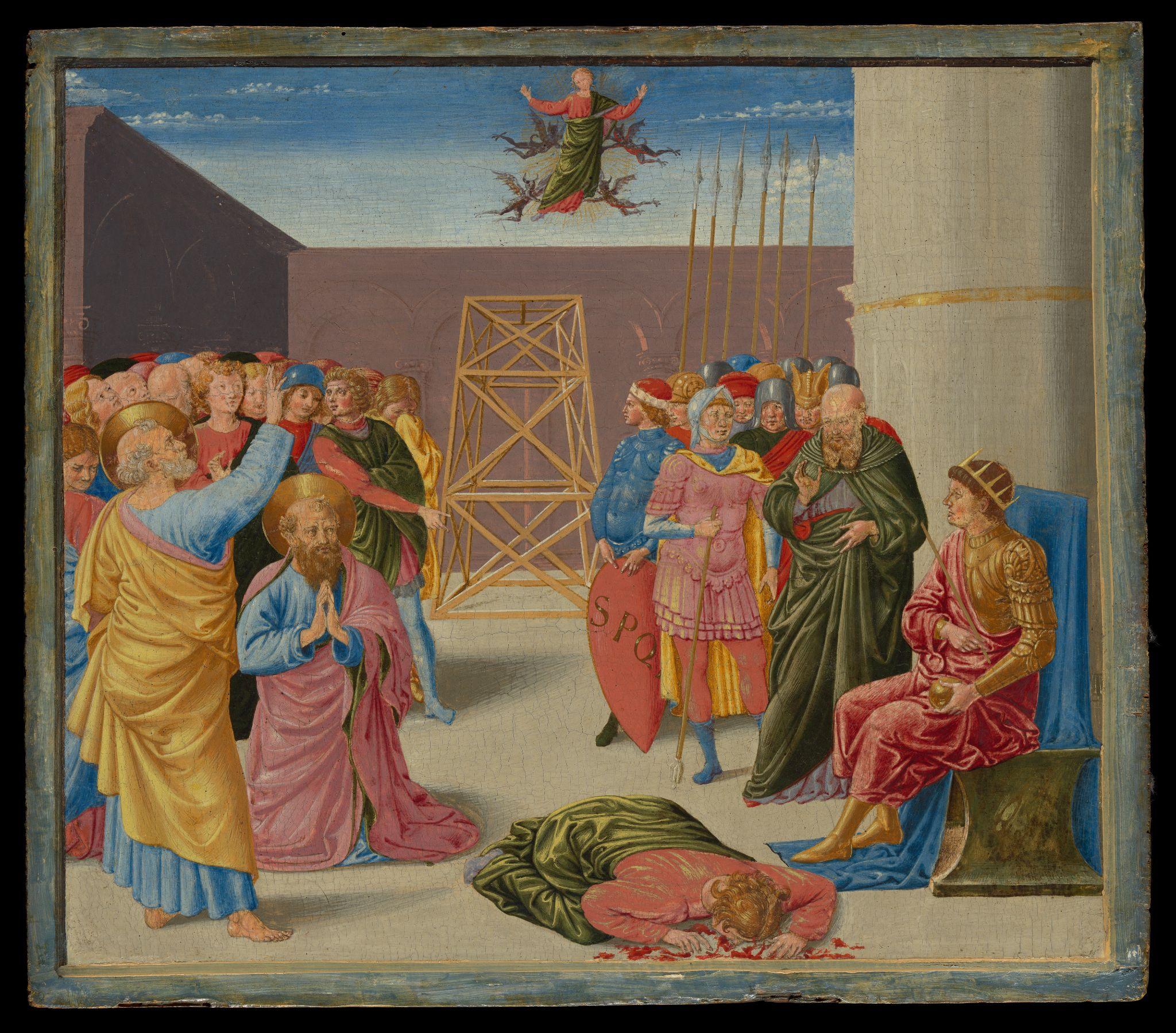
Saint Peter and Simon Magus, Benozzo Gozzoli, 1440-149727
The Death of the Antichrist, Unknown, 149328
The Fall of Simon Magus, Pompeo Batoni, 1745-175029
The similarities to the legend of Balaam should be apparent.
Balaam the Sorcerer |
Simon the Sorcerer |
|---|---|
Had the power to fly |
Had the power to fly |
Was opposed in flight by the prayer of his chief opponent, Phinehas (Phinehas opposes Balaam’s purchased work of temptation in Numbers 25) |
Was opposed in flight by the prayer of his chief opponent, Peter (Peter opposes Simon’s attempted purchase of the Holy Spirit in Acts 8) |
Fell to his injury |
Fell to his injury |
Became lame in one leg from the incident with the donkey |
Became lame in one leg from his fall |
Died after being cut by Phinehas |
Died after being cut by physicians |
Was not buried |
Was kept uninterred for three days in Nero’s false anticipation of his resurrection |
What accounts for these similarities? Is it not that early Christians understood the New Testament association of false teachers with Balaam? In particular, those who engage in the commerce of spiritual things should be identified with the Old Testament prophet for hire.
The point is not that we as Christians should accept any of these apocryphal stories as true. In fact, perhaps the point is made stronger by these merely being legends and not historic truths: Early Christians took to heart the New Testament authors’ use of the Balaam of legend as the quintessential religion grifter. They identified Simon as being like Balaam, and so are all who would treat the Word and Spirit as salable.
The Character of a False Teacher
So if the Bible presents Balaam as a prototypical false teacher—an exemplar to instruct us—what exactly does Balaam show us about the nature of a false teacher?
The most striking thing about Balaam is that he is not a false teacher in the way that most people think of a false teacher: one who promotes false propositions. In fact, this is one of the most important details in the primary narrative regarding Balaam: he is only able to speak the words that God puts in his mouth and is unable—or at least refuses—to go beyond them.30 In choosing an exemplar, Scripture does not point to Hananiah, who contended with Jeremiah and falsely declared peace. It did not point us to Zedekiah who contended with Micaiah and falsely declared victory. It points us to Balaam, who declared only what is true.
Rather than lies, Balaam is characterized by his internal motivation of greed and his external appeal to sensuality. Concerning greed, he is one who “loved the wages of wickedness” (2 Pet 2:15). Those who follow him do so “for payment” (Jude 1:11). Concerning temptations to sensuality, those who encourage sexual immorality hold to the teaching of Balaam (Rev 2:14). Even Paul’s mention of Jannes and Jambres suggests this, claiming those who are like these sons of Balaam would “captivate vulnerable women who are weighed down with sins and led astray by various passions” (2 Tim 3:6). Likewise, Peter labels him as a “son of the flesh,” making a play on words by replacing the name Beor with “Bosor,” sounding similar to the Hebrew word for flesh, “basar” (2 Pet 2:15; cf verse 18).
These attributes characterize false teachers as they are generally presented in the epistles, not just when directly associated with Balaam.
For such people are not serving our Lord Christ, but their own appetites. (Romans 16:18)
These men regard godliness as a means of gain. (1 Timothy 6:5)
For the love of money is the root of all kinds of evil. By craving it, some have wandered away from the faith and pierced themselves with many sorrows. (1 Timothy 6:10)
For the sake of dishonorable gain, they undermine entire households and teach things they should not. (Titus 11)
In their greed, these false teachers will exploit you (2 Peter 2:3)
Their eyes are full of adultery; their desire for sin is never satisfied; they seduce the unstable. They are accursed children with hearts trained in greed. (2 Peter 2:14)
Such punishment is specially reserved for those who indulge the corrupt desires of the flesh and despise authority. (2 Peter 2:10)
With lofty but empty words, they appeal to the sensual passions of the flesh (2 Peter 2:18)
These two vices of greed and sensuality form the merism of the tenth commandment: “You shall not covet your neighbor’s house; you shall not covet your neighbor’s wife” (Ex 20:17). Consider how even beyond Balaam, false teachers are characterized by covetousness, that is, discontentment. At the end of his description of false teachers, Jude summarizes: “These are grumblers, malcontents, following their own sinful desires” (Jude 16). Taking some liberty to rephrase with synonyms, “They are covetous, covetous, covetous.”
None of this is to deny that Scripture warns against heresy, only to affirm that false doctrine is de-emphasized as a derivative feature of false teachers. We are told repeatedly that false doctrine arises from such motives and indicates that someone necessarily indicates greed.
If anyone teaches another doctrine…These men regard godliness as a means of gain…For the love of money is the root of all kinds of evil. (1 Timothy 6:3,5,10)
Watch out for those who create divisions and obstacles that are contrary to the teaching you have learned…For such people are not serving our Lord Christ, but their own appetites. (Romans 16:17-18)
Now there were also false prophets among the people, just as there will be false teachers among you. They will secretly introduce destructive heresies…They are accursed children with hearts trained in greed. (2 Peter 2:3,14)
Greed drives false teachers to give instruction that accords with the fleshly desires of their audience.
Concluding Reflections
Admittedly, in focusing on Balaam, we have left some stones unturned. Jesus speaks of discerning false prophets by their fruits (Matt. 7:15-20). John teaches us to test the spirits by seeing whether they confess Jesus Christ has come in the flesh (1 John 4:3). Perhaps some may even point to these as counter-examples, indicating we are to primarily employ a doctrine-based assessment of false teachers. Each may be demonstrated to be in harmony with the approach presented here, but regardless, the recurring presentation of Balaam as a prototypical false teacher demands our attention.
On this point, an analogy is commonly offered: Those who detect counterfeit money do not study examples of counterfeits, but rather authentic currency. Therefore, to detect false teaching, there is little value in pondering examples of false teaching. Rather, we should concern ourselves with true teaching. While this analogy has some truth to it, ultimately, it must be tempered by this simple observation: the Bible commands us to consider examples of false teaching. More than that, the assumption behind that analogy of counterfeit currency is that the detection of false teachers lies exclusively in a critical evaluation of the propositions they communicate. Yet, this is not the primary emphasis when we regard examples like Balaam.
We must recalibrate how we think of false teachers. While explicit heresy is a dead giveaway, the absence of false propositions does not necessarily indicate a true teacher. Instead, we must evaluate motivations of greed and appeals to sensuality. These features may co-exist with pious aspirations; recall that Balaam desired to die the death of the righteous (Num 23:10). They may likewise co-exist with an outward asceticism (Col 2:23).
The primary way this heart of covetousness may be discerned is in Balaam’s primary transgression: the sale of the word of God. In our day, countless among the outwardly orthodox engage in this very same error. They offer their teaching at a price, they sell their conference tickets, they charge tuition in their seminaries. The evangelical landscape is awash with a doctrinally-sound grift. Like Balaam, they charge for a pristine prophetic word.
For some, this practice stems from a lack of clarity in our time. A unique patience and even sympathy is warranted that would not be in other eras. Regardless, we must hold them accountable and call them to repentance. In increasing levels, as wisdom dictates, we should demand they refuse to sell the word of God before we would patronize their ministry or support it with our own generosity. May they turn quickly from their error.
For others, this trafficking in holy things indicates something more sinister. These teachers would never promote outright heresy, but their greed leads them to take a soft approach to the sins of our generation, condoning and even encouraging sensuality, the desires of the flesh. Presently, they go unchallenged, but though they soar like birds in flight, may the prayers of the saints bring them crashing to their end.
Bible Publishers: Stewards or Gatekeepers?
―❖―
Let’s imagine that your pastor gets up one Sunday morning and announces: “If anyone wants to share passages from the Bible they need to ask me for permission first. I have to do this in order to carefully steward God’s Word, because people might abuse it. That said, I’ll be very generous in giving permission. I’ll even let you share it for free if you’re only using small portions. But if you use large portions, I’ll expect some payment to cover the costs of carefully stewarding God’s Word.” How would you feel?
While that might be unthinkable for a pastor to do, it is exactly what most Bible publishers have been doing for decades. There are some exceptions,1 but for the purpose of this article we’ll be focusing on the most popular modern English translations that most Christians use today.
Bible publishers will, of course, argue that they are carefully stewarding God’s Word. Let’s evaluate that by asking several questions:
Are publishers generous with permission?
No. While they are not all the same, they all make it difficult to get permission, whether it is due to complicated application processes, slow responses, burdensome conditions, charging fees, or simply not granting permission.5
The non-commercial permission form for the NIV6 has 49 fields to fill out, including one for your “distribution and marketing strategy”.
Crossway allowed the ESV to be used by open source Bible apps for some years, and then suddenly decided to stop and recoup licensing fees.7 Several open source Bible apps were then forced to remove it,8 resulting in these apps receiving very negative reviews from oblivious users (“Poor review due to the fact that ESV version is no longer available”).
When I myself contacted Bible publishers for permission for a free app, one took eight months to respond, another took one and a half years! And one didn’t respond at all.
Some publishers will not grant permission to apps unless they are “truly unique and innovative.” Since users will generally shun apps unless they have their favorite translation, it is very difficult for any new apps to emerge, since it is the publishers who decide if something is “truly innovative” rather than actual users.
Permission is so hard to get that some ministries boast when they have been granted it: “We have hard-to-get traction with Bible publishers, including a licensing commitment from Biblica”.9 When licensing the NIV for use in Bible commentaries, the publisher forbids any direct criticism of its rendering, which restricts the pursuit of the intended meaning of Scripture.10 Reading the entire Bible aloud in a public setting was forbidden by the American Bible Society for their Contemporary English Version.11
Even just reading portions of the LSB out loud and publishing as podcast episodes resulted in Pastor Gabriel Hughes being cautioned about copyright. He took down all previous episodes from his Hear the Word of the Lord podcast and had to “go through the right channels” before he could resume reading Scripture to people publicly.12
While publishers might seem to be generous by making their translations freely available on certain websites like Bible Gateway, that is actually in part a strategy to increase print sales. The more popular your translation is online, the more print sales you’ll likely make. I’ve heard this confessed first-hand from those in the industry.
I recently made an app13 that allows anyone to print individual books of the Bible at home for free. It was denied permission by all the publishers I asked, except one who demanded money. The technology is open source, so they could use it themselves if they wanted to, adding whatever quality assurance they would like. Instead, it is clear that publishers do not want ordinary Christians to be able to print Scripture themselves. They said so explicitly: “We do not however grant licenses for end-users to print their own editions, regardless of the amount of text they’re printing.”14
While sites like Bible Gateway allow you to print portions of a book, it maxes out at 10 chapters. There is also no special license granted for printing, so sharing a printout with anyone else is in many cases illegal, even though Christians often do it.
Do they commercialize Scripture?
Yes. To start with the clearest offender, the NKJV is a 100% for-profit translation owned by unbelievers. Job applications for Thomas Nelson simply redirect to its parent company (HarperCollins) which is a secular company,15 and is itself owned by News Corp.16
While all the other organizations are non-profit, some of them have given exclusive publishing rights to for-profit companies.17 Biblica has given Zondervan exclusive rights in the US to print the NIV commercially, meaning a significant portion of the profits go to Zondervan’s owner (also News Corp), and no other Christian publishers can print the NIV.
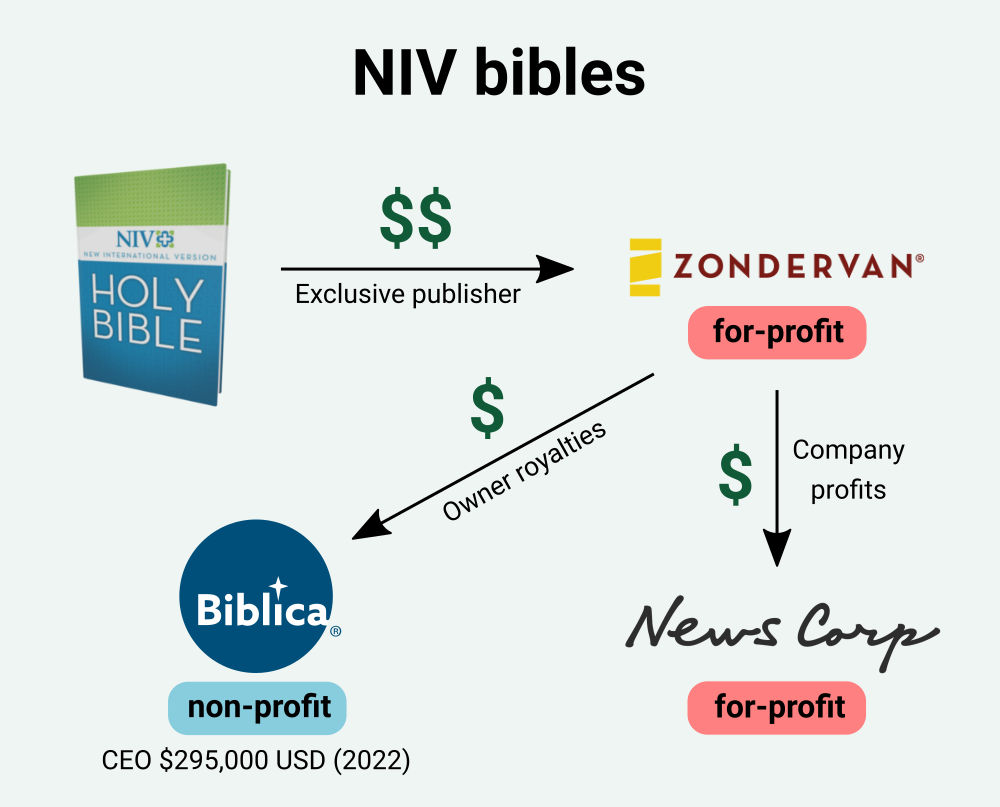
Just like secular companies, Christian publishers have been printing special gimmicks to generate profit and are even willing to exploit Christian vices to do so. Some idolize American identity, like the NASB Founders’ [of America] Bible18 and the NKJV American Patriot’s Bible,19 while others appeal to believers’ materialistic tendencies. While high quality products have their uses, the exclusive publishing and $400 USD [correction, $399.99] price tag make the ESV Pulpit Bible20 truly stand out.
Almost all Bible publishers distribute their translations via The Digital Bible Library, which is quite literally designed to restrict access to God’s Word.21 It’s an initiative by the largest Bible organizations, which requires all its members to “acknowledge the following”:
Organizations employ various business models, including donation-based models, sales-based models, service-delivery models, among others. All of these models and hybrid models among them are considered reasonable and appropriate.22
In other words, to be a member of the Digital Bible Library community you must agree that it is acceptable to commercialize Scripture as much as any other member may like. There is not even a requirement to be a non-profit organization.
Even then, the non-profit legal category itself only prevents owners from arbitrarily receiving money from their organization, but it doesn’t take into account personal profiting through high salaries and other compensation. The CEO for Crossway (owner of the ESV) in 2020 received a total of $423,927 USD in annual compensation for only 31 hours/week of work.23 While it is normal to pay CEOs large salaries to attract talent, that should not be necessary to motivate Christian CEOs.
Whether an organization is non-profit or not, to sell God’s Word with exclusive publishing arrangements is to commercialize Scripture. God’s Word has been made a commodity, providing well-paid job security to those who “steward” it. Those who labor in producing and updating translations should be financially supported, but many other organizations have managed to achieve that without restricting their translations.24
Do they ever give for free?
Sometimes. As already mentioned, you can find all these translations online for free in certain apps/websites. However, they usually expect some kind of commercial compensation from the website owner, such as royalty payments or displaying ads for their products. These agreements are all private, but my organization was offered use of a text (for free distribution) for $1,000 USD/year. I declined. This appears to be a common demand from most major translations. Ironically, if you want to share God’s Word for free, you often have to pay to do so.
Even when publishers do give for free, it is not always really for “free”. Every single one of the above-mentioned translations collects your personal information25 when choosing to download their translation for offline use in YouVersion (the most popular Bible app). Notably, they also collect your name and country, which is not ideal for persecuted Christians were that data to ever get leaked.
Publishers have in fact been reluctant to make their translations free online,26 and have been very slow to do so, fearing a drop in print sales. Not too long ago, many of these translations charged a fee to download them in apps like YouVersion. During that time, in 2011, Biblica/Zondervan made the NIV free to download27 for a limited time, explicitly as a marketing strategy to generate more print and digital sales:
This limited offer ends next Tuesday ... That’s when you’ll also be able to pick up the NIV in print at retailers everywhere. We’d like to thank Biblica and Zondervan once again for making the NIV available offline.
Charging fees for offline use in the 2010s was a blatant money-making strategy. In terms of technology, it would cost less to let people read offline than to have them keep downloading the text from servers. Publishers forced users to pay for something that would actually decrease distribution expenses. This was especially greedy in that time given bandwidth was more limited and mobile payment plans more expensive.
Some publishers like Biblica28 and Tyndale29 have encouragingly been more open with some of their resources, which is a step in the right direction. However, their most popular Bible translations remain restricted.
Do they actually protect Scripture?
No. While publishers try to protect Scripture through copyright, this is ineffective and does more harm than good.30 Copyright more commonly prevents those with good intentions from using Scripture, as those with bad intentions may well ignore the copyright anyway.
Christians generally trust sources of content rather than the copyright status of content. The KJV is public domain in most countries and yet malicious modifications have not been a wide problem as there are numerous trustworthy sources of the text.
Even with the current licensing conditions of modern translations, someone could publish blasphemous material as long as Scripture only took up a quarter of the total content.
What publishers do prevent is the sharing of pure Scripture. None of their public licenses allow copying and sharing plain Scripture. You are always forced to add your own commentary to it. You can’t even share a parable of Jesus by itself, as many oblivious Christians have done without permission over the years.
Fears of bad things happening if people have free access to Scripture is not without historical precedent, as Catholic clergy had the same fears when ordinary believers started to access Scripture through translations into the vernacular. Henry Knighton (a Catholic historian) criticized John Wycliffe’s translation into English on the grounds that ordinary believers could not be trusted to safeguard Scripture as clergy could:
The Gospel, which Christ gave to the clergy ... that they might administer it to the laity ... that Master John Wyclif translated from Latin ... so that he made that common and open to the laity ... and spread the Evangelists’ pearls to be trampled by swine. [emphasis added]31
Pope Pius IV in 1564 reluctantly allowed translations in the vernacular, but only if one had written permission from a bishop:
if the Holy Bible, translated into the vulgar tongue, be indiscriminately allowed to every one, the rashness of men will cause more evil than good to arise from it, it is, on this point, referred to the judgment of the bishops or inquisitors, who may ... permit the reading of the Bible translated into the vulgar tongue ... and this permission must be had in writing.32
Publishers today likewise believe they have been entrusted by God with the task of stewarding his Word and that they cannot trust ordinary believers to print or publish it themselves. Instead, anyone wanting to do so must receive permission from them.
To be truly free, all Bible translations should be public domain, relying on the church to uphold good teaching rather than secular law courts.33 However, for the sake of argument, if these organizations really wanted to ensure ‘purity of text’ they could make use of the popular Creative Commons Attribution-NonCommercial-NoDerivatives license.34 This license would mean anyone can freely share Scripture as long as they don’t modify or commercialize it. None of these Bible publishers have chosen to make use of it.35 It is entirely fair to conclude then that they are not just concerned about purity of text, but rather the control of the text. As Dr. Maurice Robinson puts it in his 1996 paper The Bondage of the Word: Copyright and the Bible:
It is not the “purity of the text” which has to be protected, but the liberation of that text from those non-church entities who desire to profit unjustly from marketing God’s word back to God’s people. 36
Are these publishers really worthy of such control? I received the following response from a publisher which was concerned that someone might try make money off their translation, were they to let me integrate it into one of my apps:
I want to add something in the text that we can find if the text you distribute makes it into a commercial venture. Put your thinking cap on on[sic] what we may do. Maybe we repeat a word in a verse in Eccleslastes[sic] or we misspell a word in John.37
This was for a modern English translation widely trusted by Reformed Evangelicals. I refused (politely) to corrupt Scripture in that way and they never ended up giving me the permission I needed for their text. They obviously didn’t intend on changing the meaning of the text, but they were willing to put an intentional mistake into God’s holy Word for the sake of controlling it.
Would God want his Word to be “stewarded” in this way?
No. God’s Word is the only tangible thing we have in this world that we can truly call “holy” (Rom 1:2), and yet we have let it be commercialized. Scripture cannot be chained (2 Tim 2:9) yet publishers may well sue you if you try and share it in a way they don’t approve. They call it “God’s Word” but really believe it belongs to them. A handful of monetization strategists at these organizations decide how millions of believers can and can’t use God’s Word. We celebrate smuggling bibles into hostile countries and yet forbid anyone from copying and sharing Scripture with their neighbor. We say the Reformation put God’s Word back into the hands of ordinary believers, but it has once more been taken away by modern day publishers.
Should a believer be allowed to share some of God’s Word, but be forbidden from sharing the whole counsel of God? Should it be lawful to share Scripture with commentary, but a crime to share Jesus using just his own words?
You might think this article is aimed towards Bible publishers. It is in fact aimed towards the church. Commercial publishers have made clear what they think “stewarding” looks like, and have stubbornly resisted numerous calls for freer access for decades now. It is instead up to the church to stop promoting these restricted translations, to ensure a future where God’s Word is free to be shared. The church must stop turning a blind eye to the commercial nature of these translations, and start taking seriously free alternatives.
A future generation of Christians will look back and remember the 21st century as the time when the sharing of God’s Word was restricted by Christians themselves, and it was called “godly”. Even more perplexing will be why churches allowed it to happen in the first place.
It is most fitting to end this chapter in the words of the translations themselves:38
NIV Unlike so many, we do not peddle the word of God
ESV For we are not, like so many, peddlers of God’s word
NLT You see, we are not like the many hucksters who preach
NKJV For we are not, as so many, peddling the word of God
NRSV For we are not peddlers of God’s word like so many
NASB For we are not like the many, peddling the word of God
CSB For we do not market the word of God
LSB For we are not like many, peddling the word of God
“Instead, we speak with sincerity in Christ, as from God and before God” (2 Cor 2:17).
The Sunnyvale Statement on the Stewardship of Scripture
―❖―
In the past centuries, innovations in technology have greatly increased the distribution of Scripture. However, this progress has been hindered in other ways: Anti-Christian authorities continue to inhibit access as they always have, yet some of the greatest threats to the dissemination of the Word of God come from within our own institutions. The seventeenth century introduced exclusive publishing rights that limited the printing of the Authorized Version of the Bible. The eighteenth century witnessed the advent of modern copyright law, a legal mechanism that, by design, restricts the free propagation of Scripture. In our own day, these regulations have only expanded, and their impact has increased with the invention of digital publishing.
God has given his Word freely; no man has the authority to control or limit its transmission (2 Tim 2:9). The Author of Scripture has protected and preserved this Word for thousands of years, and we can trust him to continue to do so apart from human contrivances. We thank God for the labors of those who have made the Bible accessible to the nations, but we lament that many translations and editions of Scripture are burdened with legal and organizational restrictions that are ultimately inimical to the Great Commission.
Therefore, we, the undersigned, unite in one conviction: Scripture is the Word of God, and he has authorized his people to use, copy, distribute, translate, and adapt it regardless of man’s consent.
May the Word of the Lord run and be glorified (2 Thess 3:1), filling the earth as the waters cover the sea (Isa 11:9).
Affirmations & Denials
1. Concerning the Authorship of Scripture
We affirm that God is the divine Author of Scripture, the Word of God written, and has given this Word to his people as a gift.
We deny that Scripture may be regarded as merely human writing or that any may claim an exclusive right over it.
2. Concerning the Identity of Scripture
We affirm that the sixty-six books of the Old and New Testaments are the inspired Word of God, and that all forms thereof—whether autograph, apograph, recension, translation, or adaptation—retain a divine quality that necessarily entails certain liberties for those to whom they are entrusted.
We deny that any human effort, creativity, or error involved in the transmission, recension, translation, or adaptation of Scripture undermines any of these liberties.
3. Concerning the Use of Scripture
We affirm that the people of God have been given Scripture to search and meditate on, and therefore all who have access to the Word are granted the liberty to make full use of it regardless of man’s consent.
We deny that misuse or any other danger undermines this liberty, or that any have a right to forcibly restrict others from lawfully using the Word of God.
4. Concerning the Reproduction of Scripture
We affirm that the people of God have a prerogative to preserve Scripture, and therefore all who have access to the Word are granted the liberty to copy it in any medium or format regardless of man’s consent.
We deny that textual corruption or any other danger undermines this liberty, or that any have a right to forcibly restrict others from lawfully copying the Word of God.
5. Concerning the Distribution of Scripture
We affirm that the people of God are called to propagate Scripture, and therefore all who have access to the Word are granted the liberty to distribute it in any medium or format regardless of man’s consent.
We deny that misattribution, economic exploitation, or any other danger undermines this liberty, or that any have a right to forcibly restrict others from lawfully distributing the Word of God.
6. Concerning the Adaptation of Scripture
We affirm that the people of God should make full use of Scripture, and therefore all who have access to the Word are granted the liberty to adapt it regardless of man’s consent.
We deny that mistranslation, mishandling, or any other danger undermines this liberty, or that any have a right to forcibly restrict others from lawfully adapting the Word of God.
Regarding the purpose of the statement
What’s the problem?
Most modern Bible publishers have placed legal restrictions on the copying, distributing, and translating of Scripture. This means that individuals and ministries often need to seek permission or pay licensing fees simply to include quotations of Scripture in ministry resources—even in regions where access is scarce or believers are persecuted. This practice places unnecessary barriers between people and Scripture and undermines the gospel’s call to freely share the good news. (See the legal restrictions for major translations.1)
What harm has been done by the mainstream status quo of Bible licensing?
The “All Rights Reserved” approach to copyright for most Bible versions has caused measurable harm over the years, and continues to do so.
Under typical licenses, churches are not allowed to print significant portions of Scripture, and many are turned into lawbreakers unwittingly. Scripture does not reach as many people as it could because of restrictions, especially in low-resource languages. Legal red tape often prohibits audio bibles for people in oral cultures (75% of the world). Publishers often prohibit faithful uses of their texts for trivial reasons, such as “we do not license to individuals,” or “your Bible app isn’t innovative enough.”
Specific cases have been documented by us2 and others,3 but these are just the tip of the iceberg. Few Christians question the legitimacy of copyrighting Scripture, and so most simply accept the restrictions. When copyright is breached, most believers comply with cease-and-desist demands, so violations rarely escalate to litigation.
How can these limitations be significant if I’ve never faced them in my own ministry?
Most people in ministry will have already breached the licenses of modern translations on numerous occasions without realizing it. Trivial breaches include printing a passage of Scripture for others to study, or publicly reading all 13 verses of 2 John. Public readings are subject to copyright, and reproductions of entire books are forbidden by most Bible licenses.
Even if publishers don’t respond to such uses, they still violate their licenses and may not be covered by fair use exemptions (which are only available in certain countries). This means that many ordinary uses of Scripture pastors take for granted are technically prohibited, and strict adherence to licenses would require abandoning many everyday uses of Scripture.
Was the Word of God historically restricted by legal frameworks such as copyright law?
No. For centuries prior to the establishment of copyright law, Scripture was freely shared, copied, and translated without legal limitations. This open access facilitated widespread distribution of and engagement with the biblical text across cultures and generations, especially during the Reformation.
Aren’t there already some free translations available?
Yes, some translations are already freely available in English4 and other languages. But even though these free translations exist, it does not mean the need is met. God’s people should be free to share any translation and be able to select the best translation for their particular ministry. More importantly, many languages do not have a free translation5 available at all. Most minority languages have only one translation, for which distribution is restricted by copyright law.
Regarding the wording of the statement
Are you suggesting publishers must give bibles away for free?
No, it is permissible to charge for paper and ink. The issue this statement addresses is the sale and restriction of the Word itself. This is most often done today through copyright and licensing.
What do you mean by “lawful”?
This statement retains the use of “lawful” from historic confessions (such as the Westminster Confession of Faith) to refer to that which is consistent with God’s will. It refers to God’s authority, not merely human law. This may align with civil law, but it is not bound by it.
Why does this declaration permit adaptations of Scripture?
“Adaptations” is a technical term to refer to the creation of any derivative work. This includes translation, digitization, musical arrangements, etc. These are permissible provided they are lawful in the sight of God. The declaration affirms the liberty to make such adaptations; it does not itself determine which adaptations are lawful. It does not condone distortions of Scripture or misleading renderings.
Shouldn’t this apply only to Scripture in its original form?
No, Scripture affirms that faithful copies and translations are still the Word of God. The New Testament translates Old Testament Hebrew passages into Greek, demonstrating that the divine meaning and authority are preserved in faithful translations. The Chicago Statement on Biblical Inerrancy likewise affirms that “copies and translations of Scripture are the Word of God to the extent that they faithfully represent the original” (Article X).
Faithful adaptations beyond translations also retain the divine quality of the original Word. Modern law reflects this principle in that derivative works remain subject to the copyright of the original. Similarly, since God is the author of Scripture, all faithful derivatives of his Word remain under his authority and are intended to be freely shared.
Christian teaching, which also retains a divine quality when based on Scripture, does not conflict with this statement. It simply implies analogous considerations for Christian teaching, which are outside the scope of this statement (see also Adaptation & Inspiration6).
Does this statement permit breaching the copyright of Bible editions?
At the heart of this statement is the belief that God has given his Word to his people, making claims to exclusive ownership of any form of it illegitimate. We are to submit to governing authorities (Rom 13:1, 1 Pet 2:13), but not when such submission would restrict the spread of God’s Word (Acts 4:19, 5:29).
Any genuine believer will affirm that it is right to share the gospel regardless of man’s consent. How ironic, then, would it be to suggest the gospel cannot be shared when it comes in the very words of Jesus himself, merely because a translator asserts copyright. History provides numerous examples, both ancient and modern, of believers sharing Scripture in ways declared unlawful by human authorities.
This is not to say breaching the copyright of existing editions of Scripture is the right course of action, especially when suitable alternatives are available. For English speakers, the Berean Standard Bible is one good alternative to commercial translations commonly used today.
This is principally a theological matter, and the statement only addresses the illegitimacy of restrictions on Scripture. It does not address how believers should respond to such restrictions, as godly application will depend on the laws and circumstances each believer faces.
To avoid all doubt, the Sunnyvale Statement does not itself advocate for violating any civil laws such as copyright.
Regarding objections to the statement
What is the Scriptural basis for this statement?
This is principally a statement of belief, so explanation and elaboration are not included, as is common in such declarations. The authors of this statement have spent years studying and writing on this topic, and an extensive collection of resources is available in the resources below for further study. For ease of reference, the following passages are particularly relevant:
Paul declares that “the word of God is not bound” (2 Tim 2:9), showing that restricting it in any way opposes God’s will. Jesus commanded his disciples to freely give what they had freely received (Matt 10:8), referring to the message they were to preach, which also became Scripture. Paul contrasted himself with those “who peddle the word of God” (2 Cor 2:17), commercializing their teaching and restricting access to it for payment. When human authorities demanded that the apostles stop spreading teaching about Jesus, they responded, “We must obey God rather than men” (Acts 4:19, 5:29).
These accounts underscore the sacred nature of God’s Word. Scripture is holy (Rom 1:2) and must not be treated as a commercial product to be controlled or sold, regardless of intention.
Please see the links below for many resources that go into more depth.
Don’t Bible translators deserve their wages?
Absolutely. Those who labor in Bible translation should be generously supported (1 Tim 5:18). However, fair compensation does not require restricting access to work via legal walls or paywalls. There are sustainable models that both honor the work of translators and allow the Word of God to be freely shared. The free generosity of God’s people (donations and offerings) is a feasible model that has supported the work of churches, ministries, and many Bible translators, since the early church.
Isn’t copyright necessary to protect the integrity of the text?
Only God can protect the integrity of his Word, and he did so for thousands of years before copyright law existed. While concerns about textual accuracy are valid, copyright law does not and cannot sovereignly protect the purity of Scripture as bad actors may ignore it anyway. Ultimately we must trust God to guard his Word, and the historical and global witness of the Church shows that the free sharing of Scripture can coexist with faithful transmission. It is best for Scripture to be dedicated to the public domain so that it may be used as a base for further refinement and/or translation to other languages.
See also the following chapters in this book:
“Does Copyright Actually Protect the Text of Scripture from Corruption?”
“Copyright & Jesus’ Command to Freely Give”
Don’t publishers have a responsibility to protect the text of the Bible?
While this is often assumed, no. One can publish the Bible without being saddled with a responsibility to prevent others from misusing it. Besides, if this were really their only concern, why don’t they use a license that allows copying without modification?7 The “all rights reserved” approach betrays additional motives.
If we remove copyright from Scripture, won’t it become confusing to know which versions are trustworthy or accurate?
This question confuses the notion of trademark with copyright. Copyright does not prevent someone from falsely claiming that one translation is another; there are other laws that deal with false advertising. For example, the World English Bible (WEB) is in the public domain, but its name is trademarked, ensuring that modified versions cannot falsely use the WEB name. For other translations like the KJV, there is no trademark in most jurisdictions, yet this poses no serious threat to its integrity.
Why not just encourage the free sharing of Scripture, rather than insist upon it?
This statement is primarily a theological declaration rather than a response to contemporary issues. The free sharing of Scripture is not commended merely because it is useful or advantageous, but because Jesus himself commands it (Matt 10:8). To withhold his Word, or to treat it as a product to be controlled, is not merely unwise—it is disobedience. The issue is, therefore, not one of convenience or efficiency, but of faithfulness to God’s will.
Regarding the origin of the statement
Who is behind this?
This effort is led by the creators of sellingJesus.org, copy.church, and thedoreanprinciple.org. They have substantial combined experience in Bible translation, Bible app development, publishing, pastoral ministry, and global missions. Selling Jesus provides educational resources that confront the monetization of ministry, while copy.church documents how copyright laws are used to restrict the sharing of Scripture and ministry resources. The Dorean Principle is a biblical response to the commercialization of Christianity. They share the common message that ministry should be supported, not sold.
What if I don’t agree with all your views on copyright or ministry finance?
When you sign this declaration, you are only agreeing to the preamble and affirmations, not this Q&A or our other resources.
Is anyone else doing anything about this?
Yes. Some publishers are responding to these concerns. Biblica, for example, has made many of its contemporary translations available for free use8 under open licenses. Other voices within the Christian community are also calling for a reexamination of current copyright policies to better reflect biblical values and the global need for access to Scripture.
How can I help?
You can support this movement by signing the statement, sharing it with others, and raising awareness in your community, church, or ministry organization. Encourage Bible publishers to reconsider their policies in light of biblical principles and advocate for translations that are open to all.
Where can I learn more?
You can start with the following resources:
“The Bondage of the Word”9
“How the Jesus Trade Harms the World”10 (video)
Recommended books and articles on copyright and licensing from sellingJesus.org11
For statistics, see:
PART TWO
Foundational and Supplementary Material
The Dorean Principle
―❖―
Jesus says: “Freely you have received; freely give” (Matt 10:8), and then, in the same flow of instruction, he says: “The worker is worthy of his provisions” (Matt 10:10). Luke records the latter saying as “The worker is worthy of his wages” (Luke 10:7). Any account of ministry and money that quotes the first statement while ignoring the second has not yet understood Jesus. But neither is it valid to use the worker’s wages to empty “freely give” of its ordinary meaning. Christ did not forget what he had said two sentences earlier. He did not first prohibit payment and then immediately authorize the sale of ministry. The two commands belong together, and the dorean principle is what unites them. The term dorean comes from the Greek word δωρεάν, translated “freely” in Matthew 10:8. In this context, it refers to giving apart from payment, or without cost. Paul uses the same word when he says that he preached the gospel to the Corinthians “free of charge” (2 Cor 11:7).
The principle may be stated simply: Christian ministry should be supported, not sold. The distinction is not between receiving money and receiving no money. It is not between paid ministers and unpaid ministers. It is not even, strictly speaking, between receiving support from those who benefit from ministry and receiving it from someone else. Instead, the distinction is between support and purchase—between sustaining a servant of God and buying the things of God from him.
In Matthew 10 Jesus sends out the disciples without ordinary provisions. They are to enter worthy homes and receive hospitality from those among whom they minister. Their ministry is not to be an exchange of the spiritual for money. They have received gifts from God, and they must pass them on in the same manner, as gifts.1
The two opposing types of exchange in view can be described by the terms reciprocity and co-labor. Reciprocity treats ministry as one side of a transaction: the minister provides spiritual service conditioned upon payment or something else from the recipient. Co-labor, by contrast, places both minister and supporter beneath the authority of a common Master. One servant engages in spiritual work, while another uses the resources God has entrusted to him to sustain that work. Money may pass from the recipient to the minister in either arrangement, so the mere movement of money does not determine its moral character. The decisive question is why the payment is given. Under reciprocity, the recipient gives because the minister has withheld the spiritual work on condition of payment, and the recipient feels indebted or obligated to the minister. Under co-labor, the believer gives because God has called him to share in the work and to provide for a fellow servant. In the first, ministry creates a debt between men. In the second, both giver and minister respond to obligations imposed by God. We see the model of co-labor clearly in 3 John 1:7-8: “For they went out on behalf of the Name, accepting nothing from the Gentiles. Therefore we ought to support such men, so that we may be fellow workers for the truth.” The idea of being fellow workers is the essence of co-labor.
The Lord of the Harvest
Immediately before sending the twelve, Jesus tells them: “The harvest is plentiful, but the workers are few. Ask the Lord of the harvest, therefore, to send out workers into his harvest” (Matt 9:37–38). The disciples are workers, but the people among whom they labor are not their employers. The employer is “the Lord of the harvest.” He sends the workers, owns the field, and assumes responsibility for their provision, and he ordinarily provides through the free generosity of his people. The Church has a real duty to sustain its ministers, but the duty is governed by the Lord who stands over both parties. The giver is not purchasing control over the minister, and the minister is not selling divine grace. Both are servants participating in the same work.
Ordinary Christians already recognize this distinction in other settings. A congregation that supports a pastor does not buy each sermon from him. A family that gives generously does not purchase greater access to the promises of God. The pastor preaches to all without price, while the church supports him so that he may continue to labor.
Paul’s Right & Paul’s Renunciation
No passage addresses the material support of gospel ministers more extensively than 1 Corinthians 9. Paul draws upon apostolic precedent, ordinary labor, the law of Moses, the temple system, and the command of Christ to establish that those who devote themselves to gospel ministry possess a genuine claim to material provision. Yet the chapter does more than defend that claim. It appears within Paul’s larger treatment of food sacrificed to idols, where the governing question concerns the proper exercise of Christian liberty. Believers may possess a legitimate authority while remaining obligated to govern its use by love, the edification of others, and the honor of Christ. Paul therefore closes chapter 8 by declaring that he would permanently surrender his liberty to eat meat rather than cause his brother to stumble, and he then turns to his own financial conduct as an extended illustration of the same principle (1 Cor 8:9–13; 9:1–27).
Paul begins by asserting his freedom and apostleship, both of which the Corinthians themselves confirm as the fruit and seal of his ministry among them (1 Cor 9:1–3). He possesses the same authority as the other apostles to receive food and drink, to travel with a believing wife, and to be relieved from the necessity of supporting himself through ordinary manual labor (1 Cor 9:4–6). He then appeals to familiar examples from daily life. A soldier does not ordinarily serve at his own expense; the planter of a vineyard eats from its fruit; and the shepherd who tends a flock drinks from its milk (1 Cor 9:7). The law of Moses expresses the same principle in its command, “Do not muzzle an ox while it is treading out the grain” (Deut 25:4; 1 Cor 9:8–10). Paul applies the command to human laborers who plow and thresh in the expectation of sharing in the harvest, and he draws the application directly to the Corinthians: having sown spiritual things among them, he could rightly reap material things from them (1 Cor 9:10–12). Thus, the recipient of ministry may contribute to the support of the minister.
At this point the nature of the right must be carefully defined. Paul develops an argument for ministers being sustained, rather than an argument for placing a price upon the ministry they communicate. The soldier receives what is necessary to continue serving; the vinedresser and shepherd partake of the fruit produced within their sphere of labor; the ox is permitted to eat as it treads; and the plowman and thresher anticipate a share in the harvest (1 Cor 9:7–12). None of these examples portrays spiritual instruction as merchandise withheld until the recipient pays. Paul’s argument establishes the right to support, but nowhere legitimizes sales.
The temple analogy reinforces this understanding. Those who work in the temple eat from the temple, and those who serve at the altar receive a portion of the offerings presented there (1 Cor 9:13). The worshiper brings his offering to God, and God appoints part of that offering for the provision of those who serve in his sanctuary. The priest is thereby sustained through the worship of the covenant community without selling anything. Paul then applies this pattern to the new covenant: “In the same way, the Lord has prescribed that those who preach the gospel should receive their living from the gospel” (1 Cor 9:14). It is striking that some who would deny that the gospel itself should ever be sold appeal to this verse to justify charging for ministry. If “receive their living from” means to make merchandise of something, why would “the gospel” refer only to teaching associated with the gospel, rather than to the gospel itself? Instead, Paul is clearly teaching that spiritual work should be supported, not sold.
Having established that gospel laborers possess this authority to receive material provision, Paul turns to his own decision concerning its exercise in Corinth. “But we did not exercise this right,” he says. “Instead, we endure anything rather than hinder the gospel of Christ” (1 Cor 9:12). After appealing to the temple and to the Lord’s command, he repeats the point with even greater force: “But I have not used any of these rights” (1 Cor 9:15). These declarations form the rhetorical turning points of the argument. Paul has demonstrated his authority from every conceivable direction and then explains why he declined to exercise it among the Corinthians. He assumed the expense himself and received assistance from established believers elsewhere because accepting their provision would have created an obstacle, burdened an immature church, and obscured the sincerity of his mission (1 Cor 9:12; 2 Cor 11:7–12). Paul also wanted his financial practice to stand in unmistakable contrast to those who sought gain through ministry (2 Cor 2:17; 11:20).
The language of 1 Corinthians 9:18 clarifies the result of this decision. Paul asks, “What then is my reward?” and answers that, in proclaiming the gospel, he may render it ἀδάπανον (adapanon) and refrain from making use of his authority in the gospel (1 Cor 9:18). The adjective ἀδάπανος is formed from the noun δαπάνη, meaning “cost,” “expense,” or “outlay,” together with the privative prefix ἀ-. It describes something as costless, without expense, or requiring no outlay. The word ἀδάπανον (in any form) occurs only once in the NT and never appears in the Septuagint, making it impossible to compare across a variety of contexts. A Greek-English Lexicon of the New Testament and Other Early Christian Literature (also known as BDAG) glosses it as “free of charge,” and most English versions render some variation of the same. This communicates the general economic sense, but can suggest to modern readers that Paul waived a sales price he otherwise possessed the right to impose. The context supplies a more precise meaning: Paul made the gospel available at no expense to the Corinthians by declining to receive from them the material support to which he was otherwise entitled. A better translation would be: “What then is my reward? That in my preaching I may present the gospel without expense.” Or, with the implicit made explicit: “make the gospel available at no expense to those who hear it.” Paul’s ministry required no financial outlay from the Corinthians.
Therefore, Paul’s ministry was ἀδάπανος to the Corinthians without being unsupported. He later explains that he accepted assistance from other churches in order to serve the Corinthians, and that believers arriving from Macedonia supplied what he lacked (2 Cor 11:8–9). The Philippians likewise sent gifts to meet his needs, which Paul received as participation in the gospel (Phil 4:15–18). Again, these gifts did not purchase Paul’s preaching or secure privileged access to his ministry. They sustained a servant of God whose labor was directed toward the benefit of others.
The remainder of the chapter returns this financial policy to the larger theme of Christian liberty. Although Paul is free from all, he makes himself a servant to all so that he might win more people (1 Cor 9:19). He subordinates every liberty to the advance of the gospel (1 Cor 9:19–27). The Corinthians are later called to imitate him as he imitates Christ (1 Cor 10:23–33; 11:1).
Paul’s conduct should not be dismissed as an exceptional standard for unusually devoted ministers. He repeatedly presents himself as a model for the Church and grounds his financial practice in the command of Christ, the law of Moses, and the temple system (Matt 10:8–10; Deut 25:4; 1 Cor 9:8–14; 11:1). He received support when it expressed partnership in the gospel and relinquished it when it threatened to hinder the gospel, establishing a pattern that Christian ministers are called to follow.
First Corinthians 9 distinguishes between two financial arrangements: 1) the legitimate support of gospel workers and 2) Paul’s voluntary renunciation of that support in Corinth. Although the chapter does not directly address the sale of ministry, nothing in Paul’s argument establishes a right to place a price upon ministry. His concern throughout is the support of the laborer, not the sale of the laborer’s message.
Sharing with the Teacher
Galatians 6:6 brings the relationship between minister and recipient into focus: “The one who receives instruction in the word must share in all good things with his instructor” (Gal 6:6). Paul places responsibility of support upon the person who has received spiritual instruction, demonstrating that it need not come exclusively from a detached patron or an unrelated congregation. The language Paul chooses locates this provision within the fellowship of the Church rather than within a commercial exchange. The verb κοινωνέω (koinoneo) carries the sense of sharing, participating, or entering into fellowship. The minister imparts biblical teaching, and the one taught responds by sharing the material goods God has entrusted to him (as unto the Lord, not man). This mutuality belongs to the wider context of bearing one another’s burdens, sowing to the Spirit, persevering in good works, and doing good especially to the household of faith (Gal 6:2, 7–10). Ministerial support thus emerges as an expression of Christian communion: the members of the Body sustain one another according to their different callings and resources (the opposite of selling spiritual things to each other). The teacher gives the Word freely, including to those who possess little or nothing, while believers with means assume a share of the material burden. The freedom of the gift calls forth generosity rather than indifference, since those who receive spiritual nourishment should desire the continued flourishing of the ministry through which it comes.
Double Honor & the Worker’s Wage
Paul further develops the obligation to support ministry in his instructions concerning elders:
Elders who lead effectively are worthy of double honor, especially those who work hard at preaching and teaching. For the Scripture says, ‘Do not muzzle an ox while it is treading out the grain,’ and, ‘The worker is worthy of his wages.’ (1 Tim 5:17–18)
The two citations establish that “honor” includes material provision. The command concerning the ox protects the laborer’s participation in the fruit of his work, while Christ’s saying affirms his right to μισθός (misthos), ordinary remuneration for labor performed. The Church honors those who devote themselves to preaching, teaching, and oversight by supplying the material resources necessary for sustained service. This provision is a genuine obligation, not an optional kindness that may be withheld whenever generosity grows inconvenient.
The ordinary meaning of μισθός should be allowed its full force. As BDAG observes, the word denotes “remuneration for work done, pay, wages” in Luke 10:7 and 1 Timothy 5:18. Paul employs the same economic logic when he says that the worker’s wage is reckoned according to obligation rather than grace (Rom 4:4). In both our world and the ancient world, a distinction exists between money given as a wage and money obtained through sales. Wages attach to the laborer and his service; a sales price attaches to the thing acquired by the purchaser. That linguistic and economic distinction is necessary, and the dorean principle presses the question further. To call a payment a “wage” does not reveal the moral structure of the relationship. It tells us that the laborer receives what is fitting for his work, but it does not by itself determine who ultimately employs him, who bears the obligation to provide for him, or whether the immediate giver is purchasing the fruit of his ministry. The distinction between reciprocity and co-labor addresses precisely this issue. In reciprocity, the recipient gives from a sense of direct indebtedness to the minister: the minister has supplied spiritual service to him, and the recipient therefore owes repayment to the minister. Co-labor involves mediated obligation. The giver considers himself directly obligated to God and, because of that prior obligation, duty-bound to sustain a fellow servant engaged in God’s work. Minister and supporter contribute different resources toward the purpose of a common Master.
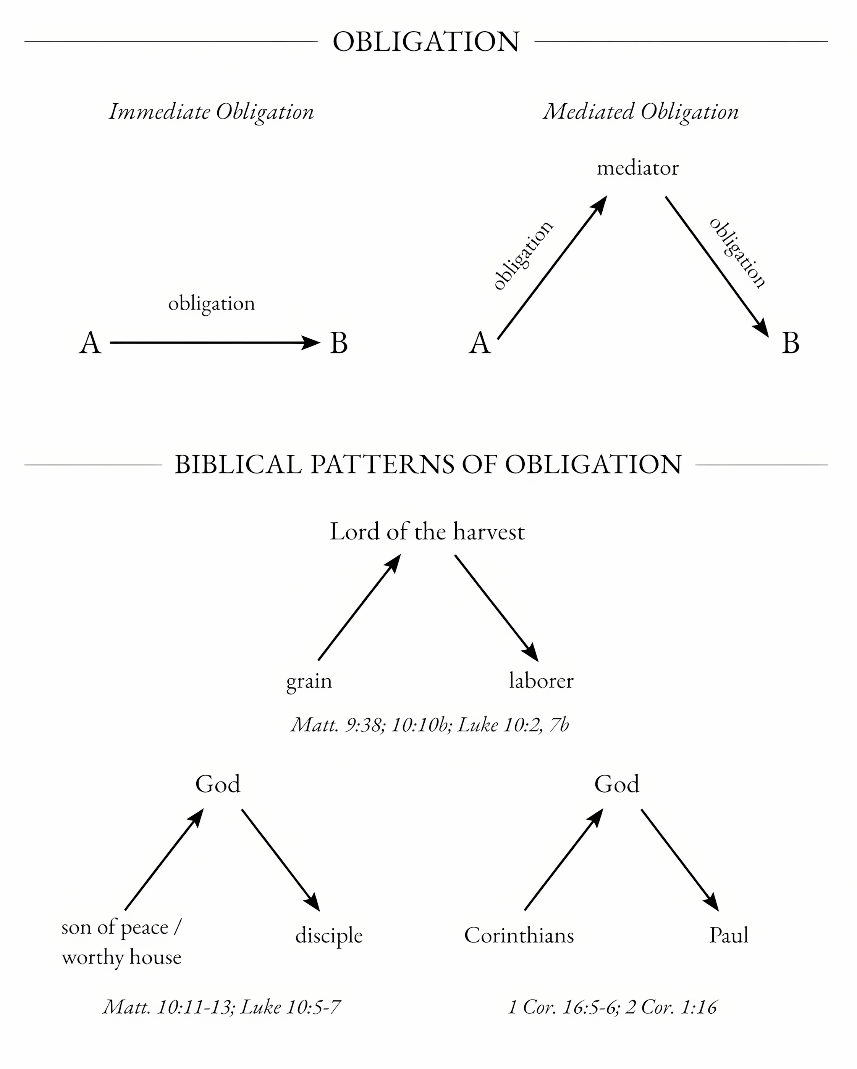
Jesus’ missionary discourse places the laborer’s wage within this mediated structure. Immediately before sending the disciples, Jesus identifies them as laborers whom “the Lord of the harvest” sends into his field (Matt 9:37–38; Luke 10:2). As we saw previously, God is the employer within the controlling metaphor. The disciples announce the kingdom freely, while God provides through the hospitality of a worthy household or “son of peace” (Matt 10:8–13; Luke 10:5–7). Luke calls this provision the worker’s μισθός, while Matthew describes it as his τροφή (trophe), his food or sustenance (Matt 10:10; Luke 10:7).
Paul’s argument in 1 Corinthians 9 follows this same triangular pattern. The Corinthians may supply his needs, but they do so as people accountable to God for the advance of the gospel, not as customers purchasing apostolic ministry. First Timothy 5 places the elder within a similar triangle of obligation. Earlier in the chapter, Paul commands the Church to “honor” (provide for) widows who are truly in need and describes a recognized group of widows known for faithful service (1 Tim 5:3, 9–10). Their material support is not calculated as a fee for each act of hospitality, but instead, the Church supports them because God commands his people to care for faithful servants who lack sustenance. When Paul then calls for “double honor” toward elders and supports the command with the sayings concerning the ox and the worker’s wages, the same mediated structure remains in view (1 Tim 5:17–18).
Thus, the distinction between wages and sales may be stated more precisely. A ministerial wage is provision that God appoints for the laborer and ordinarily supplies through the fellowship of his people; a sale makes the recipient’s payment the condition for obtaining the ministry itself. In the first arrangement, the Church says, “Because God has called you to labor among us and has commanded us to honor that labor, we will provide for you.” In the second, the minister says, “I will not provide any spiritual benefit unless you pay me.”
Salaries, Contracts, and Honoraria
The mediated character of support does not require it to be irregular, unpredictable, or informal. A salary may serve as an orderly means by which a congregation fulfills its continuing obligation to God concerning one who labors continually among them. Yet the existence of such an arrangement does not determine the moral nature of the ministry. The underlying question remains as to whether it organizes the Church’s obedience to God or assigns purchasable prices to spiritual benefits. A healthy salary frees the minister to pursue the common work of the Body and remains unaffected by the ability of particular hearers to pay. It does not divide ministry into billable units, grant wealthy members greater claims upon the minister, or make the delivery of biblical truth contingent upon individual payment. Regular provision may therefore remain thoroughly collaborative, while an apparently spontaneous “gift” may be reciprocal if it is understood as repayment for ministry already received.
For example, a listener may freely hand a preacher $100 after hearing a sermon. Outwardly, the gift looks the same in either case; the difference lies chiefly in the giver’s heart and in the obligation he believes he is fulfilling. If he thinks, “The preacher gave me something, so I now owe him repayment,” the gift is reciprocal, even though no price was announced. If he thinks, “God has called me to support this work, and I want to help this preacher continue serving others,” the same gift expresses co-labor. The giver’s internal motivation matters.
A salary is not sanctified merely by being called “support,” and an honorarium is not condemned merely because it accompanies a particular occasion. The arrangement must communicate that the giver and minister are fellow servants of God, rather than customer and vendor exchanging money for ministry.
The Wages of Balaam
The use of μισθός in the warnings concerning Balaam confirms that the noun itself carries no fixed moral connotation. Peter says that Balaam “loved the wages [μισθὸν] of unrighteousness” (2 Pet 2:15), while Jude describes false teachers who rushed into Balaam’s error “for gain [μισθοῦ]” (Jude 11). But, as we have seen, 1 Timothy 5:18 employs the same noun for the rightful provision of the faithful worker. So, the moral difference lies in whether the reward supports faithful labor or rewards corrupt service, as well as in the obligation and relationship surrounding the payment.
Balaam’s error lies in bending his ministry toward the reward Balak places before him. The payment thus operates reciprocally: the patron offers compensation in order to secure a desired prophetic result, and the prophet’s desire for that compensation corrupts his relation to the Word entrusted to him.
The elder’s wages in 1 Timothy 5 arise from the opposite structure. He labors under God’s commission, and the Church provides for him under God’s command. His ministry remains governed by the truth and directed toward the good of the whole Body, while his support comes through co-labor among fellow servants. Balaam allows gain offered by man to direct his prophetic conduct; the elder receives provision ordered by God so that he may continue in faithful conduct. Scripture can therefore command wages, condemn the withholding of wages, and denounce the pursuit of Balaam’s wages without inconsistency (Deut 24:14–15; 1 Tim 5:17–18; Jas 5:4; 2 Pet 2:15; Jude 11).
Historical Roots
Although the term dorean principle is new, the distinction it expresses is ancient, and appears early in Christian reflection. The Didache, one of the oldest Christian writings outside the New Testament, offers detailed instructions concerning traveling apostles and prophets that bear a close resemblance to the missionary discourse of Matthew 10. Christian communities were expected to receive genuine ministers, provide them with food, and give firstfruits to recognized prophets, since “they are your high priests.” At the same time, the document treats requests for money and the exploitation of hospitality as signs of corruption, calling the one who does so a “Christ-monger” or Christ-seller.2 So, the concern of antiquity is twofold: the community owes provision to faithful ministers, while ministers must preserve the sacred character of their calling from commercial manipulation.
Other early sources display the same instinct. The Shepherd of Hermas contrasts the true prophet with the one who prophesies in response to payment and whose speech is governed by the expectations of wealthy patrons.3 Apollonius of Ephesus criticized the elaborate financial arrangements that had grown around Montanist prophecy, including salaries, gifts, and the collection of money through appointed agents.4 Tertullian summarized the Christian ideal by declaring that there was no buying and selling in the things of God.5 Such testimony does not carry the authority of Scripture, nor does it prove that the early Church consistently embodied its own convictions, but it does show that Christians living near the apostolic period recognized a meaningful distinction between sustaining ministers and trafficking in spiritual things.
The subsequent history of the Church demonstrates how easily that distinction may be lost. Sacred offices, masses, relics, indulgences, and promises of spiritual benefit gradually became entangled with systems of payment and privilege. The term simony, drawn from Simon Magus’s attempt to purchase spiritual power (Acts 8:18–24), expanded to describe commerce in ecclesiastical office and other sacred realities. The indulgence controversy at the dawn of the Reformation exposed the grotesque consequences of an economy in which assurances of spiritual benefit were connected to financial transactions. Reformers such as Luther opposed this commerce while continuing to affirm the duty of congregations to maintain their pastors. Their protest arose from the conviction that grace possesses a mode of communication appropriate to its divine origin. It may be proclaimed by ministers who receive ordinary provision, but it comes to the sinner as the gift of God.
Therefore, the historical roots of the dorean principle lie in a recurring Christian effort to preserve both generosity toward ministers and ministry that is clearly uncommercialized. At its best, the Church has recognized that these commitments strengthen rather than undermine one another. Well-supported ministers are equipped to serve with diligence and stability, while freely given ministry displays the priceless nature of the spiritual truth imparted and the lavish heart of the God who is its source. Commercialization introduces a sinful distortion, converting the recipient’s need for spiritual good into leverage for institutional or personal gain.
Scripture, Translation, and Christian Publishing
The dorean principle bears directly upon the stewardship of Scripture. Bible translation, editing, typesetting, software development, teaching, and publication all require substantial human labor. Translators may devote decades to acquiring languages, studying the biblical text, consulting communities, revising drafts, and resolving difficult exegetical questions. Editors, programmers, designers, administrators, and consultants contribute additional forms of expertise. Therefore, faithful stewardship includes provision for the people who undertake this work. If such a translation endeavor is warranted and worthy, Churches and donors should regard their support as participation in the ministry of the Word. The worker’s wage is a legitimate and necessary expense of the mission.
A funding model shaped by the dorean principle seeks to provide for this labor in a manner that allows its spiritual fruit to circulate freely. Churches, ministries, foundations, and individual believers may fund translation and publishing at the stage of production, treating their contributions as offerings to God and investments in the edification of the Church. The completed work can then be released for unrestricted copying, translation, adaptation, recording, and distribution. Such a model directs money toward the creation of ministry rather than deriving continuing revenue from control over those who receive it (see Phil 4:15–18).
Physical books introduce genuine material costs. Paper, ink, binding, warehousing, and transportation are scarce goods whose production requires funding. A print edition may therefore be sold at a price reflecting the cost of manufacturing and delivery without thereby assigning a price to the divine revelation it contains. The distinction becomes especially clear when the same text is available digitally without charge or legal restriction. In such a case, the price belongs to the physical artifact and the services required to place it in the reader’s hands. Money derived from exclusive control of the spiritual content presents a different arrangement, particularly when readers must purchase permission to quote, translate, record, distribute, or adapt the text.
Licensing conditions may establish reciprocity even when no money is demanded. Requirements of attribution, prohibitions on commercial use, restrictions on adaptation, distribution limits, and permission procedures impose continuing obligations upon the recipient. The giver retains a measure of authority over the subsequent use of what has ostensibly been “given.” Public-domain dedication offers a more fitting expression of dorean ministry because it relinquishes that continuing claim and entrusts the work to the Church at large. The ministry may continue to raise funds, identify itself as the original source, publish authoritative editions, correct errors, and invite supporters into future projects. Its financial stability rests upon God’s provision through the generosity of those who believe in the work, rather than upon legal restraints placed around its fruit. The result is an economy of stewardship in which the people of God collectively bear the cost of ministry so that access to its spiritual benefit may extend far beyond the circle of those who financed it.
Conclusion
The dorean principle offers a coherent account of the biblical teaching on ministry and money by holding together passages that are too often separated and explaining those that are frequently misunderstood. The texts we have examined establish an ordered relationship in which the people of God generously sustain ministry while ministers communicate spiritual goods according to their priceless nature and the free manner in which they were received.
Copyright & Jesus’ Command to Freely Give
―❖―
All the believers were together and shared everything they had. – Acts 2:44
In the mid-sixth century, an Irish monk named Finnian traveled home from Rome. Excitement gripped him, for he had come in possession of a great treasure: a Bible. While he certainly had access to some Scripture in his hometown, this Bible represented a purer and more complete copy than anything he owned, and all in a single volume. Nearby monks heard of Finnian’s new prize, and many came from significant distances to see it. It more than pleased Finnian to show it off, yet all the same, he was rather possessive of his book.
Among those who visited was a monk named Colmcille, a charismatic, young redhead. He was equally excited by the Bible, so much, in fact, that he sneaked into the church where it was kept in order to spend the night copying it. He administered a scriptorium nearby and anticipated the opportunity to reproduce and disseminate the Scriptures on a grander scale. When Finnian discovered the act taking place, he became furious. Soon afterward, he pursued litigation.
Both men requested an audience before the High King Diarmaid for arbitration, each one confident that justice would rule in his favor. Finnian argued that because the book was his, the copy was his as well. Colmcille responded, offering his defense:
My friend’s claim seeks to apply a worn out law to a new reality. Books are different to other chattels (possessions) and the law should recognize this. Learned men like us, who have received a new heritage of knowledge through books, have an obligation to spread that knowledge, by copying and distributing those books far and wide. I haven’t used up Finnian’s book by copying it. He still has the original and that original is none the worse for my having copied it. Nor has it decreased in value because I made a transcript of it. The knowledge in books should be available to anybody who wants to read them and has the skills or is worthy to do so; and it is wrong to hide such knowledge away or to attempt to extinguish the divine things that books contain.1
To Colmcille’s shock, the king ruled in Finnian’s favor. Many speculations surround this event. Perhaps it represented an unbiased attempt at justice, or perhaps the court counselor, a druid, sought to hinder the advancement of Christianity. Regardless, the details of the story certainly make for interesting considerations.2
In our day, access to efficient copying is vastly more widespread than it was in Colmcille’s. Through the digitization of information, even a child can reproduce a book in near-infinitesimal time at near-infinite quantities. Through the internet, that same work may be disseminated to nearly every person on the planet. If the fiery monk worried that outdated laws would hinder the advancement of the gospel in a new era, how much more should we revisit those same concerns?
Copyright and Obligation
Defined broadly, copyright is any legal mechanism that regulates the reproduction and use of creative works.3 While copyright offers legal protections to authors, it simultaneously restricts the freedoms of those who consume creative works.
Scripture’s teaching on freely giving ministry should lead us to question the Church’s use of copyright protection mechanisms in the context of gospel ministry.4 If a minister is to give freely, has he really done so if he retains exclusive rights to the content of his proclamation? In my estimation, the answer is a resounding no.
Even though maintaining full copyright protection does not necessitate an exchange of money, it does impose a burden on the recipient of ministry. Apart from express permission, he may not copy, modify, or redistribute that work, the information he has received. Note that this imposes a requirement, requirement being the innermost circle of the forms of acceptance that violate the dorean principle.5 As such, it is the most serious form of violation. Moreover, typically, money is involved in the exchange. Ministers refuse ministry—in the form of books, recorded lectures, etc.—apart from a payment collected from the recipient.
Additionally, the involuntary nature of copyright precludes colabor (the voluntary support of ministry in obligation to God). One who complies with legal restrictions does not offer a freewill sacrifice to the Lord but only a concession to the one protected by the law. One who gives money to receive access to gospel-related material does so only as an exchange, compensating another to settle a debt owed to him.
Copyright and Sincerity
Stepping back and examining things through the lens of sincerity, we must question the earnestness of one who asserts all copyrights over the content of their ministry. If they impose restrictions or require payment, can they truly say that they operate as a servant of Christ (cf. 1 Cor 9:16)? If they impose restrictions or require payment, can they truly say that they are a servant to all so that more might be won (cf. 1 Cor 9:19)?
To be clear, I think highly of fellow pastors who have writing ministries, many of whom engage in the kind of exchanges forbidden by the dorean principle. Most have never directly faced this issue and therefore have made their decisions in ignorance. In a sense, I hold nothing against them because I likely would have taken the same steps had I never been led to especially ruminate on the passages we’ve examined. However, all this being said, I cannot ignore the logical conclusion of what the Bible says about sincere ministry. From a human perspective, the error is understandable. From a divine perspective, these models of ministry culpably transgress Christ’s plan for the advancement of the gospel.
While the day-to-day activities of the local church largely remain within the boundaries set by the dorean principle, the advent of the Christian publishing industry has introduced breaches of sweeping proportions. Believers who want to deepen their knowledge of the faith frequently find themselves required to give to an author or publisher (i.e., the copyright holder) before receiving the benefit of some ministry. The issue goes much further than books, encompassing Bible study software, performance rights for worship songs, etc.
Of course, it has not always been this way. While the dorean principle has always been in danger of being violated, for the majority of the life of the Church, there were relatively few opportunities for temptation or confusion to arise. However, the advancement of publication technology, especially as it has culminated in digital media, has presented the Church with a test of faithfulness. Unprepared for the challenge set before her, the Church has blindly followed the model of the world in its publication practices, distributing materials for a fee. Additionally, as the cost of reproduction and distribution wanes, being virtually negligible for digital content in the present era, the severity of transgression waxes stronger. Prior to the twentieth century, to purchase a book was to purchase a bound edition of printed pages. One was not paying for the content so much as they were paying for the tangible product as a whole, a matter of limited ethical concern. Today, a physical book and its content are more easily distinguished as paper and data. While people still purchase paper books, the sale of e-books indicates that publishers intend to charge not only for the physical good but also for the content. A completed work may be disseminated online to millions at no cost to the producer, yet ministering entities often default to charging for this service.
Not only does the use of copyright protection have potential to violate the dorean principle, but in most instances, it constitutes the most direct violation conceivable. Regardless of the intent of those behind such ministries, to require payment in exchange for religious education is to engage in the practices condemned by both Scripture and the early church.6
Alternative Licensing
Simply stated, the antithesis of using the power of governing authorities to enforce copyright is not using the power of governing authorities to enforce copyright. However, under United States law, a creative work is protected by copyright as soon as it is fixed in a tangible medium. A minister who has no intention of taking advantage of these protections must go out of his way to explicitly waive his rights if he wishes to assure others they are free to use the creative products of his ministry however they wish.
To that end, institutions have fashioned a variety of licenses. The earliest of these licenses were largely designed to accommodate collaborative software projects,7 but more recently, initiatives have addressed the needs of non-software (i.e., non-functional) projects. The most popular of these, Creative Commons,8 is not a single license but a suite of licenses designed to give copyright holders the ability to mix and match specific rights they would like to reserve or waive. Each Creative Commons license ensures that a work may be distributed in its original form, but additional restrictions may apply. As an exercise, I’d like us to take a look at these restrictions and evaluate their implications for dorean ministry.
Adaptation: The first option available for a Creative Commons license is the No Derivatives feature. One who applies this to their creative work restricts others from making adaptations of that work. For a book, this would prohibit translations and audio adaptations. For a song, this would prohibit musical rearrangements and public performances. Anyone wishing to make such adaptations would be required to obtain express permission from the copyright holder.
Such restrictions do not accord with the dorean principle. The recipient of ministry should not be bound to comply with the wishes of the minister. It is not sufficient to talk merely in terms of financial burden; all forms of burden (i.e., direct, horizontal obligation to the minister) fall in the same category. These stipulations do far more to hinder the gospel than advance it.
One may object that allowing adaptations opens a work to distortion and perversion. True; but at a fundamental level, all good things may be corrupted. Further, the history of Christian resources testifies that works available for adaptation encourage more good than they do harm. For example, Joseph Smith (the founder of Mormonism) produced a modified version of the King James Bible in order to promote his aberrant beliefs, yet few would argue that the harm caused by this document outweighs the proliferation of the Bible in audiobooks, tracts, study Bibles, and dramatic readings, all made possible through the availability of the King James Version. Most importantly, such pragmatic objections cannot dominate the principled concern of dorean ministry.
Commercial Use: Creative Commons additionally provides a Noncommercial feature, which prohibits use of the creative work for commercial purposes. For example, this would keep one from directly selling the licensed material, or incorporating it into a derivative work that is then sold.
From a secular perspective, this feature has received substantial pushback due to the inherent ambiguity in the concept of “commercial purposes.”9 The text of the licenses using this feature speaks specifically of uses that are “primarily intended for or directed toward commercial advantage or private monetary compensation.”10 Even if it is not sold in a traditional fashion, an entity that uses a work licensed for noncommercial use in a way that supports a commercial endeavor potentially violates the terms of the license.
Regardless, the guidelines we have already set give us a clear path forward. Restricting uses of a product of ministry, even commercial uses, does not accord with the dorean principle.
Attribution: The most commonly used option of a Creative Commons license is the Attribution feature. This requires that anyone distributing the original licensed work or a derivative credit the copyright holder. For example, a Bible translation licensed with this feature would require that any tract quoting it credit the copyright holder of the translation.
In several ways, this seems more reasonable than the previous restrictions we have covered. Unlike those, the requirement of attribution does not imply friction between the consumer and the copyright holder for typical adaptive uses. For the other restrictions, typical uses require explicit authorization from the copyright holder in order to proceed. Attribution, on the other hand, may be provided by anyone downstream apart from any interaction with the copyright holder.
However, from the perspective of dorean ministry, there is no reason to classify this condition as fundamentally different. Even if no money changes hands, it imposes a direct obligation on the recipient of ministry to the minister. It should therefore be rejected in the context of gospel ministry.
Naturally, the primary concerns over waiving the right to attribution center around plagiarism and misattribution. Unfortunately, the complexity of the current situation makes it difficult to provide a simple response. Copyright law is designed to address matters related to the eighth commandment (thou shalt not steal), yet it has been co-opted to address matters related to the ninth commandment (thou shalt not bear false witness). Measures to inhibit plagiarism should certainly be welcome, but it is not clear that copyright enforcement was ever the right solution. Defamation laws may offer some alternative protection and perhaps the technology of the future will provide more immediate detection of such misappropriation. Regardless, in the course of ministry, a Christian’s first priority should be the honor of Christ rather than security of credit.
License Propagation: A frequent feature of alternative licenses requires all derivative works, provided they are disseminated, to be made available under the terms of the same license. This is known as copyleft11 and guarantees that a creative work is not used and repackaged under more restrictive terms. To this end, Creative Commons provides a Share Alike feature.
This particular feature does not require explicit permission from the copyright holder for typical adaptive use. Furthermore, it seems to have the added benefit of encouraging others who might use ministry materials in a similar context to embrace the same licensing scheme. For these reasons the Creative Commons Attribution-ShareAlike License (CC BY-SA)12 has been a favorite among many, and continues to be promoted in the world of Bible translation.
In the context of ministry, the ShareAlike feature has a natural appeal. For one who cares about the no-cost distribution of ministry materials, CC BY-SA ensures that derivative ministry materials are also distributed at no cost. One who writes a book and offers it gratis would certainly be disappointed to see another translate the book only to sell it.
Yet, there are several reasons why applying this feature is problematic.
An objection considered
Some have asserted that Creative Commons Attribution Share-Alike actually advances biblical concerns. Consider the following image from Unfolding Word:19
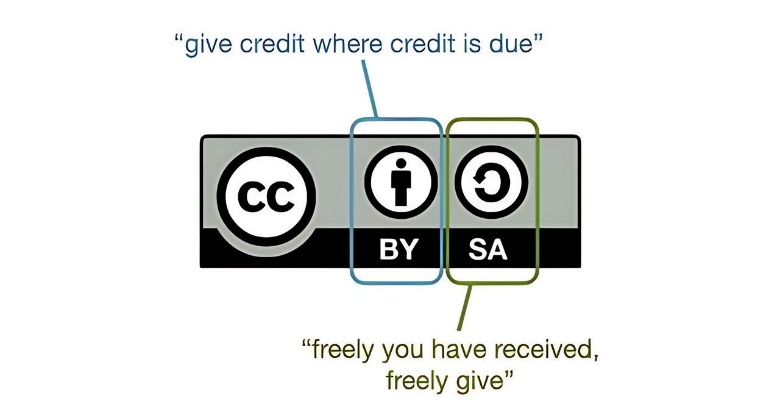
An attempt at a biblical justification for CC BY-SA
Presumably, “give credit where credit is due” is an allusion to Romans 13:7. While we could take issue with both the selective translation and application of this text, our present concern is ShareAlike rather than Attribution. Here, the graphic implies that the ShareAlike feature promotes the kind of freely giving Jesus commanded in Matthew 10:8.
First, we should consider who primarily has the obligation of freely giving. It is the minister who is charged with giving freely, not the recipient of ministry. This choice of license restricts the recipient of ministry, not the minister. Moreover, because it restricts the recipient of ministry, it actually entails a lack of free giving on the part of the minister. He has saddled the recipient with obligations for how they may use what they have received (see reason 2 above).
Second, if imposing these restrictions is not freely giving, then any recipient of such ministry may not freely give it either, since they are required to maintain the same license on any derivative work. Perhaps one would argue that this is begging the question, since I’m assuming that these licensing restrictions truly are burdens at odds with freely giving. Granting that for a moment, consider the very real scenario where one who shares the convictions of this article receives a CC BY-SA work from some ministry. If he wishes to build on top of it, making a derivative work to bless others, his hands are tied. He is unable to dedicate it in the public domain as he considers right. In this case, an attempt at generosity has hampered further generosity.
Third, the command to freely give is as much a command to internal attitude as it is outward actions. Offering the word of God freely is to go hand in hand with gospel sincerity (1 Corinthians 2:17). Yet, the threat of litigation does nothing to promote such generosity. In fact, if the recipient freely offers what he has received, it is only because he has no other way to redistribute this resource. Forced charity is no virtue at all (2 Cor 9:7). In fact, at this point, the ministry who originally chose a Share-Alike license is guilty of violating the pattern set by Paul in 2 Corinthians 9: to encourage giving without it being a matter of compulsion. This is not to say the one who redistributes a CC BY-SA work is required to do so, but if they do, they are required to do so without charging under threat of penalty.
Fourth, we should consider that it was possible to freely give long before copyright ever existed. To consider this licensing scheme as essential to the end of promoting the command of Christ is simply anachronistic. Perhaps one may not go as far as to consider it “essential,” yet this approach still represents a radical departure from that which Jesus actually advocated. His kingdom is not one of this world, and he did not advance it with the sword. By employing the threat of penalty through law and the power of government force, we are not simply using a modern mechanism to reach the same end but adopting a different strategy altogether.
While the ShareAlike feature of Creative Commons licenses seems to promote free access and sharing of ministry materials, it prohibits truly free access. Ministries should abandon this feature of the Creative Commons license as well as any other restriction. It is only through waiving every claim to works of ministry that the gospel may be freely given as it was freely received. For this we turn to the public domain.
The Public Domain
Beyond various licenses, another option exists. A public domain work is a work that is not subject to copyright protection. Placing a work in the public domain is not always straightforward, especially in jurisdictions that acknowledge and do not allow for the waiver of “moral rights,” which include, among other things, the right to attribution. In order to provide a simple approach to this, Creative Commons offers the Creative Commons Zero Public Domain Dedication. Rather than a license, it is a waiver of rights that provides a license fallback in the event the waiver is deemed insufficient. This dedication states the intent of the author to provide maximal freedom to any consumer of the work.
In my estimation, a public domain dedication such as Creative Commons Zero offers the most consistent approach for dorean ministry. While the dorean principle does not mandate that a minister explicitly apply such a dedication to his work, it does require the spirit of such a dedication be present in all acts of gospel ministry.
The Specter of Copyright Hijacking
A question occasionally arises at this point: Couldn’t another party republish that content and claim it as their own? Further, couldn’t they then take legal action against the original creator who hadn’t claimed copyright?
For lack of a more official term, I’ll refer to this as “copyright hijacking.”
1. The Public Domain Is Not New Ground
Often, people have this concern because they believe the public domain is untrodden territory, and they would be taking a relatively new risk that others have not. This simply isn’t the case.
Innumerable older works are already in the public domain and have been for a long time. While someone could claim authorship of older works and then use this to litigate others who might republish, we’re not aware of any cases where this has happened.20
Works by the US Government are in the public domain. This would include the speeches of government agencies as well as any information produced directly by them and not some third party contractor. These comprise millions of documents and recordings. Once again, we’re not aware of any case where someone has claimed ownership of one of these works and then used that claim to litigate others.
Other public domain dedications have been around for some time. The most popular of these, Creative Commons Zero, has been in frequent use since 2009.21 If copyright hijacking is such a serious threat for works dedicated to the public domain, where are the manifold examples of a Creative Commons Zero work being hijacked in this way?
2. Copyright Hijacking Is Not Legal
Perhaps the main reason folks worry about copyright hijacking is because they imagine it is legal. However, it is not. If one waives their rights to a work, there is no legal ground for another party to come along and claim those rights exclusively.
The Berne Convention (an international copyright treaty) addresses these matters with common sense. Rights are granted specifically to authors, not publishers or other distributors.22 Someone may falsely claim to hold the rights to a work “in the absence of proof to the contrary”, but this “shall cease to apply when the author reveals his identity and establishes his claim to authorship of the work.”23 Likewise, in the United States, one has to be the author of a creative work or receive a license from that author in order to claim exclusive rights.24 Apart from such licensing, no prosecution would have legal standing. Any evidence of prior authorship would immediately render the claim invalid.
In fact, a claim to ownership over a work authored by another and dedicated to the public domain would not only be invalid but potentially would even be subject to litigation. One photographer who had dedicated her images to the public domain brought a lawsuit25 against Getty Images for claiming ownership of her photos. The court agreed with Getty that the public domain photos could be commercialized but it also upheld the photographer’s claim26 that Getty was acting deceptively by claiming ownership of them. While the parties involved ended up settling outside of court, it is evident from this case that you cannot claim exclusive rights to a public domain work, and even large corporations can’t get away with falsely claiming ownership.
These are basics when it comes to copyright.27 Simply put: when one waives exclusive rights, that exclusivity does not become “up for grabs.”
3. Asserting “All Rights Reserved” Does Little to Prevent Copyright Hijacking
Even if one does claim “all rights reserved” on a creative work, it does little to prevent copyright hijacking.
Regarding unintentional actors, there are some instances where a public domain work, because it is freely available, may be added to a system designed to detect unauthorized copies. By all appearances, this is what happened in the Getty Images case. However, other well-known phenomena like the frequency of false YouTube copyright strikes on original content make it evident that platforms will often claim third party ownership even of fully copyrighted works. In either case, legal recourse is available.28
Regarding malicious actors, there is no difference. One could just as easily claim authorship/exclusive rights to work that is dedicated to the public domain as they could to a work that is not. Criminals don’t stop simply because you put a sign up that says, “You’re not allowed.”
4. Copyright Registration and Public Domain Dedications Are Not Mutually Exclusive
If even works with “all rights reserved” are subject to copyright hijacking, what is the remedy? The generally recommended solution is copyright registration. By registering with the copyright office, you make some public record that could assist you in the event of litigation and would even be necessary if you were the party filing legal action.
In fact, this is exactly the same approach one can take with a work dedicated to the public domain. Dedication to the public domain does not change whether a work can be registered. Stated differently, what you intend to do with the work and how you intend to license the work does not affect the authorship of the work.
Of course, this registration process takes several months29 and costs $65.30 Depending on the quantity of creative works your ministry produces, registering each could become onerous. Furthermore, legal protection still exists even without this registration, which is why few choose to pursue this route with most forms of creative works. Practically, uploading your work on a third party website like archive.org under your own account would provide equivalent evidence of authorship while being both quick and free.
5. Principle Trumps Pragmatism
Finally, it’s important to ask such hypothetical questions about copyright with the right mindset. There are commendable ways of approaching this concern:
How do I dedicate my work in the public domain responsibly so that I don’t open myself or others up to unnecessary harm?
Are there any implications to the public domain that would prove inconsistent with other moral imperatives in Scripture?
There are also less honorable approaches. For example:
Regardless of what Jesus commands, what approach seems like it will ensure my ministry has the most success?
What justifications can I find for withholding generosity in ministry?
While we should walk by faith and not by sight in every area of life, this is especially true in the work of ministry. In fact, the Bible specifically tells us that pragmatic (results-oriented) approaches to generosity typically don’t play out as one would expect.
One gives freely, yet gains even more; another withholds what is right, only to become poor. (Prov 11:24)
Let me encourage you to take a step back and examine your heart around whatever concern you may have regarding copyright hijacking. While copyright hijacking is a real thing, it is a rare threat and should not be a major concern for ministries. Moreover, the difference between asserting “all rights reserved” and making a public domain dedication has little impact on whether a work would be subject to copyright hijacking.
As such, a ministry’s decision to dedicate their works to the public domain should not be influenced by such pragmatic concerns. Instead, it should be based on their desire to generously follow the command and example of Christ.
Conclusion
To restrict others in their use of any product of gospel ministry is to require direct repayment—i.e., reciprocity—and violate the dorean principle. In not so many words, it says, “If I provide this ministry to you, you must do something for me.” Furthermore, employing the power of governing authorities to coerce others to comply with such restrictions adds an objectionable level of hostility to the transgression.
In response, ministers and ministries should consider waiving any government-established copyright protections.31 For most creative works and in most jurisdictions, this may be done effectively through the use of Creative Commons Zero.
Copyright as a Perversion of Justice
A Biblical and Natural Law Critique
―❖―
Do not participate in the unfruitful works of darkness,
but instead expose them. – Ephesians 5:11
atural law has long occupied a central place in Western legal and political thought. In its broadest sense, it teaches that there is a moral order prior to and higher than human legislation. While positive law is made by rulers, courts, and legislatures, natural law judges such enactments by a standard rooted in reality itself. For the Christian, however, this order is not grounded in autonomous nature or unaided reason, but in the Creator. “Yahweh is our judge, Yahweh is our lawgiver, Yahweh is our king” (Isa 33:22). Creation reveals his glory (Ps 19:1), and his invisible attributes are perceived through what he has made (Rom 1:20). Thus, any Christian account of natural law must begin with God, not with nature as an independent authority. Classical natural law, especially in the Thomistic tradition, emphasized objective moral order, human duties, virtue, and the common good. Human beings were created with a purpose and were to live according to the moral structure God had built into creation.1
Our goal in this chapter is to ask whether intellectual property (IP)2 is legitimate in light of natural law and Scripture. If property is a natural right, does that right extend to ideas, texts, inventions, and artistic works? Or is intellectual property a state-created monopoly that restricts the natural liberty of others?
Natural Law in Scripture
Paul teaches that Gentiles, though lacking the written Mosaic law, “show that the work of the law is written on their hearts” (Rom 2:15). Creation testifies externally, and conscience testifies internally. Yet this moral knowledge is not saving knowledge. Fallen humanity suppresses the truth in unrighteousness, and sin darkens the mind (Rom 1:18). So, natural law renders mankind accountable and sustains civil order, but it cannot replace Scripture or redeem the heart.3
The Bible repeatedly appeals to nature as a witness to divine order. Jeremiah rebukes Israel by contrasting their disobedience with the instinctive obedience of birds: “Even the stork in the sky knows her appointed seasons. The turtledove, the swift, and the thrush keep their time of migration, but my people do not know the requirements of Yahweh” (Jer 8:7). Proverbs makes a similar appeal: “Walk in the manner of the ant, O slacker; observe its ways and become wise” (Prov 6:6, also 30:25). Creation displays patterns of wisdom, order, diligence, and dependence that rebuke human folly.
Jesus likewise directs his disciples to nature when teaching them not to worry. Birds and lilies become witnesses against unbelieving anxiety because they live under the Father’s care (Matt 6:26, 28). Paul follows a similar pattern in Athens, reasoning from creation and providence before Epicurean and Stoic philosophers (Acts 17:26–27). He concludes that God cannot be reduced to “gold or silver or stone, an image formed by man’s skill and imagination,” since “in him we live and move and have our being” and “we are his offspring,” (Acts 17:28–29). Thus, Scripture teaches us to look at the world God has made and discern what it reveals about his order, his purposes, and the moral shape of reality.4
Peace & Property
The biblical concept of shalom is often translated as “peace,” but it encompasses far more than the mere absence of conflict. Shalom refers to a state of wholeness, harmony, well-being, and right relationship in which people are free to flourish according to God’s design. Scripture consistently portrays this state as a blessing that accompanies righteousness, justice, and obedience to God. Yahweh promised Israel that covenant faithfulness would result in peace and security in the land (Lev 26:3–6), while the Psalms describe peace as the fruit of righteousness and upright living (Ps 34:14; 37:37). The prophets likewise connect peace with justice and righteousness, declaring that “the effect of righteousness will be peace” (Isa 32:17). Jeremiah speaks of God’s desire for the welfare and peace of his people (Jer 29:11), and the New Testament exhorts believers to pursue peace with everyone (Rom 12:18; Heb 12:14).
Throughout Scripture, peace is closely connected to justice, respect for one’s neighbor, and the security of one’s life, family, and possessions. The Mosaic Law repeatedly forbids theft, fraud, coveting, oppression, and violence (Ex 20:13–17; Lev 19:11–13; Deut 24:14–15), thereby establishing boundaries around persons and property that allow peaceful coexistence. The commandment “You shall not steal” (Ex 20:15) protects property, while the prohibitions against murder and coveting protect both persons and possessions (Ex 20:13, 17). Scripture also condemns the use of dishonest scales and fraudulent business practices (Prov 11:1; 20:10), recognizing that economic injustice disrupts peace and harms one’s neighbor. In this sense, biblical shalom rests upon the principle that individuals ought not initiate force, theft, fraud, or oppression against one another, but should instead respect the God-given stewardship and responsibilities of their neighbors.
Scripture grounds this principle in God’s moral order and human beings’ status as his image-bearers (Gen 1:26–27; 9:6). A peaceful society is one in which people do not steal, assault, defraud, or otherwise invade the legitimate sphere of another. Such conduct is repeatedly condemned throughout Scripture (Ex 21:16, Mic 2:1–2, Mal 3:5, 1 Cor 6:10). Conversely, believers are instructed to live quietly, mind their own affairs, and work honestly with their hands (1 Thess 4:11–12), while rulers are expected to punish evildoers and protect those who do good so that people may live “peaceful and quiet” lives (Rom 13:3–4, 1 Tim 2:1–2). Property rights serve as a means of preserving this peace by clearly defining what belongs to whom and thereby reducing conflict over scarce physical resources. Scripture summarizes this ethic in the command, “You shall love your neighbor as yourself” (Lev 19:18, Matt 22:39), for genuine peace is found where people honor God and refrain from harming one another.
The Derivative Nature of Human Possession
Scripture affirms personal property, but never as absolute ownership detached from God. “You shall not steal” (Ex 20:15) presupposes that one person may rightly possess what another may not take. “You shall not covet” (Ex 20:17) likewise confirms the reality of goods outside one’s possession. Yet Israel’s law also limits property by justice and mercy. Landowners were commanded to leave gleanings for the poor and the foreigner (Lev 19:9–10) and the land itself ultimately belonged to Yahweh (Lev 25:23). Biblical property is real, but it is stewardship under God and must serve love of neighbor.
Thomas Aquinas provides a helpful classical framework for understanding this biblical view of property.5 He begins by affirming that God alone possesses absolute dominion over creation: “The earth is Yahweh’s, and the fullness thereof” (Ps 24:1). External things,6 considered in their nature,7 belong to God alone, since only God is sovereign over creation. Yet this does not mean that human beings have no true dominion over created things. Aquinas distinguishes between the nature of external things and their use. The use of the material universe has been entrusted to man. This delegated dominion is grounded in creation itself, for God made man in his image and gave him rule over the earth (Gen 1:26–28, Ps 8:6). Thus, human ownership is a subordinate stewardship exercised under the lordship of the Creator.
Aquinas also argues that private property is lawful and useful for human life. Though the earth is given by God for the sustenance of mankind, private possession helps preserve diligence, order, and peace. People care more responsibly for what has been particularly entrusted to them; society functions with more order when specific persons are charged with specific goods; and peace is better preserved when each person knows what is his own.
Theft is possible only where there is some rightful distinction between what belongs to one person and what belongs to another. Yet Aquinas insists that ownership must never be treated as absolute exclusion. A man may possess goods as his own with respect to procuring and managing them, but he must use them as common in the sense that he remains ready to share with those in need. Thus, Paul commands the rich “to do good, to be rich in good deeds, and to be generous and willing to share” (1 Tim 6:18). Against the rich fool who said, “my crops” and “my goods” (Luke 12:18), Aquinas reminds us that no creature owns anything principally, as though he had not received it from God.
Notably, Aquinas grounds property entirely in external, created, material goods. He never argues that abstract ideas, information, or other immaterial realities can themselves be owned. Thus, while Aquinas provides a defense of private property in tangible things, he does not affirm the existence of metaphysical property or ownership rights in abstract patterns apart from their physical embodiment.
Locke & Labor
John Locke’s labor theory of property became the most influential natural-rights foundation for later defenses of intellectual property. Locke argued that although God gave the earth to mankind in common, an individual may come to own a particular thing by joining his labor to it. For example, an apple hanging wild on a tree belongs to no one in particular; but when a man picks it, carries it home, and prepares it for food, his labor has removed it from the common supply and made it his own.8
When modern theorists extend Locke’s principles to intellectual property, they construct a straightforward argument: if physical labor can generate property rights, then mental labor should do so even more clearly.9 But Stephan Kinsella explains that this argument rests on a categorical mistake. Labor is not a physical commodity or tangible substance that can be poured into an object; it is a dynamic physical action performed by an actor in real-time. Because actions cannot be owned in the same way physical items are, they cannot be legally mixed with resources to establish an ownership claim. To treat labor as an ownable asset confuses the expenditure of energy with the creation of property boundaries. This mistake leads directly to a confusion between causation and ownership. Just because an individual’s effort alters an object’s shape or value does not mean they have infused it with a magical essence of ownership. As philosopher Robert Nozick famously noted, if you pour a can of tomato juice into the ocean so that its molecules mingle evenly throughout, you do not own the ocean—you simply lose your juice.10 Similarly, expending labor or expressing an idea out into the world does not grant a property right over the surrounding environment or an abstract pattern.11
Therefore, even though authors, inventors, and artists may create valuable works that did not previously exist in that form, their labor is not what grants them ownership, nor does it allow them to own ideas.
Lysander Spooner and Ayn Rand argued on the basis of self-ownership that products of the mind belong to an individual because his mind belongs to him. But the Apostle Paul contradicts this: “You are not your own; you were bought at a price” (1 Cor 6:19–20). The believer’s body, mind, labor, and gifts belong finally to God. This does not deny wages, property, or stewardship, but it does reject the idea that the self is the ultimate source of ownership.
This is especially important in relation to spiritual truths. Peter’s confession of Christ did not arise from unaided human insight; Jesus said it was revealed by “my Father in heaven” (Matt 16:17). Paul likewise says that we have received the Spirit of God
that we may understand what God has freely given us. And this is what we speak, not in words taught us by human wisdom, but in words taught by the Spirit, expressing spiritual truths in spiritual words. (1 Cor 2:12-13)
Spiritual understanding is therefore not merely the product of private genius or autonomous labor. The Christian teacher, theologian, translator, or author may truly labor and may be worthy of support, but the truth he handles is received as a gift. He is a steward of revelation, not the owner of spiritual ideas. As Paul reminds us: “What do you have that you did not receive?” (1 Cor 4:7). Therefore, again, Scripture does not lend credence to the concept of intellectual property, especially in regards to divine truth.
Conflictability
A key natural-rights critique of intellectual property begins with the concept of conflictability.12 Property rights exist to prevent conflict over goods. Two people cannot exercise the same full control over the same field, tool, house, or body at the same time. Naboth and Ahab could not both possess Naboth’s vineyard in the same way. If Ahab had obeyed the law, no conflict would have arisen (1 Kings 21). Therefore, property rights are simply a set of rules that assign a rightful owner to a physical thing so everyone knows who gets to decide how it is used without resorting to violence.
But ideas are different. If someone composes a melody, he is not deprived of that melody if another person learns it. The same is true of methods or words; more than one person may use them simultaneously. A physical manuscript may be conflictable, but the pattern or information embodied in it is not conflictable.13
Stephan Kinsella provides the following illustrations to drive home the distinction between conflictability and non-conflictability:
If I take a bite out of your apple, there is less apple for you. If I drive your car to work, you cannot drive it to work at the same time. Physical matter cannot exist in two places at once. Because these goods are rivalrous, they are inherently conflictable.
If you give me a recipe for apple pie, you still have the recipe. If I build a house using your architectural blueprint, you still have your blueprint, and you can still build your own house. My use of your idea does not reduce your ability to use it. Ideas are non-conflictable.14
Debates about “intellectual property” often suffer from a failure to distinguish between physical things that are owned and their characteristics, which are patterns, features, or ideas connected to those physical things. Kinsella writes,
confusion about the IP issue sometimes stems from identifying “property” with the owned resource. People then get bogged down in loaded or confused questions like, “Are ideas property?” If one keeps in mind that the question is not what is property, but rather who is the owner of a conflictable resource, then the IP mistake is harder to make. A related mistake stems from the failure to understand that all human rights are property rights and all property rights just are rights to the exclusive control of a given scarce (conflictable) resource. But every property right is an ownership right held by a particular person or owner with respect to a particular conflictable resource. It is the actual resource itself which is owned, not its characteristics.
For example, if you own a red car, you own that car, but you do not own its color; you do not own red or redness. If owning a red car meant you owned its characteristics, you would own not only that particular car, but its age, weight, size, shape, color, and so on, and, thus, would thereby have an ownership claim over any other object that is red, and so on. This would amount to reassigning ownership rights in someone else’s red car to you, even though he owns that car and you did not homestead it or obtain it by contract. Likewise, information cannot be owned since it is not an independently existing thing; information is always the impatterning of an underlying medium or carrier or substrate, which is itself a scarce resource that has an owner. If I own a copy of Great Expectations, I own that physical object: paper and glue and ink. It has various characteristics: an age, a size, a shape, and a certain arrangement of ink on its pages—the way the ink is impatterned so that it represents letters and words and meanings to someone who can read and who can observe the features of the book. But just as you don’t own the color of your car, you don’t own the way an object is arranged or shaped.15
As Roderick Long explains:
It may be objected that the person who originated the information deserves ownership rights over it. But information is not a concrete thing an individual can control; it is a universal, existing in other people’s minds and other people’s property, and over these the originator has no legitimate sovereignty. You cannot own information without owning other people.16
Ideas cannot simply be treated as physical property. To do so would require a unique justification, because it grants control over non-conflictable information. More than that, it grants this control by restricting how other people may use their own physical property—their paper, ink, presses, computers, instruments, voices, and bodies.
Ideas are inherently reproducible, and in a digital age, the cost of reproducing most works is negligible. Thus, copyright law is an artificial imposition on the economy of creative works. In the words of May and Sell, “Intellectual property constructs a scarce resource from knowledge or information that is not formally scarce.”17
These observations about the nature of ideas are not new. St. Augustine observed the unique quality of words, noting that they are shared without “withholding them from another” and can be consumed by all without deprivation.18 Thomas Jefferson also wrote:
If nature has made any one thing less susceptible than all others of exclusive property, it is the action of the thinking power called an idea, which an individual may exclusively possess as long as he keeps it to himself; but the moment it is divulged, it forces itself into the possession of every one, and the receiver cannot dispossess himself of it. Its peculiar character, too, is that no one possesses the less, because every other possesses the whole of it. He who receives an idea from me, receives instruction himself without lessening mine; as he who lights his taper at mine, receives light without darkening me. That ideas should freely spread from one to another over the globe, for the moral and mutual instruction of man, and improvement of his condition, seems to have been peculiarly and benevolently designed by nature, when she made them, like fire, expansible over all space, without lessening their density in any point, and like the air in which we breathe, move and have our physical being, incapable of confinement or exclusive appropriation.19
Therefore, once again, nature and basic human logic testify against the premise required for copyright, and this has been recognized by great thinkers for a long time. Conley Owens observes that
the relatively recent advent of copyright regulations demonstrates their nature as purely human inventions, rather than the outworking of natural laws.20 If these regulations were codifications of a divine principle, one would expect such statutes to appear earlier in human history. 21
Additionally, copyright protection is temporary, and its term is set by nothing but legislative choice. This is telling not because genuine property must last forever; Israel’s law itself returned alienated land at Jubilee, since “the land shall not be sold in perpetuity, for the land is mine” (Lev 25:23). The difference is in what the limit is for. The Jubilee reversion restored the property to a definite prior owner. Copyright’s expiry does the opposite: it extinguishes the claim altogether and transfers the subject to no one in particular, because at the end of the term there is no prior owner to whom it can return. A limit that restores an entitlement to its rightful holder reflects the nature of real property. A limit that simply dissolves an entitlement reflects that it was merely a temporary legal privilege all along. This constitutes an implicit concession that “intellectual property” is not property in the truest sense. That some of these legal monopolies endure for twenty years while others extend well beyond a lifetime reveals the fundamentally arbitrary character of copyright law.
The State’s Perversion of Justice
At this point we must ask whether the state may justly create exclusive rights over ideas by limiting the natural liberty of others. The founding fathers of the United States incorporated provisions for intellectual property law in the constitution on the basis of a Lockean understanding of natural rights mentioned above.22 But as we have seen, this theory is flawed. The state’s intervention is not necessary to protect the fruit of mental labor, because those who wish to do so can simply keep a secret.
For the purposes of this discussion, we will focus on American IP legislation, since it set a global precedent, and the U.S. has spent decades aggressively pressuring other countries to adopt it.23 The U.S. Constitution gives Congress the power “To promote the progress of science and useful arts, by securing for limited times to authors and inventors the exclusive right to their respective writings and discoveries.” The purpose of promoting “progress” is purely utilitarian, based only on a theory, rather than on empirical evidence and true natural, God-given rights. Even the Statute of Anne (1710) in Britian claimed to establish copyright law “for preventing [the detriment of authors and proprietors] for the future, and for the encouragement of learned men to compose and write useful books.”24 Therefore, IP law arises as a pragmatic solution to the ill-conceived desire to create an economy of ideas mirroring the economy of physical goods.
But the state does not have the authority to violate the natural rights of its citizens, which is what IP law does. The God-ordained authority of the civil magistrate is limited to the enforcement of retributive justice, which means that its purpose is only to prosecute those who have violated the natural rights of another. Owens writes:
In this view, lex talionis (Ex 21:24) combined with the Deuteronomic principle that justice shall not be perverted by other prerogatives (Deut 16:17–20) restricts governing authorities from erecting legislation extraneous to the violation of one’s property rights. In other words, the magistrate may punish violations of natural rights, but it may not manufacture new rights and then punish their infringement.
If copyright is not a natural right, then its protection is not a legitimate function of government. If copyright is not a natural right, then it is unethical for any man or ministry to use the power of the government in a court of law to enforce copyright. In fact, rather than a protection of the copyright holders’ rights, such an action would be a violation of the consumers’ rights, as they ought to be able to do as they please with the information in their possession.25
Because an idea itself cannot be locked in a physical cage, the law has to do something highly intrusive: it gives the IP holder control over other people’s physical property. Again, at the risk of sounding repetitive, consider one more illustration to this effect. If you write a book, and I use my own physical paper, my own physical ink, and my own physical printing press to copy your words, copyright law says I cannot do that. So in the name of protecting “intellectual property,” the law actually invades and restricts my real, physical property rights.
The analysis of Vern Poythress (one of the few evangelical scholars who have thought deeply about copyright) is worthy of consideration on this issue:
Not all governmental actions are morally right. The government officials must work for justice, not for their own private gain or in order to favor some individuals or groups. God instructed ancient Israel as follows:
You shall appoint judges and officers in all your towns that the LORD your God is giving you, according to your tribes, and they shall judge the people with righteous judgment. You shall not pervert justice. You shall not show partiality, and you shall not accept a bribe, for a bribe blinds the eyes of the wise and subverts the cause of the righteous. Justice, and only justice, you shall follow, that you may live and inherit the land that the LORD your God is giving you. (Deuteronomy 16:18-20)
Thus we must ask whether the current laws are just….
Copying is not theft…. In fact, copying imitates God. The Bible says that when God first created human beings, he made them as a “copy” of himself…. God entrusts some of his property to human beings, so that they are like managers of someone else’s property. In order to fulfill their managerial responsibilities they are made in God’s image, and so they are authorized to be copiers. Thus their management includes a God-given right to copy what God has made, and even to copy God himself by imitating him. By copying, they display the presence of God and spread blessings to other human beings who enjoy the fruit of copying.
The same principles hold when copying information…. The human authors of biblical books quote freely from older books, and this alone should show that people had the freedom to copy either ideas or words. But that implies that ideas and words and sentences are not “property.”…
What we think is “right” may be merely what we have become accustomed to, and what others in the same society assure us is right. That does not amount to an absolute standard…. [B]y not forbidding copying, the Bible tacitly recognizes a right of another kind: the right of human beings freely to copy and use words and ideas. The argument is even stronger. Man is made so that he can imitate God and God’s copying. The right to copy is built into human nature, and it is a great blessing and privilege from God.
Copying is also an implication of the commandment to love your neighbor as yourself (Matthew 22:39). I can help my neighbor and express love to him by giving him a copy of what I own, or allowing him to make a copy.26
Thus, copyright and patent law are a perversion of justice. By granting monopolies over ideas, the state oversteps its God-given mandate and creates artificial privileges where no natural rights exist. Rather than protecting property, IP law restricts what people may do with their own property, turning the civil magistrate from a defender of justice into an enforcer of state-created monopolies. Moreover, history has shown repeatedly that the constitutional purpose of promoting “progress” failed, and actually has hindered progress.27
An Analogy from History
One need not look far for examples of how the law has been used to pervert justice rather than uphold it, both in the present and the past. Legislation facilitating the buying and selling of human souls, the murder of unborn babies, same-sex marriage, and other such execrations, show how the state repeatedly and openly defies God through twisted jurisprudence—and many Christians have tolerated and even applauded it. In 1961 the National Council of Churches endorsed the bloodshed of children in the womb.28 Ten years after Roe v. Wade, the Presbyterian Church (USA) declared abortion “an act of faithfulness before God.”29 In 1971 The Southern Baptist Convention (the largest Protestant denomination in the U.S.) passed a resolution stating that abortion should be allowed if it were “likely” that the mother’s pregnancy might damage her emotional or mental health.30 “Two years later, a poll conducted by the Baptist Standard found that 90 percent of Texas Baptists believed their state’s abortion laws were too restrictive.”31 In the words of the Evangel Presbytery:
Bloodguilt is everywhere among God’s people in the Western world today, especially in North America where there still remains such a treasure of Christian faith and witness. Having been given much, our guilt is that much greater.32
Before the mass murder of the innocent came the transatlantic slave trade. For centuries, this wicked commerce rested upon a legal fiction that contradicted both natural law and basic human intuition. Every person instinctively recognizes that a human being is fundamentally different from a horse, a wagon, or a parcel of land. Men and women bear the image of God; they possess reason, conscience, moral agency, and inherent dignity. Yet governments enacted slave codes that transformed human beings into legal property. Through statutes, courts, and state enforcement, the law created the illusion that one man could rightfully own another.33
The injustice of slavery did not become just because it was written into law. The law merely concealed the injustice beneath a veneer of legitimacy. Merchants, investors, ship captains, bankers, and plantation owners could participate in the trade while assuring themselves that everything was lawful and respectable. The state had declared human beings to be property, and therefore many accepted the fiction without examining whether the claim itself was true. The state’s pragmatism had been elevated above both natural law and biblical law.34
Intellectual property operates through a similar inversion of justice. Just as slave laws transformed persons into property, copyright and patent laws transform ideas, information, and patterns into property. In both cases, the state asserts ownership where no natural property relation exists and then uses its coercive power to enforce that claim. The existence of a legal statute creates the appearance of legitimacy, causing many to assume that the underlying right must be real. Yet the central question remains unchanged: does the thing being claimed as property actually possess the characteristics necessary to be owned? Human beings are not property simply because a legislator says they are, and ideas do not become property merely because governments declare them to be so.
The analogy is not one of equal magnitude. The horrors of slavery far exceed the injustices of copyright. Rather, the comparison concerns the legal mechanisms used to pervert justice. The lesson of history is that legality and morality are not the same thing. An unjust law may enjoy widespread acceptance for generations, yet remain a violation of the natural order established by God.
Many professing Christians appealed to the law to justify sin. They also used Scripture.35 And while slaveholders pointed to statutes that recognized ownership of human beings, modern Christians point to copyright laws that legitimize human ownership of God’s Word. When believers allow state-created property claims to override the demands of justice, stewardship, and love of neighbor, they implicitly condone an abomination to the Lord (Prov 17:15, Isa 10:1).
The Suppression of Love
Vern Poythress lists five main problems with the pragmatic argument for restricting copying, and the second is worth highlighting: the suppression of love.36 People naturally want to share helpful, beautiful, edifying things with others, and laws against copying criminalize this impulse to give freely. This impulse should neither be ignored nor impeded. It is especially strong in regenerate followers of Christ—even in those deeply entrenched in the evangelical industrial complex. Christian authors seldom discuss the tension in which they live: they want to reach as many people as possible with their writing, especially the poor, but their work is held hostage by the publisher, and the authors themselves have signed away the legal right to share a digital copy of their book with others. So, when a man asks an author for a free file of his work (because he is unable to afford it), the author is faced with only two unfortunate options: tell him he cannot send the file, or break the law. This tragic scenario is common. Love is stifled, and a joyful opportunity is turned into an awkward legal dilemma.
Non-Intuitive
Another way by which to assess the naturalness of copyright law is to ask whether it is simple and intuitive. For example, murder is wrong, and children can intuitively understand this without reading lengthy legal arguments. But modern copyright law is so complex, technical, and counterintuitive that the average person cannot reasonably comprehend it without consulting specialists.
The rules are so intricate that even well-intentioned people often do not know whether they are complying with the law. Human beings possess an innate sense of justice and instinctively recognize why theft is wrong, but they do not instinctively recognize copying as immoral. Copyright law requires an elaborate web of regulations to transform what appears to be an ordinary and harmless activity into a legal offense. Such arbitrary laws tend to: 1) make citizens dependent upon experts, and 2) encourage disregard for the law itself. The widespread unauthorized copying of music, movies, and other media may stem not merely from moral indifference, but from a common perception that the system is artificial, confusing, and fundamentally disconnected from genuine principles of justice and reality.
Absurdities
When IP ideology is pushed toward its logical end, the results quickly become absurd. If a person may own not merely a physical book, but the reproducible pattern embodied in it, then it becomes difficult to explain why the same logic should not extend to dance steps, athletic maneuvers, parenting methods, or even children’s play. For example, Bikram Choudhury attempted to claim copyright protection over a fixed sequence of yoga poses and breathing exercises. And Alfonso Ribeiro sought protection for a dance sequence he created. Thus, courts and copyright authorities have had to draw arbitrary limits.
The U.S. Copyright Office has explicitly stated that ordinary motor activities and athletic movements (such as a tennis swing, golf swing, or unique slam-dunk maneuver) are not registrable as choreography. Patent law has produced similar absurdities, including a patent for a “method of swinging on a swing.”37 These examples expose the basic problem: once property rights are detached from physical, conflictable things and attached instead to patterns, movements, methods, or information, the boundary of ownership becomes capricious. The law must then decide by sheer subjective opinion which non-scarce patterns may be monopolized and which remain free for all to use and build upon.
Biblical Parameters of Theft and Stewardship
In Exodus 20:15 the command “You shall not steal” uses the Hebrew verb גָּנַב (pronounced ganav). Analyzing the mechanics of how ganav operates throughout the Bible reveals a clear limitation. It has both figurative and literal applications, but neither of them supports the concept of stealing ideas. Whenever ganav describes literal theft, it strictly and exclusively applies to physical, tangible things: idols (Gen 31:30), oxen, sheep, or grain (Ex 22:1,6), silver or gold (Gen 44:8), water (Prov 9:17), men (Ex 21:16), or a ewe lamb (2 Sam 12:1–6). The moral weight of the law is entirely tethered to physical deprivation. You never see the concept of ganav applied to the replication of words, skills, or designs.
One might attribute this to a lack of technology: they never could have anticipated the need to protect “intellectual property” because torrent websites or printing presses did not yet exist. But the ancient world was not devoid of specialized knowledge. In fact, it was highly dependent on it. There were entire guilds of artisans: blacksmiths, copper workers, silversmiths, weavers, etc. These individuals were constantly engineering unique designs that gave them economic advantages. While God had ample opportunity in Scripture to establish divine rules around the copying of ideas, designs, and professional skills, he did not.
Deuteronomy 17:18 informs our discussion in a significant way, revealing that Scripture does not merely permit the copying of God’s written law; it commands it. Every king of Israel was required to “write for himself a copy of this instruction on a scroll in the presence of the Levitical priests” (Deut 17:18). The act of reproducing Scripture is presented as obedience, not theft. One might object that this command applied only to Israel’s king, not to every believer. But under the New Covenant Peter calls believers “a royal priesthood” (1 Pet 2:9; see also Rev 1:6). While this does not mean every Christian occupies the civil office of an Israelite monarch, it does carry implications regarding a Christian’s freedom to copy Scripture. If the king was commanded to make a copy of the law, and if all believers now share in a royal-priestly calling under Christ, then the burden of proof falls heavily on anyone who would claim that God’s people may not freely copy, preserve, and distribute his Word. Scripture’s own pattern treats copying God’s revelation as a covenantal duty and blessing, even a sacred act.38
A possible objection is that the king’s copy had to be made “in the presence of (מִלִּפְנֵ֥י) the Levitical priests,” and therefore resembles obtaining permission from an authorized publisher. But this misunderstands the role of the priests in the passage. The priests were not proprietors of the text; they were custodians of it. Never does the text insinuate that God’s law is priestly property, nor does it give them authority to forbid copying. Rather, their role was to preserve the integrity of the copy so that the king would not rule according to a corrupted, abbreviated, or self-serving version of the law. In other words, Deuteronomy 17:18 establishes a principle of textual accountability, not textual monopoly. This distinction is crucial for modern Bible translation. A publisher may rightly care about accuracy, attribution, and the prevention of corrupted editions, but none of these concerns requires treating Scripture as private property or forbidding reproduction. Fraud, misattribution, and textual corruption can be addressed as matters of truthfulness and deception without criminalizing copying itself. Textual preservation does not require claiming ownership of God’s Word.
The scriptural prohibition against moving a neighbor’s landmark (Deut 19:14, 27:17; Prov 22:28) serves as the primary legal mechanism for defining property. These landmarks were public, visible boundaries that prevented interpersonal conflict over scarce material resources. Intellectual property fails this biblical test of “theft” because the use of an idea by a second party does not physically deprive the first of its use, nor does it cross an objective, material landmark. Again, the system perverts justice by erecting legislation extraneous to the violation of natural, material property rights (Deut 16:17–20). To claim ownership of a pattern of information is to claim a right to control how others use their own God-given resources.
Intellectual property law, rather than preventing theft, restricts what a man may do with property that is indisputably his own. Copyright reverses or warps the moral order. It gives one man partial control over another man’s property simply because that property has been arranged according to certain thoughts or patterns. It tells a man what words he may print on his own paper, what files he may store on his own hard drive, what sounds he may make with his own voice, and what knowledge he may share with his own neighbor. This is not the protection of property, but the invasion of it. The copyright holder accuses the copier of theft, while claiming authority over goods that do not belong to him. He trespasses the boundary into another man’s dominion and wrongfully takes control of what is not his.
When applied to the restriction of Scripture, copyright takes away from the people of God their rightful liberty to copy, translate, record, print, and share the Word with the goods God has entrusted to them. This is not stewardship. It is a man-made fence around another Man’s vineyard.
To make the offense even more grievous, when a publisher marks the Bible with “all rights reserved,” he bears false witness about the nature of the gift, because it presents as human property what God has given freely by revelation. It speaks with a double heart and forked tongue: “This is God’s Word, and it is mine.” It adds falsehood to injustice.
Common Objections
The preceding sections have presented the positive case against intellectual property from Scripture, natural law, and history. The following sections address several of the most common objections and misconceptions raised in defense of copyright and other forms of intellectual property, showing that none ultimately overturns the case already made.
Future Loss of Profit & Fraud
There exists a common pragmatic appeal to lost future profit as the reason copyright infringement should be viewed as theft. But many lawful actions reduce another person’s income without violating his rights. A better teacher may attract students, a new shop may draw customers, or a more efficient farmer may lower prices. Scripture does not treat such losses as theft. The eighth commandment protects present possessions, not expected future revenue. Copyright blurs this distinction by treating unrealized hypothetical profit as though it were stolen property. This view cannot exist without a certain level of hubris, claiming to possess a God-like knowledge of the future.
It should also be said that opposition to copyright does not imply indifference toward fraud or plagiarism. These are distinct moral categories. A man who falsely claims authorship lies. One who misrepresents the origin of a work bears false witness, also known as fraud. But fraud is not the same thing as copying. Again, questions of attribution and deception can be addressed without treating information or truth itself as property.
Incentives
A common objection to abolishing copyright is that no Christian would have any incentive to create ministry resources. Yet this objection assumes that there are no other motivations for followers of Christ than money or prestige. Centuries of ministerial labor prior to copyright law have shown that God’s people are motivated by higher things, such as love for the Lord and neighbor. Jesus himself endured the cross “for the joy set before him” (Heb 12:2), not for a paycheck.
Indeed, throughout church history some of the most influential Christian works were produced with little or no expectation of financial reward. The apostles wrote their letters without reaping royalties. The early church fathers copied and circulated theological works by hand. Medieval scribes spent countless hours preserving Scripture and Christian literature. The Reformers translated, printed, and distributed biblical and theological works at great personal cost, often facing persecution rather than profit. The spread of the gospel has historically depended not upon the promise of exclusive rights, but upon the willingness of believers to labor sacrificially for the good of others and the glory of God.
Moreover, modern Christians routinely engage in ministry activities for which they receive no financial compensation. We do not assume that these activities would cease if monetary incentives disappeared. Why, then, should we assume that the production of ministry resources and bibles is uniquely dependent upon government-enforced monopolies? Such an assumption lays bare how thoroughly worldly ideas regarding money, motivation, and intellectual property have shaped our thinking.
If we were to abolish copyright and patent law for everyone, believer and unbeliever alike, the world would thrive. This is often hard for defenders of the status quo to imagine because they believe the current copyright and patent system is the only possible arrangement. Because governments have monopolized this field for so long, alternative institutions and business models have been crowded out before they had the opportunity to develop. Asking exactly how innovation would be funded in an IP-free world is therefore somewhat like asking how a free market would organize a service that has long been controlled by the state. No one can predict in advance all the ways that entrepreneurs, patrons, charities, contracts, and voluntary associations would adapt to meet human needs. What we do know is that history has shown empirically that the absence of copyright fuels progress at every level.
For example, German economic historian Eckhard Höffner argues that the near absence of copyright law in 18th and 19th century Germany laid the groundwork for the country’s enormous wave of economic growth during that time. Höffner contends that this lack of copyright law led to authors being paid better, and an “incomparable mass of reading material” being produced in Germany by the 1830s, including works on crucial subjects such as physics, chemistry, biology, and steel production. In contrast, Britain saw deplorable progress during this time due to stronger copyright guarantees, which led to poorly paid authors, a weaker book market, and hindered the dissemination of useful knowledge. This difference in copyright law played a significant role in Germany’s rapid catch-up to become an equally developed industrial nation by 1900.39
Creators of non-ministry (or non-spiritual) content are not unique in facing competition. Every entrepreneur must find ways to serve customers while competitors attempt to imitate successful ideas. Restaurants, manufacturers, retailers, and countless other businesses cannot demand government-granted monopolies simply because others learn from their successes. Content creators face the same challenge. Rather than relying on state force to suppress competition, they must discover ways to provide value that consumers are willing to support. In many cases this is already happening. Musicians earn income from performances, authors build reputations that create speaking and consulting opportunities, filmmakers enhance the viewing experience through theaters, developers of open source software receive funding from companies, and businesses increasingly succeed by offering superior convenience, quality, authenticity, or service rather than relying on legal restrictions.
The digital age has demonstrated that creativity can flourish even in the face of widespread copying. Crowdfunding platforms, patronage models, direct-to-consumer sales, donations, subscriptions, endorsements, live events, and countless other innovations have emerged to support creative work. No one can foresee all the solutions that a freer market might discover, but history suggests that human ingenuity is remarkably adaptable.
For those engaging in legitimate ministry, the answer has been staring them in the face since the time of the Levites (Num 18:8-20; Deut 18:1-5).40 They need not appeal to a state-enforced distortion of justice to support their labor, but rather to the Lord who will provide what they need through the offerings of his people.
Do All Property Rights Limit Other People’s Freedom?
Intellectual property defenders often say: “All property rights limit other people’s freedom! If your ownership of a physical plot of land stops me from walking across it, why can’t my copyright stop you from copying my book?”
Kinsella points out that this is a false equivalency. There is a fundamental difference in how traditional property rights and IP rights affect the physical world.41 When you acquire a physical piece of property—like a car or a plot of land—your ownership is bound by physical borders. You are simply saying, “I control this specific matter in this specific space.” Your ownership of your car does not change the physical nature of my car, my tools, or my body. I can still do whatever I want with my own things, as long as I do not cross your border and touch your car. Traditional property rights allow everyone’s physical property rights to exist side-by-side without overlapping.
Intellectual property behaves entirely differently. When the government grants you a patent for an invention, you are not just exercising control over your own physical workshop. You are being granted a legal right that reaches out across the world and changes what other people can do with their physical belongings. If I buy my own metal, use my own tools, and work in my own garage to build a machine that looks like your patented design, your patent allows you to send the government to stop me.
Tangible property rights only stop you from trespassing on someone else’s physical stuff. Intellectual property rights give the creator a veto power (or negative easement) over how everyone else in the world is allowed to use their own physical stuff. Therefore, traditional property rights do not limit the property rights of others; they define clean, non-overlapping boundaries. Intellectual property, by contrast, is an inherent limitation on other people’s tangible property rights, effectively taking a degree of control away from the rightful physical owners.
“I Created It, Therefore I Own It.”
Another popular idea put forward by defenders of IP is: “I created this, therefore I own it.” But in the physical world, humans never actually create matter or energy; we only rearrange what is already there. If you build a wooden chair, you did not create the wood; you took a tree that already existed, used tools, and changed its shape. Because you used your own body and your own existing property to do the reshaping, you own the resulting physical chair. But you do not own the concept of a chair, nor do you own the laws of physics that allow the chair to hold weight.
From a biblical perspective, man is not a creator ex nihilo but a steward who transforms the raw materials God has already provided (Gen 1:28-30). As Kinsella argues:
In other words, creation is not the basis for property rights in scarce goods. Creating something does not make you its owner…. A vandal who creates a mural on someone else’s property does not own it. An employee who creates a consumer device using his employer’s facilities and materials does not own it. Creation is not sufficient to generate rights. And those who transform their own property to create a more valuable product own the resulting product because they already owned the original material, not because of creation. The creator of an idea does not thereby own the idea.42
This philosophical point aligns perfectly with the linguistic and theological framework found in Scripture. In biblical Hebrew, the verb bara’ (בָּרָא) is used exclusively with God as the subject, which denotes creation out of nothing (e.g. Gen 1:1). Because God created the very fabric of matter, space, and time out of nothing, his ownership over the universe is absolute, total, and ultimate. He owns the raw materials because he spoke them into being.
When humans make or build things, the scriptures use entirely different words, such as ‘asah (עָשָׂה to make, fashion, Gen 13:4), banah (בָּנָה to build, 1 Kings 6:5), or yatsar (יָצַר to form, fashion, Isa 44:9). While God also performs these actions, humans are strictly limited to them, being unable to speak things into being. Humans are always working with preexisting materials. Our “creation” is always derivative. We are merely rearranging ingredients from God’s pantry. The way we come to own physical creation is either through homesteading or contract.43
Because the earth is the Lord’s (Ps 24:1), man’s role is to use his hands (Eph 4:28) to work within a physical order where conflict is avoided through objective links between owners and material things. IP laws, however, create artificial scarcity and subjective links between the “owners” and immaterial ideas. Again, this may only be accomplished through state-granted monopoly privileges, which effectively give authors a partial ownership claim over the material property of every consumer, which is both unnatural and unjust.
This all applies to the spiritual realm. Spiritual things do not originate with us; they originate solely in God. When an author writes a Christian book or a theologian unpacks a doctrine, those spiritual truths did not originate in the human mind. God is the author of truth. When a human writes a spiritual book, they are doing the theological equivalent of a carpenter building a chair. They are taking God’s preexisting raw materials—his written Word, the gospel message, and the language structures God designed—and rearranging them with the guidance of the Holy Spirit into a new format. The author did not invent any of the spiritual things freely given by God (nor the human intellect), and thus has no logical right to claim an exclusive monopoly over the thoughts in the book he writes. The moment he uses the state to stop someone else from sharing the spiritual ideas he has arranged, he is claiming ownership over something that belongs to God and violating the natural rights of others.
This reality becomes most acute when we look at Bible translation. Modern Bible publishers usually claim absolute (all rights reserved) ownership over the sacred text, which legally restricts how believers may use it. Translators do not create the message of John 3:16. They do not own the historical events around it or the divine inspiration. To claim a copyright on a Bible translation effectively says, “Because I spent labor and money rearranging God’s words into English, I now have the legal right to use state power to stop a missionary from printing this specific arrangement of God’s words.”
In the end copyrighting biblical texts is a legal fiction built on top of theological error and sin. Moreover, it is one of the ultimate acts of arrogance for a created human to lay claim to divine revelation, place it under a state-enforced monopoly, and prohibit God’s people from sharing it under threat of legal aggression.
Conclusion
The burden of proof rests on those who would defend copyright as a Christian moral category that is biblically sanctioned and just. It is not enough to say that copyright is useful, customary, or profitable. The question is whether God has granted men a natural right to restrict the copying of non-conflictable ideas or truth once they have been communicated to others, and whether the civil magistrate has authority to punish such copying as though it were theft. To be clear, we believe that ministers and ministries should be supported. But we do not see Scripture or nature granting them the right to use the coercive power of the state to prevent others from copying, sharing, or building upon information already received.
A biblical view of theft and natural law should make Christians cautious about creating new forms of property beyond those revealed in creation and Scripture. Unlike moral law, copyright law is continually revised: its duration changes, its scope changes, and its exceptions change. Such instability does not reflect a timeless moral order of divine origin, but a corruption of justice, logic, and nature.
2 Corinthians 2:17
Commercializing the Word of God
―❖―
In 2 Corinthians, Paul speaks of false apostles (the “super apostles”) who, in comparison to Paul, charged for their preaching (2 Cor 11:7,12-13). The first indication in the epistle that the false apostles wrongly accepted money from the Corinthians is in 2:17, but bibles differ on how best to translate this verse. The ESV renders it as:
For we are not, like so many, peddlers of God’s word, but as men of sincerity, as commissioned by God, in the sight of God we speak in Christ. (2 Cor 2:17)
In this article we will argue that the best way to translate καπηλεύοντες in the phrase “peddlers of God’s Word” is with a word that carries the primary meaning of commercial action and intent, such as “retailers,” or “merchants,” or simply “sellers.” Paul is contrasting his own free ministry with the commercialized ministry of false teachers, and using this distinction to show God’s seal of authenticity on him as a true servant of Christ.
In 2 Corinthians, Paul defends the dignity of his ministry, which is fraught with things most would find shameful: beatings, shipwrecks, missed itineraries, etc. In constructing this defense, he must compare himself to the false teachers of Corinth. In this particular verse (2:17), The “many” (οἱ πολλοὶ) may refer to false teachers in general, but most especially refers to those of Corinth. However, the same entity reappears in the next verse as “some” (τινες), indicating that a particular group is in mind. This parallelism “suggests that ‘the many’ is rhetorical (and disparaging) rather than numerical.”1 With this remark, Paul intends to implicate his opponents, the false apostles.
That said, the primary source of interest in this verse is the word translated by the ESV as “peddlers” (καπηλεύοντες, from καπηλεύω). Commentators and translations divide over recognizing this word as indicating an adulteration or commercialization of the gospel. Furthermore, they differ on whether or not this word necessarily implies a motive of profit. Thus, as we will see below, some translations add “for profit” to the verse because they believe it to be implicit information from the context that needs to be made explicit to the reader, even though the words “for profit” are not found in the Greek.
Version |
Commerce |
Corruption |
God’s Word |
Profit |
|---|---|---|---|---|
Historical |
||||
Geneva |
Make merchandise of |
the worde of God |
||
KJV |
corrupt |
the word of God |
||
ASV |
corrupting |
the word of God |
||
Modern literal |
||||
ESV |
peddlers of |
God’s word |
||
NASB |
peddling |
the word of God |
||
NKJV |
peddling |
the word of God |
||
ISV |
commercializing |
God’s word |
||
Modern with explanatory gloss |
||||
CSB |
market |
the word of God |
for profit |
|
NIV |
peddle the word of God |
the word of God |
for profit |
|
BSB |
peddle |
the word of God |
for profit |
|
NET |
hucksters who peddle |
the word of God |
for profit |
|
NLT |
hucksters |
who preach |
for personal profit |
|
CEV |
from preaching God’s message |
try to get rich |
||
Corruption or Commerce?
It should be recognized at the outset that the word in question, καπηλεύω, occurs only in 2 Corinthians 2:17 in all of the NT. The rarity of this word presents a challenge to interpreters because there are no other biblical contexts with which to compare its use, besides the Greek version of Isaiah 1:22 which uses a nominal form of the word (κάπηλοί).
In spite of this difficulty, there are good reasons to understand καπηλεύω as referring to commerce and not explicitly to corruption. These reasons include a careful lexical analysis of the extrabiblical and Septuagint’s use of καπηλεύω and its related forms, the wider context of 2 Corinthians, a close look at what exactly Paul was being criticized for in terms of financial policy, a parallel passage in 1 Thessalonians 2:3–5, and the objective nature of Paul’s criticism. Let’s look at each of these in turn.
A Lexical Study of καπηλεύω
In spite of καπηλεύω being a hapax legomenon within the NT, there is ample evidence that it primarily means to engage in market transactions,2 and for this reason BDAG gives the fundamental meanings of “trade in, peddle, huckster.” Although some older versions translate the word as “adulterate,”3 there are compelling arguments not to go that direction. These arguments include a careful examination of two primary pieces of evidence: 1) the anti-Sophist polemic in the Greek classics and Hellenistic Judaism, 2) the use of the word “retailer” (κάπηλος) in the Greek LXX of Isaiah 1:22.4
Before discussing the evidence, it should be understood that the research of Hans Windisch from 1924 stands behind many of the mainstream arguments for understanding καπηλεύω as to sell.5 Windisch did acknowledge the possible meaning of “adulterate,” but only as a secondary meaning. Unfortunately, some who read his research misunderstood or misapplied it, and took the idea of adulteration as primary.6 But Scott Hafemann, in his painstakingly thorough exegesis of 2 Corinthians 2:14-3:3 has shown that the idea of corruption is not inherent in the commercial sense of καπηλεύω, but rather added to it.7
The anti-Sophist polemic in the Greek classics boils down to the idea that Plato, who did not sell his teaching, criticized the Sophists for doing so. For example, “The Sophist is really a sort of merchant or dealer (κάπηλος) in provisions on which a soul is nourished.” They are “hawking (καπηλεύοντες) [their doctrines] about any odd purchaser who desires them, commending everything that they sell.”8 Some interpreters have assumed that Plato looked down on them because they were selling corrupt teaching or watered-down philosophy, and so the meaning of καπηλεύω must include the idea of corruption or adulteration. But a deeper understanding of Plato from more context leads to the conclusion that Plato was not critiquing the Sophists for corrupting their message, but instead for claiming to sell what they did not have. “For Plato, Sophistry was a sham, and its teachers were entertainers (see Soph. 235A). What they sold was worthless.”9 Furthermore, a careful reading of Plato’s treatment of this issue shows that “to sell one’s instruction implied that what one had to teach was valuable enough to warrant its purchase. To sell one’s teaching was, in effect, to make a positive claim concerning the worth of one’s message.”10 Thus we cannot take Plato’s use of καπηλεύω as support for the idea that it implied corruption. Rather, the context of Plato’s writing strengthens the conclusion that the word refers to the simple act of selling, and possibly the connotation of pretending to sell something that one doesn’t really have.
In Hellenistic Judaism (second-century B.C.) we find the word κάπηλος used by Jesus ben Sirach in Sirach 26:29: “A merchant will scarcely be delivered from wrongdoing, and a retailer (κάπηλος) will not be innocent of sin.” This teaching is undoubtedly related to what Sirach says later in the next chapter:
Many have sinned on account of cash, and he who seeks to increase will avert an eye. Between joints of stones a peg will be driven, and between selling and buying sin will be wedged. If one does not hold fast in fear of the Lord, quickly, with speed, his house will be overthrown. (27:1-3)
Notice that in Sirach 26:29 “merchant” (ἔμπορος) is parallel to “retailer” (κάπηλος). BDAG defines ἔμπορος as “one who travels by ship for business reasons, merchant.” So, although Sirach rightly believes that the pursuit of money can cause one to sin, his use of the word κάπηλος gives no reason to conclude that it also carries the inherent meaning of adulteration of goods. The fact that merchants have historically fostered a bad reputation for themselves through dishonest dealings does not mean that the work of a merchant is primarily the work of corrupting things. And if we examine the works of both Lucian and Philostratus, we will arrive at the same conclusion.11 To be inherently suspect of watering things down in a certain culture does not change the definition of words like merchant, retailer, or wine-seller.
Another important piece of historical evidence comes from the use of the related noun form (κάπηλος) in Isaiah 1:22: “Your silver has no value; your taverners (κάπηλοί) mix the wine with water.” Before going further, it should be emphasized that the Greek version differs significantly from the Hebrew, which does not mention “taverners” or “drink-sellers.”12 That said, notice that these κάπηλοί are the people who sell wine, but we only find out what else they are doing to that wine later on in the Greek verse. In other words, the noun form κάπηλοί here only identifies the merchants, and then tells us that they are also watering down the wine. κάπηλοί does not refer to the act itself of adulterating wine. As Hafemann writes, “there is no evidence that this word-group ever directly signified the idea of ‘watering down’, ‘adulterating’, or ‘falsifying’ or that these ideas were ever present as part of the wider semantic field of the verb.”13 So while it may be understood why interpreters might be led to venture too far and impose the meaning of adulterate onto κάπηλοί because of the immediate context of Isaiah 1:22, that reading is tenuous at best. Although Paul was certainly concerned with the adulteration of God’s Word (cf. 2 Cor 4:2), this verse does not address it.
What “the Word of God” Refers to in 2 Corinthians 2:17
Now that we have established that καπηλεύω implies commerce, we turn to the object of that commerce: τὸν λόγον τοῦ θεοῦ (“the Word of God”). What exactly does Paul mean by this phrase that has become so commonplace? Can “the Word of God” somehow be divorced from a connection to “Scripture” in the context of 2 Corinthians 2:17? In other words, is there a way to argue that Scripture can be commercialized because “the Word of God” means something else entirely?
A Handbook on Paul’s Second Letter to the Corinthians published by the United Bible Societies (UBS) offers the view that: “God’s word does not refer to the Old Testament. As also in 4:2, the reference is to the message from God, especially the message about Christ.”14 This is partly right, since Paul refers to the Christ-centered message entrusted to him. But this comment draws too sharp a distinction, separating the message about Christ from the scriptures that promised and explain him. Paul holds no such dichotomy. He presents his gospel as fulfillment “according to the scriptures” (1 Cor 15:3-4) and treats his divinely inspired teaching as deliverable “by word of mouth or by letter” (2 Thess 2:15), showing that while the form changes, the message does not. Therefore, in the phrase “the Word of God,” Paul refers to the message about Christ he proclaims, which is rooted in Scripture, preserved in writing, and transmitted across languages without losing identity.
The genitive phrase τοῦ θεοῦ (“of God”) marks the Word as from God and belonging to him. God is the source, and has entrusted this Word to his messengers. This is reinforced by the remainder of the verse. Paul speaks “from God,” “before God,” and “in Christ.” The entire statement emphasizes that Paul is not the proprietor of the message but its commissioned steward.
The noun λόγος has a broad semantic range. It can refer to a word, statement, discourse, account, or message. Translating it as “message” in 2 Corinthians 2:17 is entirely reasonable, provided that “message” is not made to signify something that exists only in an oral and momentary form. A message may be spoken, written, read aloud, memorized, copied, or translated. The medium changes, but the communicative content may remain the same.
Paul’s use of λαλοῦμεν (“we speak”) shows that proclamation is the immediate activity in view. But the λόγος does not exist only while an apostle is audibly speaking. The distinction between the Word itself and the means by which it is communicated must be maintained. Paul and his companions speak the Word of God, but the Word is the divine message they communicate, not the act of speaking. If the message is later written, copied, read aloud, or translated, the mode of communication changes, but the message itself does not.
This distinction is especially important because 2 Corinthians itself is a written communication intended to function as Paul’s apostolic address to the church. Paul writes to the Corinthians, but when the letter is read in the assembly, he also speaks to them through the text. The fact that Paul describes his ministry in terms of speaking cannot create a hard division between an oral message and the same message placed in writing.
Thus, the UBS Handbook is correct if it means that Paul is not specifically accusing his opponents of trafficking in Old Testament manuscripts. It is also correct that the focal content of the Word is Christ. But “not merely the Old Testament considered as physical documents” is different from “not the Old Testament.” The latter appears to exclude the very revelation from which Paul derives and explains his gospel.
Paul never presents his gospel as a message about Christ that can be detached from Israel’s Scriptures. At the beginning of Romans, he calls it “the gospel of God,” which God “promised beforehand through his prophets in the holy scriptures” (Rom 1:1–2). Paul’s summary in 1 Corinthians 15 makes the same point. Christ died for our sins “according to the scriptures,” was buried, and was raised on the third day “according to the scriptures” (1 Cor 15:3–4). Galatians 3:8 states the relationship even more strongly: “The Scripture, foreseeing that God would justify the Gentiles by faith, preached the gospel beforehand to Abraham.”
Romans 10:8 provides a particularly important example of how Paul relates the written and proclaimed Word. He cites the language of Deuteronomy 30:14 and says, “The word is near you, in your mouth and in your heart.” He then explains that this Word is “the word of faith we are proclaiming.” In this passage Paul uses ῥῆμα rather than λόγος for “word,” following the wording of Deuteronomy in the Septuagint. Paul identifies the scriptural Word with the Word he proclaims. What was spoken through Moses has reached its fulfillment in Christ and is now being announced by the apostles. The Old Testament Word and the apostolic gospel belong to the same unfolding revelation.
λόγος and ῥῆμα overlap significantly in their reference to divine revelation.15 Paul calls the oral preaching received by the Thessalonians λόγος θεοῦ, “the word of God” (1 Thess 2:13), so λόγος is not limited to written Scripture. He also calls the scripturally preserved promise to Israel ὁ λόγος τοῦ θεοῦ (Rom 9:6), so it is not limited to oral proclamation. Conversely, in Ephesians 6:17 he calls the Spirit’s sword ῥῆμα θεοῦ, “the word of God.” Both terms can therefore refer to God’s truth as written, spoken, or actively brought to bear upon its hearers.
First Peter 1:23–25 makes this overlap especially clear. Peter first says that believers have been born again through the living and enduring λόγος of God. He then quotes Isaiah: “The ῥῆμα of the Lord endures forever” (Isa 40:8) and concludes, “This is the ῥῆμα that was proclaimed to you.” Within the same argument, Peter moves from λόγος to ῥῆμα while referring to the same enduring divine word: written in Isaiah, proclaimed as the gospel, and received by believers.
Romans 10:8 follows the same pattern. Paul uses ῥῆμα because he is quoting a particular scriptural declaration and emphasizing the Word as something near, spoken, confessed, and proclaimed. Yet the declaration does not cease to be scriptural when it is preached, nor does it become a new message when applied to Christ. Paul’s movement between λόγος and ῥῆμα demonstrates that the identity of God’s Word does not depend upon one vocabulary term or one mode of delivery. Again, its form and immediate emphasis may change, but its source, substance, and authority remain God’s.
This relationship is visible throughout 2 Corinthians itself. Paul’s ministry of the new covenant is explained through the reading of Moses. The old covenant remains veiled when it is read apart from Christ, but in Christ the veil is removed (2 Cor 3:14–16). Paul does not contrast his gospel with Scripture; he contrasts a veiled reading of Scripture with its unveiled meaning in Christ. Paul also applies Isaiah 49:8 directly to the day of salvation announced through his ministry (2 Cor 6:2). Elsewhere in the letter, he appeals to the Old Testament for authoritative explanations of Christian ministry and conduct. For example, he applies the gathering of manna to Christian generosity (2 Cor 8:15; Exod 16:18), draws upon the Psalms to explain both apostolic proclamation and giving (2 Cor 4:13; Ps 116:10; 2 Cor 9:9; Ps 112:9), and presents the prophets as God’s living address to the church (2 Cor 6:16–18; Isa 52:11; Ezek 37:27; 2 Cor 10:17; Jer 9:24). The perspective of Paul is clear: his message is inextricably intertwined with Scripture. He is a steward of the mysteries of God (1 Cor 4:1), helping people see Scripture unveiled, fulfilled, and illuminated in Christ. Written Scripture and divine messages are not mutually exclusive categories in Paul’s vocabulary.
Paul’s use of the exact expression λόγος τοῦ θεοῦ (“Word of God”) throughout his letters further demonstrates that it is not a rigid technical term restricted either to oral preaching or to a written corpus. Its immediate reference varies according to context, while its central identifying feature remains the same: it is divine communication entrusted to human recipients and messengers. For example, in Romans 9:6, Paul writes, “It is not as though God’s Word has failed.” He then explains this “Word of God” by citing the promises concerning Isaac and Jacob (Rom 9:7–13). Here the Word of God is God’s covenant promise as preserved in Scripture.
In 1 Thessalonians 2:13, by contrast, the expression refers immediately to the apostolic proclamation heard by the Thessalonians:
When you received the Word of God that you heard from us, you accepted it not as the word of men, but as what it truly is, the Word of God, which is now at work in you who believe.
Its divine origin and authority remained intact through human mediation. Colossians 1:25–27 likewise identifies the Word of God with the mystery now revealed among the nations: “Christ in you, the hope of glory.”
In 2 Timothy 2:9, Paul can be chained as a criminal, “but the Word of God is not bound.” The Word is capable of traveling beyond the bodily presence and spoken voice of the apostle. Paul’s imprisonment does not imprison the message. It continues through other preachers, hearers, letters, copies, and churches.
First Corinthians 14:36 also speaks of the Word of God as something that did not originate with the Corinthians and did not reach them alone. Whatever specific aspect of authoritative revelation is in view, Paul emphasizes that God’s Word precedes the Corinthians, comes to them from outside themselves, and governs more than their local congregation. They are recipients, not owners or originators, of the divine Word.
Therefore, the predominant Pauline usage of the phrase “Word of God” concerns the divine saving message entrusted to proclamation. But this message includes scripturally preserved promise, apostolic revelation, Christological fulfillment, and authoritative instruction. Paul’s usage is varied without being equivocal. The common element is divine source, authority, and content—not a single physical or rhetorical medium.
Other Pauline expressions reinforce this pattern: “the word of faith” (Rom 10:8), “the word of reconciliation” (2 Cor 5:19), “the word of truth” (Eph 1:13; Col 1:5), “the word of life” (Phil 2:16), and “the word of Christ” (Col 3:16). These should not be counted as exactly equivalent to λόγος τοῦ θεοῦ, but they show that Paul characteristically speaks of God’s revealed saving message as a Word that is promised, proclaimed, received, taught, and allowed to dwell within the Church.
First Corinthians 14:37 makes the authority of written apostolic instruction explicit: “If anyone considers himself a prophet or spiritual person, let him acknowledge that what I am writing to you is the Lord’s command.” What Paul writes carries the authority of the Lord, and inscripturation does not weaken the message’s divine source and spiritual quality. Thus, when Paul condemns commercializing the Word of God, the principle cannot be confined to the fleeting instant in which sound passes from an apostle’s mouth to a hearer’s ear, a simple (or lengthy) gospel message, or merely Paul’s writings. The object is the divinely entrusted message, revealed and rooted in the Old and New Testaments.
Beyond the specific usage of Paul, the wider New Testament confirms that “the Word of God” has a broad application, and unambiguously includes written revelation. In Mark 7, Jesus accuses the religious leaders of “nullifying the Word of God by your tradition” (Mark 7:13). In context, the Word of God includes commandments preserved in the written law. John 10:34–35 draws an equally close connection between the Word of God and Scripture. Jesus quotes Psalm 82:6, speaks of those “to whom the Word of God came,” and then declares that “Scripture cannot be broken.” The argument depends upon the authority of the written Word. To Jesus “the Word of God” and “Scripture” are not rival categories.
From these passages it is clear that the New Testament does not sustain a categorical division between God’s message and God’s written Scripture. The gospel may be called the Word of God; the written commandments and promises may be called the Word of God; and the scriptural Word may be identified with the Word proclaimed to Christian hearers.
The remaining question is whether the identity of the Word is lost in translation. A translation necessarily employs human skill, judgment, and interpretation. It does not reproduce the formally inspired wording of the Hebrew and Greek texts. Yet it does not follow that a faithful translation communicates a merely human, non-spiritual message that falls completely outside the category of God’s Word.
The New Testament’s authors repeatedly present Old Testament Scripture to Greek-speaking audiences in Greek. They introduce translated scriptural wording as what God says, what Scripture says, or what the Holy Spirit says. They build theological arguments upon it and expect their hearers to receive it as the authoritative address of God. And they never commercialized it or restricted its use.
For example, in the passage from Mark 7:9-13 mentioned above, Jesus quotes the written law in Greek, and identifies the divine command being nullified as “the Word of God.” The fact that the command is presented in Greek rather than in the Hebrew wording of Exodus does not place it outside the category of God’s Word. Again, Paul’s letter to the Romans calls the scripturally preserved promise “the Word of God” and then communicates that promise through Greek quotations from Genesis (Rom 9:6). And Peter quotes the Greek form of Isaiah’s declaration that the Lord’s Word endures forever and identifies that enduring Word with the message preached to the churches (1 Pet 1:15). The authority of the divine speech reaches the audience through translation.
This does not require the assertion that translators are inspired in the same immediate manner as prophets and apostles. Nor does it require the claim that every translation is equally accurate or that the wording of every target-language possesses the same formal authority as the original wording. Rather, the claim is simply that a faithful translation retains the divine and spiritual quality of the original. As Conley Owens writes in the chapter “Adaptation & Inspiration”:
As much as they reflect the truth of Scripture itself, adaptations of Scripture have the power and authority of Scripture. With appropriate qualification in mind, we may even confess along with the Reformers that adaptations of the word of God are the word of God. Furthermore, prohibitions against making merchandise of Scripture necessarily apply to its derivatives.
Is This Merely Equivocation?
An argument equivocates when it uses the same expression in two unrelated senses and treats the resulting propositions as though the term had remained unchanged. Some might claim that we have made the following argument:
Paul’s gospel is popularly called the Word of God.
A modern Bible is also popularly called the Word of God.
Therefore, everything said of Paul’s oral ministry automatically applies to a modern Bible.
Such an argument would rest upon a shared label without demonstrating a real continuity between the objects. But the actual argument is as follows:
Paul condemns the commercialization of the divine message entrusted to him.
That message is the fulfillment and apostolic exposition of the scriptural revelation God had already given.
The same apostolic message was authoritatively delivered both orally and in writing.
The New Testament identifies written Scripture as the Word of God and treats translated Scripture as the continuing authoritative speech of God.
A faithful Bible translation communicates that same divine revelation in another language.
Therefore, changing the message from oral to written form, or from one language to another, does not place it outside the scope of Paul’s implicit prohibition in 2 Corinthians 2:17.
The difference between proclamation, inscripturation, and translation is real. An apostolic sermon, an inspired autograph, and a modern translation are not formally identical. They differ in immediacy, wording, authority, and susceptibility to error. But these distinctions do not make them unrelated messages, nor do they allow all translated Scripture to be commercialized (and legally restricted to maximize monetary gain from it).
Difficulty in identifying the exact boundary between a faithful and unfaithful translation does not invalidate the principle. Translations vary in fidelity, and at some point a paraphrase or adaptation may depart so substantially from the inspired text that it can no longer properly be called Scripture. But the inability to identify a mathematically precise boundary does not mean we must dismiss Paul’s words as irrelevant to us today.
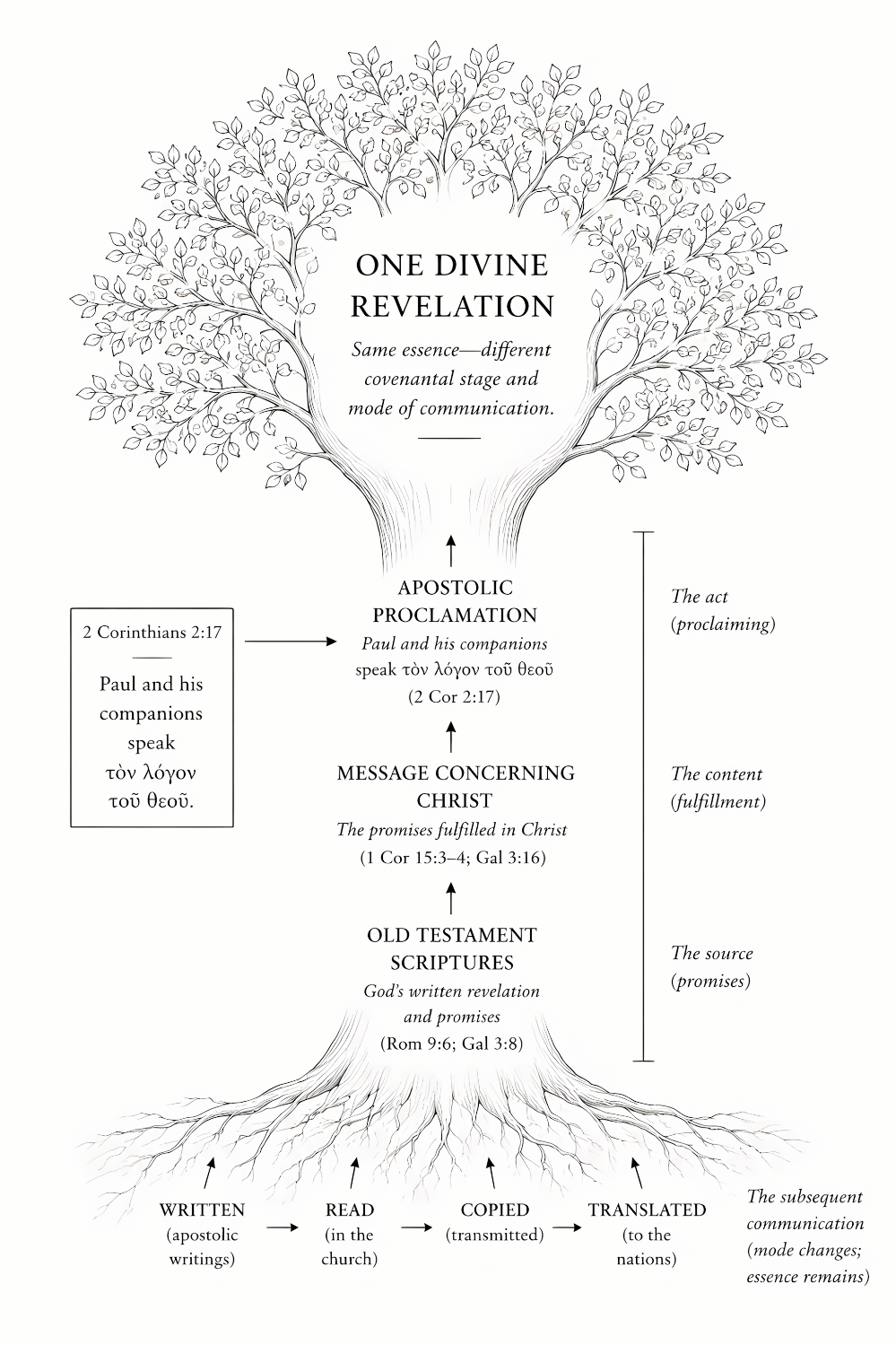
Conclusion
In 2 Corinthians 2:17, “the Word of God” refers immediately to the divinely commissioned message concerning Christ that Paul and his fellow workers proclaimed. Paul’s gospel was promised beforehand by Scripture, proclaimed according to Scripture, and explained through the unveiling of Scripture in Christ. The λόγος in 2 Corinthians 2:17 cannot be confined to an unrepeatable oral event and separated from the inscripturated and translated forms through which that same divine message continues to address the church.
Forbidding the commercialization of Paul’s proclamation along with written and translated Scripture is a recognition that God’s message retains its identity through legitimate changes of medium. Consequently, one cannot evade Paul’s condemnation merely by moving the divine message from speech to text or from one language to another. Paul decries the commercialization of God’s revealed message in the forms through which God has appointed that Word to be preserved, transmitted, and received.
The Wider Context of 2 Corinthians
The phrase “in the sight of God we speak in Christ” reappears (albeit in a different verbal form) later in the same letter in 2 Corinthians 12:19. What is the issue in the context of chapter 12? Paul continues to refuse to financially burden the Corinthians (2 Cor 12:13–18). Twice Paul has appealed to his speech being in the sight of God in Christ, emphasizing the sincerity of his message and lack of ulterior motives. If the commercial interpretation of 2 Corinthians 2:17 is correct, both of these appeals have been in precisely the same financial context.
Criticism of Paul for His Financial Policy
Paul is not disparaged for the content of his gospel (corruption) but rather for the free giving of it (commerce), as seen in 2 Corinthians 11:7: “did I commit a sin… because I preached God’s gospel to you free of charge?”. He says that, “in the sight of God” he speaks in Christ. In other words, he asserts his impunity before man as long as he has pleased God. In other words, he is not on trial before the Corinthians but rather stands before a heavenly court where his only aim is to please the Lord. This indicates that there is some offense he is responding to. If καπηλεύω refers to corruption, then the Corinthians have been offended by the content of his preaching because they find his truthful message displeasing and prefer an adulterated one. However, the contents of the letter do not sufficiently account for this interpretation. Even if the false apostles had been tampering with God’s word to offer something more attractive (cf. 2 Cor 4:2), at what point do we see evidence that the Corinthians despise Paul because of the contents of his gospel? If, on the other hand, καπηλεύω refers to commercialization, then the Corinthians have been offended because they find a free message displeasing and prefer the “dignity” of teachers who charge a fee. Indeed, reading the rest of 2 Corinthians, we see that this is precisely what has offended them (2 Cor 11:5–7). The commercial interpretation of 2 Corinthians 2:17 acknowledges Paul’s need to respond to a past offense with a defense of his apostleship.
The Parallel Passage of 1 Thessalonians 2:3-5
Paul writes something remarkably similar in 1 Thessalonians 2:3–5. Although he doesn’t present his concerns in the same sequence, this passage helps shed more light on 2 Corinthians 2:17, as the following comparison demonstrates:16
| 2 Corinthians 2:17 | 1 Thessalonians 2:3–5 |
|---|---|
| For we are not, like so many, καπηλεύοντες of God’s word, | [5a] For we never came with words of flattery, as you know, nor with a pretext for greed |
| but as men of sincerity, | [3] For our appeal does not spring from error or impurity or any attempt to deceive, |
| as commissioned by God | [4a] but just as we have been approved by God to be entrusted with the gospel, |
| in the sight of God we speak in Christ. | [4b] so we speak, not to please man, but to please God who tests our hearts. [5b] God is witness. |
The key issue in 1 Thessalonians 2 is greed (1 Thess 2:5). If the similarity of these passages indicates a shared concern, it is natural to conclude that 2 Corinthians 2:17 is addressing the commercialization of the gospel over the corruption of the gospel as the primary concern.
The Objective Nature of Paul’s Criticism
Paul’s directness in this verse demonstrates that his opponents accept payment for their preaching and teaching. We should ask, “How is Paul able confidently to attribute such negative motives to these men, while expecting his own claim ‘of sincerity’ to be accepted?”17 If the false apostles are misusing Scripture in a particular way, then the matter is subjective, and Paul’s accusation jumps too quickly to a verdict. But if the accusation has to do with selling God’s Word, then the issue is already out in the open and objective: His opponents have accepted payment whereas Paul has refused.18
A Motive of Profit?
Beyond the concern between commercialization and corruption, many translations choose to elaborate on the motive behind the action (as seen above). Does “καπηλεύω” imply a desire to profit?
Of course, there is a normative sense in which anyone who sells—or even corrupts for that matter—has a desire to profit. Few would deny this. In fact, it is exactly for this reason that any word used for the commercialization of Scripture will naturally carry tacit suggestions of a profit motive. “Peddling,” the common word among many translations, does this sufficiently. Why add additional words, transforming undertones to overtones?
Adding an explicit reference to profit restricts Paul’s condemnation to the motive itself, failing to unambiguously condemn the specific action that is actually forbidden in the Greek text. For example, does Paul wish to distinguish himself from all who would sell God’s Word, or only to distinguish himself from those who would sell God’s word for profit? Is it actually wrong to sell God’s word? Or is it only wrong when the one who is doing so doesn’t have his heart in the right place?
Of course, Paul clearly answers these questions later in the same epistle. He wishes to distinguish himself from all who would sell God’s word. He preaches free of charge (2 Cor 11:7) and he will continue to do so to distinguish himself from those who don’t (2 Cor 11:12). Would Paul have been satisfied with the commercial practices of his opponents if they had charged less? Of course not. Would he have been sufficiently distinguished from them if he simply charged less than they did? Of course not. Only a free proclamation of the gospel distinguishes itself from one that is offered at a price.
When modern translations add a “for profit” clause, are they providing themselves and others with a loophole to escape Paul’s condemnation? Are they justifying themselves as “non-profit” organizations by adding “for profit” to Paul’s words? Only God knows their hearts and intentions.
Conclusion
There is something delightfully simple with the rendering of “καπηλεύω” provided by the ISV: “commercializing.” There is no attempt to suggest any motive. There is no restriction of this verse to those with underhanded practices, as words like “peddlers” or “hucksters” might imply. There is only an acknowledgement of the meaning of the word and the actual nature of the sin: to engage in a reciprocal exchange that trades the Word of God for something in return. To quote a larger portion, “we are not commercializing God’s Word like so many others.”
Paul distinguished himself from the false apostles of Corinth, not merely by having a right heart as he sold the gospel, but by refusing to sell it at all. There are indeed “so many others” who sell the message of Christ. May the Church of God follow in the apostle’s footsteps, offering that message at no charge at all. After all, when he did this, Paul was merely imitating his master, Christ (Matt 10:8; cf. 1 Cor 11:1).
The Myth of Institutional Innocence
―❖―
Awidespread optimistic assumption exists that Christian publishers, Bible societies, and ministry institutions are largely immune to the temptations of power, prestige, and financial self-interest, and that their policies are guided solely by concern for the welfare of Christ’s Body. While a charitable disposition toward fellow believers is appropriate, an uncritical confidence in institutions can easily obscure reality. Across many decades, both public accounts and private testimony have documented deep-seated corruption within the faith-based publishing world. In our own conversations with individuals possessing extensive experience behind the scenes of these organizations, a recurring theme has emerged: Christian publishing is rife with pride, greed, and deceit. What follows will present evidence for this claim, and evaluate whether these institutions should be entrusted with proprietary control of God’s Word for millions of Christians.
The Selling of Jesus
In 1985 Victor Bryditzki published the account of his experience with the Christian bookselling industry in The Selling of Jesus: the Confessions of a Christian Bookstore Owner. He wrote:
I was looking forward to our first CBA (Christian Booksellers Association) convention with anticipation. We had never attended one of these conventions…but it would be a gathering of the saints, a convention of those who thought and wrote about God and His Word…it would be a chance to participate in a business devoted to promoting the Holy Kingdom of God among His children….
Alas for my hopes and aspirations. When we arrived, I found it no different than the San Francisco furniture mart during Market Week! Banners, streamers, balloons, blinking signs decorated the center. It was “Temple Time” minus the pigeons. It appeared that all the money-changers from the whole country had come here this day to peddle the Word of God. The atmosphere and the vocabulary were identical to my other past experiences: “Fast mover…double your money…sells easy…quick turnover…now this one sells!” “This one for your impulse buyer; he won’t be able to resist it…how many would you like?” The only difference was the product itself….
There is no way for me to know the original intents of the founders of today’s Christian publishing houses. I suspect that many of them truly intended to honor the Lord. But all I know for sure is what is happening today under the banner of Christianity.
Too many Christian publishers have long ago been bought out by large, secular corporations. JE$U$ means money, and the smart boys know it. It is common knowledge, for example, that one of the biggest Christian publishers has been bought out and is owned by ABC (American Broadcasting Company).
The responsibility of ABC or any corporation is to show a profit to its stockholders. People invest money to make money, not to support a cause. The officers of the company are there to ensure that the investors make money. They are interested only in “winners” that move fast and in large numbers. A “loser” is a slow mover and is scrapped instantly. The question is not, “Is it Christian?” or “Will it help Christians?” but “Will it sell?” …
I had seen so many examples of “Christian” companies leaving Christianity behind in an effort to make a profit for their investors that I was ready to believe anything.1
When the surrounding churches united in a boycott against his bookstore (because he refused to sell heretical material), he was forced into grave financial straits and closed his doors. This is when the industry showed its true colors even more.
What we hadn’t counted on was the unmerciful harassment by hard-nosed credit managers, the insulting and dehumanizing collection agencies, the hired-for-a-percentage attorneys. There is an uncanny sense within the “system” when someone’s back is against the wall; they move in for the kill. Our big buying days were over; there was no more fawning solicitation of our purchasing power. The JE$U$ companies and publishers of yesterday turned into avid hunters of today.
I had previously been in the business world for over 30 years. At one time I owed over ten times what I now owed, but I received more understanding and better treatment from pagans than I was now getting from those who profess to believe in the King of Love. The insulting letters, the incriminating phone calls were driving my once loving and giving wife to the funny farm. Not inured to the insults and unmerciful abuse, she began falling apart, her nerves ripped to shreds. All she could do was cry, and cry she did.
Watching the object of your love being hurt and destroyed by “Christians” sets a man into a frame of mind he never knew he was capable of. I am not talking about large amounts. The amount we owed to any one company was not large. We were nailed to the wall for nickels and dimes compared to the thousands upon thousands of dollars we had given each company for merchandise in years past. For example, one of the biggest names in the “Christian jewelry” business, one who himself admits he became a millionaire selling jewelry to Christians, turned us over to collection for a debt of $21.15! A prominent California Jesus-junk dealer took us to small claims court to collect $60.27 for interest only! We had paid the bill, but he wanted the interest badly enough to go to court.
One of the biggest “Christian” book distributors on the West Coast put a lien on our home to collect $44.67 for interest only on a once past-due invoice. Another big-name “Christian” publisher hired an attorney to sue us for not being able to pay an outstanding bill of $108.44. Of course, the summons read $368.30 because $259.86 was added for interest! Please note the favorable and “inside” interest rates that these JE$U$ companies charge their brethren: you pay interest on the interest on top of the interest. It is strange to note that the secular companies that we owed money to did not ever harass us, nor did they ever charge us interest.
These are only a few examples of uncaring, deliberately merciless dealings that left us with a psychological wound that I doubt will ever be healed. “Christian” businessmen had a way of punishing those who fall from their favor that is unknown even among the heathen.
People wonder why we now run away from those who announce themselves to us as “Christian.” We feel we need to wait until we see the evidence….2
The phone rang again. I just happened to be looking at a large publisher’s catalog, admiring a picture of their new multi-million-dollar facility, and the caller happened to be them. The voice on the other end of the line was cold and stern. If we did not pay our past-due bill today he was going to notify the IRS….
Then there was a knock on the door. It was the sheriff serving papers drawn up by a “Bible-belt” JE$U$ publisher suing us for $178.56. What had happened to 1st Corinthians, where Paul clearly states that Christians are not to sue one another? We are instructed to accept a wrong and even be defrauded if need be, rather than go to law. Now, of course, business argues that business is business, and you can’t run a business on air, or even hopes and dreams. But this business had already made a huge profit from us; would it really have cost them anything to wait a while for the remainder of our money? …
Others of these publishers turned us over to collection agencies, attorneys, or sued for the interest due after we had paid the principal of the debt.3 …
It appears that the publishers, the bookstores, and even the churches have all been carried away with one thing: profit…. I am about as angry at the “Christian” booksellers as I can be—I would like to blame them for the way things are today. Yet Jeremiah blamed the people themselves. They supported the false prophets by listening to them. Perhaps the only way out is for people to rise up in rebellion against “big business” and demand the old way of truth. Is it possible? It doesn’t seem so…but it has happened before a few times in history.
Sometimes one has to fail in order to succeed. If we had continued to be a money-making “ministry,” as we were at first, we would no doubt wrongly believe that God was blessing us. We had to fail in our “ministry” to realize that bookstores like ours, even though we tried to keep our inventory “clean,” was illegal in the eyes of God. The whole JE$U$ SELLS syndrome has to be thrown out of the temple of God. Thank you, Lord, for our failure, for in it we found a true victory.4
“It’s Always Been about Money”
Fast forward to 2018 and little had changed. The greed, pride, and deceit still ran rampant, but technology and corporate consolidation had amplified it. Katelyn Beaty, in her book Celebrities for Jesus: How Personas, Platforms, and Profits Are Hurting the Church, revealed what she saw in her fifteen years of work in faith-based publishing, admitting that she cannot recommend that authors submit their work to the industry. She writes:
The primary reason for my caution is that the book publishing industry—and the agents, publicists, brand consultants, social media managers, and conference organizers connected to it—has added jet fuel to the problem of Christian celebrity, to the tune of $1.22 billion in sales in 2018 alone….
[M]odern celebrity can lure individuals and companies to skirt ethical standards while feeding the lucrative celebrity machine.
Some top mainstream publishers—notably HarperCollins, owned by Rupert Murdoch’s News Corp—have recognized the massive sales potential in faith-based publishing. Since HarperCollins acquired Zondervan in 1988 and Thomas Nelson in 2011, half of Christian publishing is now owned by a multinational corporation that primarily exists to create a profit….
I spoke with several leaders in Christian publishing to assess the role celebrity plays in our industry. They agreed to speak with me off record, because they wanted to keep their jobs and also because they felt some ambivalence about their role.
One acquisitions editor at a corporately owned publisher noted that celebrity has always shaped publishing. “Thirty years ago, it was Chuck Swindoll and James Dobson—whoever had the biggest radio show,” she told me. “It’s always been about money.” But today, she said, the pressure to sell is greater than ever, as more Christian publishers are owned by corporate giants. “Most people who work in editorial are believing Christians who want to publish good books,” she told me. “But above them, if they’re not in a place with a mission that’s spiritually minded, it’s about revenue.”
The pressure to turn a profit gives platform an outsize role in who gets book deals. Quality of writing, educational credentials, and hard-won wisdom are not enough to get a contract. Writers are told they must also have platforms. Some author hopefuls find that creating a platform is like a second job. By contrast, someone with a large social media following, who can’t write or doesn’t have much to say, will find plenty of publishers and agents who want to publish their book. Numbers rule….
“We love to bitch about empire, but in Christian publishing, we’re in it,” another longtime editor told me. He says the celebrity dynamic has mushroomed in recent years, in part because global conglomerates own half of the Christian publishing pie.
[A]dvance amounts are determined mostly or solely by author platform—which is often shorthand for celebrity status—with relatively little weight placed upon quality of writing, freshness of ideas, and credentials. It’s a self-fulfilling system: publishers invest more attention and money into authors they’ve already paid large advances to. Celebrity begets celebrity. “The larger advances create a gap… in the minds of employees,” said the editor. “It allows preferential treatment.” He’s concerned that celebrity creates a tiered system among authors.5
Once celebrity becomes a commodity to be bought, sold, and leveraged, the line between promotion and deception can quickly blur. As Beaty observes, modern Christian publishing has increasingly embraced practices that create misleading impressions about authorship, endorsement, and influence:
Today, ghostwriting even crops up with endorsements and forewords. In these cases, publishers—usually an editor or marketing team member—will write an endorsement for a celebrity leader, then run it by that leader to get their sign-off, like, “You’d say something like this, right?” Other times a celebrity endorser has their team or assistant read the book and submit an endorsement on their behalf. The celebrity endorser doesn’t read the book that they are attaching their name to….
All ghostwriters are paid something—usually by the author in a work-for-hire agreement. If a big-name “author” gets a $500,000 advance from a publisher, then pays the actual author $50,000, we might think that’s a decent sum and a fair wage. But doesn’t the actual author bring more than 10 percent of the value to the project? After all, the words on the page wouldn’t exist without the blood, sweat, and tears of the ghostwriter. And if the book sells, the actual author won’t be rewarded in royalties; the celebrity will….
But when it comes to questions of credit, ghostwriting doesn’t just involve two individuals in a private agreement. It also involves a reading public—people buying the book….
If you found out that your pastor didn’t write their sermons, or that your professor didn’t write their lectures, or that your favorite musician didn’t write their lyrics—that they were presenting someone else’s intellectual work as their own—you’d feel deceived and lied to, because you were, in fact, deceived and lied to. Such deception is grounds for firing or a lawsuit in other arenas. Yet the practice is common in publishing, including Christian publishing.6
Counterfeit Influence for Cash
Beaty also explains how the profit-driven demands of the publishing industry have created a market for manufactured influence. One editor she interviewed from a Christian publishing house described how pastors and ministry leaders sometimes hire social media consultants to artificially inflate their online followings. By purchasing large numbers of inexpensive followers, often from inactive or fraudulent accounts overseas, an author can appear to command a massive audience while generating little genuine engagement. These inflated numbers may then be used to secure book contracts, speaking opportunities, or ministry positions—all compelled by the desire of Christian publishers for more money.7
Purchased followers, engagement farms, and other forms of digital manipulation have become commonplace. Artificially inflating one’s influence is the digital equivalent of exaggerating attendance figures, membership rolls, or evangelistic results—for worldly gain or prestige. It is deception. The publishing industry has led many to confuse the appearance of influence with faithfulness, or numerical prominence with genuine spiritual fruit.
Beaty also warns that even when a pastor’s audience is entirely real, treating church members as a consumer base can distort the nature of ministry. Publishers often evaluate pastors by the size of their congregations and networks, seeing potential book buyers. Churches may then purchase books in bulk or build teaching series around them, boosting sales and royalties. Such arrangements can subtly reshape perceptions. Pastors may begin to view their congregations less as souls to shepherd and more as audiences and customers to cultivate.8
When Mark and Grace Driscoll secured a $400,000 publishing contract with Thomas Nelson in 2011 for a book on marriage, Mars Hill Church subsequently partnered with ResultSource, a marketing firm specializing in fake bestseller campaigns. According to a former Mars Hill staff member who requested anonymity, the Thomas Nelson executive involved in the deal knew of the arrangement and raised no objection. ResultSource’s method was straightforward: ministries purchased large quantities of books, while the company structured the orders to resemble purchases by individual consumers, increasing the likelihood of appearing on the New York Times bestseller list. Other ministry figures, including Les and Leslie Parrott, David Jeremiah, and Perry Noble, have acknowledged using ResultSource’s services. Mars Hill spent roughly $242,000 on the campaign. The illusion succeeded. In early 2012, Real Marriage appeared on the New York Times bestseller list for one week.9
Beaty writes,
But we—book lovers, buyers, and publishers—would be remiss to simply chalk that story up to the excesses of a toxic church environment and its celebrity pastor. Even if our pastor isn’t faking social media numbers or passing off someone else’s content as their own, we have tacitly accepted that such practices are part and parcel of an industry where metrics of eternal worth are often subsumed into metrics of the market.10
She concludes:
It didn’t have to be this way. Yet even discerning, spiritually sensitive editors are no match for the broader industry’s push for bigger profits, shinier personal brands, and the all-consuming logic of late-modern capitalism. To be sure, plenty of individual leaders and authors in Christian book publishing stay in the industry to serve the church and amplify important messages, regardless of celebrity appeal. They have the right motives. But the pressure to create larger profits year after year often requires trading good motives for pragmatic market considerations.11
Where Is the Heart of Christ?
These witnesses expose an evangelical book industry that is rotten to its core. The spirit of Christ is glaringly absent. These institutions, by their actions, despise the servant heart of Jesus, his meekness, generosity, and love. Instead, they promote posturing, dishonesty, idolatry, and the love of money. Why then do we cower before their exclusive claims on the Word of God? Why do we trust them to be arbiters of truth?
Yet these are the very people and institutions we have entrusted with the stewardship of Scripture. Should we be allowing them to nickel-and-dime the Church for access to the Word of God while they lie to us, manipulate appearances, and make Christ into merchandise? If the same industry that lies about authorship, manufactures celebrity, and commercializes Christ insists that Scripture must remain under its proprietary control, it is a disgrace for the Church to accept it. At the very least, these realities should make us deeply suspicious when Christian publishers speak of “stewardship” while enriching themselves by restricting the very Word that God gave to be proclaimed freely.
The Wages of a Prostitute
Many point to how the unjust gain of this industry is often spent on good works. They argue that as long as the proceeds fund righteous causes, the ends justify the means. “That publisher uses a lot of the money to give away bibles, support missions, subsidize translation work, and train pastors! So don’t criticize them!” But Scripture does not teach that money acquired through sin can be whitewashed by giving it to God. Yahweh, the creator of heaven and earth, will not be used for spiritual money laundering. He forbade Israel to bring “the wages of a prostitute” into his house to fulfill a vow, because the source of the gift was detestable (Deut 23:18). Even though Saul imagined that plunder taken in disobedience could be sanctified by sacrifice, Samuel answered, “To obey is better than sacrifice” (1 Sam 15:22).
This exposes the moral weakness of the common defense: “We charge here so that we can give there.” Christ is not honored when we baptize pride, deceit, disobedience, or greed as generosity simply because some portion of the profit is later used for ministry. God does not need us to disgrace his name in order to finance his mission.
A Seat at the Table
During an interview with a Christian publishing insider who has spent decades deep in the belly of the beast, he explained one of the reasons so few speak openly about the abuses and contradictions within the industry as he has done. Simply put, many still hope to benefit from the system themselves. The prospect of gaining influence, recognition, conference invitations, endorsements, publishing contracts, and a place among the industry’s respected figures exerts a powerful pull. Even those who privately recognize serious problems may hesitate to challenge them publicly because they do not want to jeopardize future opportunities or relationships. The system offers not only financial rewards but also social rewards: prestige, access, and proximity to influential leaders. As a result, some who might otherwise serve as whistleblowers remain silent, unwilling to risk exclusion. The result is a culture in which loyalty to an institution’s elite is more important than loyalty to truth. Those who continue hoping for a seat at the table rarely wish to overturn the table itself.
What about All the Good People?
Whenever concerns are raised about the commercialization of Scripture and other pervasive evils within the faith-based publishing industry, defenders instinctively point to the many godly men and women involved. They rush to say, “Not everyone is a Mark Driscoll.” They remind us of faithful editors, sacrificial translators, diligent proofreaders, and beloved authors whose books have strengthened the Church. And they are correct. There are sincere Christians laboring within these institutions, and we know many of them personally. Some of the most edifying books published in the last century have come through these broken channels. Many authors whose ministries have blessed millions are themselves godly men and women who would be appalled by some of the practices described in these pages. But rather than exonerate the corruption, these good people serve to obscure and perpetuate it.
In A Key to Uncle Tom’s Cabin, Harriet Beecher Stowe confronted one of the most common defenses of slavery: the appeal to the “kind master.” Defenders of the institution would point to honorable, compassionate slaveholders and argue that such men proved the slave trade was good and right. Stowe rejected the argument entirely. The question, she insisted, was not whether nice men could be found within the system, but whether the system itself was righteous. She argued that the existence of kind masters often made the evil more difficult to see. Their personal virtue softened public criticism, reassured the conscience of outsiders, and lent moral credibility to an institution that deserved condemnation. Far from refuting the charge against slavery, they often helped perpetuate it by obscuring its true nature.
The same dynamic can be observed in Christian publishing. The issue is not whether good people exist within that world. The issue is whether good people have been used to sanitize a sinful system. For decades, faithful authors have supplied the moral credibility. Faithful editors have supplied the goodwill. Faithful translators have supplied the labor. Faithful donors have often supplied the money. Yet the beneficiaries of this arrangement have largely been institutions whose incentives are shaped less by the kingdom of Christ than by the demands of market share, revenue growth, intellectual property portfolios, and investor expectations. The virtue of good Christians has become a veneer covering structures that deserve far greater scrutiny.
This is precisely what makes the problem so dangerous. If Christian publishing were populated entirely by obvious charlatans, the Church would have rejected it long ago. Instead, the system is populated by enough good people to keep its legitimacy intact while the underlying incentives steadily drift in ungodly directions. These admirable believers laboring to serve Christ all help reassure the public that the institution itself is healthy, rather than a malignant pestilence infecting the Body. Their integrity becomes a shield protecting structures that violate the command of Christ to freely give (Matt 10:8) and routinely reward celebrity over substance, platform over wisdom, marketability over truth, and profit over access.
The result is that many Christians have come to place extraordinary trust in institutions that exist to commodify Christ. Let it be said once again that these are the same institutions that claim the authority to determine who may copy Scripture, who may distribute it, who may translate it, and under what conditions it may be shared.
As Stowe understood, an institution should not be judged by the character of its most virtuous participants, but by its alignment with the law of Christ, the incentives it creates, and the fruit it consistently produces. On those grounds, the modern Christian publishing industry deserves far more skepticism than it typically receives.
Conclusion
The Church once had a name for the sin of selling Jesus: simony. Though it bears the name of Simon Magus (Acts 8), its spirit can be traced back to Gehazi, who sought personal gain from a gift God had freely bestowed, and was punished with leprosy (2 Kings 5:20–27). Throughout church history, Christians rightly recognized simony as a contagion capable of spreading through entire institutions.
That disease has not disappeared. It has metastasized. What perhaps began as occasional abuses has become woven into the fabric of modern Christendom. The commercialization of spiritual gifts, the commodification of Scripture, the monetization of access to biblical resources, the cultivation of celebrity for profit, and the transformation of Christ’s flock into a customer base are not isolated indiscretions of an otherwise righteous legacy. They are manifestations of the same ancient plague.
It has spread across denominations, organizations, and continents. Like leprosy, it has infected structures that many believers have long assumed to be healthy. Like leaven, it has worked its way through the whole lump and “spread like gangrene” (2 Tim 2:17). The Church has embraced it as normal, respectable, and even ideal.
The answer is not cynicism, nor silence, nor merely the replacement of one institution with another. The answer is reproof and repentance. John Huss wrote, “One shares in simony by failure to reprove or by silence.”12 We must recover the mind of Christ and refuse to call the Jesus trade “stewardship.” Yahweh repeatedly commanded: “Purge the evil from among you” (Deut 13:5; 17:7; 19:19; 21:21; 22:21; 24:7). The same principle remains. Judgment begins with the household of God. If the Church is to bear faithful witness to Christ, we must acknowledge this evil for what it is, renounce it wherever it appears, and cleanse it from our midst. May God be merciful.
The KJV Is Not the Solution
―❖―
One of the common misconceptions about the King James Version (KJV) of the Bible is that it is a universally public domain work—something many tout as a feature of its superiority to modern copyrighted translations. But most don’t realize that it is still under a special perpetual restriction of the Crown in the United Kingdom that essentially operates as a form of copyright. Therefore, an exclusive use of the KJV is not the solution to the problem of copyrighted bibles.
Unlike the KJV, some modern translations such as the Berean Standard Bible are public domain worldwide. This means that there are modern translations that fulfill the need for a restriction-free Bible better than the KJV does.
When the KJV was completed, special printing rights were given to the King’s Printer, ensuring that only authorized printers could publish it within England and later the United Kingdom. The legal mechanism that established this in 1611 was the Royal Printing Privilege, granted by King James I. The Crown’s control of who can print the KJV continues today. Cambridge University Press, Oxford University Press, and Collins Publishers are the only entities with rights to print and distribute the KJV in the UK.1 Additionally, modern editions or versions of the KJV outside of the UK that include editorial work, notes, or formatting may be copyrighted as derivative works.2 To be clear, the KJV has been treated as public domain in most countries outside the UK for many years due to international standards regarding the age of the work. This makes the KJV an outlier in the world of intellectual property.
The Crown does not attempt to enforce its perpetual control over the KJV in foreign countries primarily due to legal, practical, and political reasons. Crown prerogative is a unique feature of British law. It is tied to the authority of the British monarchy and does not extend beyond UK jurisdiction. Most other countries do not recognize such perpetual privileges for government works, and foreign copyright laws typically have explicit time limits for works to enter the public domain.
If the Crown wanted to enforce its perpetual control abroad, it would face significant legal hurdles. International copyright enforcement relies on treaties like the Berne Convention, which standardizes certain copyright protections but does not recognize perpetual copyrights specific to one country. Attempting to enforce such a claim in a country where the KJV is already in the public domain would likely result in dismissal by the courts.
Terms of Use
The Cambridge website describes the legal restrictions on the KJV in the UK as follows:
Rights in The Authorized Version of the Bible (King James Bible) in the United Kingdom are vested in the Crown and administered by the Crown’s patentee, Cambridge University Press. The reproduction by any means of the text of the King James Version is permitted to a maximum of five hundred (500) verses for liturgical and non-commercial educational use, provided that the verses quoted neither amount to a complete book of the Bible nor represent 25 per cent or more of the total text of the work in which they are quoted, subject to the following acknowledgement being included:
Scripture quotations from The Authorized (King James) Version. Rights in the Authorized Version in the United Kingdom are vested in the Crown. Reproduced by permission of the Crown’s patentee, Cambridge University Press.
When quotations from the KJV text are used in materials not being made available for sale, such as church bulletins, orders of service, posters, presentation materials, or similar media, a complete copyright notice is not required but the initials KJV must appear at the end of the quotation.
Rights or permission requests (including but not limited to reproduction in commercial publications) that exceed the above guidelines must be directed to the Permissions Department, Cambridge University Press, University Printing House, Shaftesbury Road, Cambridge CB2 8BS, UK (https://www.cambridge.org/about-us/rights-permissions) and approved in writing.3
History
At the beginning, by design, monopolies were established over the printing of the KJV in the United Kingdom. For approximately two centuries, the Oxford and Cambridge University presses, along with the King’s Printer in England, maintained exclusive rights to print it. This privilege, known as the “Bible privilege,” was not initially a matter of copyright but rather a monopoly granted by royal authority, as the first copyright law did not even exist until the 18th century. The primary justification for this monopoly was to ensure the accuracy of the biblical text and to keep prices affordable. However, over time, these monopolies were criticized for leading to high prices, limited availability of copies, and less textual accuracy.4
In the 19th century, campaigns emerged to challenge these monopolies, particularly in Scotland, where the monopoly was more stringent. Activists argued that the monopolies hindered the widespread and affordable distribution of the Bible. By the end of the 1830s, the patent granting a monopoly to the King’s Printer for Scotland was not renewed, effectively ending the single-printer monopoly there. Despite similar campaigns in England and Wales, the English privilege persisted; even after an 1860 Parliamentary Select Committee recommended ending it, the Crown renewed the Queen’s Printer patent, allowing the royal prerogative—administered via Letters Patent—to remain active through Cambridge University Press, Oxford University Press, and the King’s Printer to this day.5
Modern scholars agree that the KJV’s long-standing dominance was driven primarily by commercial interests rather than its intrinsic literary or scholarly merits. The KJV was cheaper and easier to print than both the beloved Geneva Bible and the officially favored Bishop’s Bible, which sparked fierce disputes and legal battles among London printers. As Daniell writes, “the business of the printing of the KJV became almost at once devious, and at times, vicious.”6
For example, when bookseller Michael Sparke began importing bibles to bypass the monopoly and cut costs, Robert Barker, the King’s Printer retaliated by seizing those bibles and the equipment of rival printers. Avarice ruled with an iron fist over the distribution of the KJV. Ironically and sadly, its triumph over rival translations “came about in part because it was an inferior production: in fair competition it would probably have lost, but its supporters had foul means at their disposal.”7
In short, the KJV’s beginnings sowed the seed and set a precedent for Bible publishers to allow the profit-driven strategies of the world to dictate how they operate.
The Biblical Contradiction
The current public domain status of the KJV in most countries arises not from any spirit of generosity or devotion to freely sharing the Word of God, but in spite of historical and ongoing attempts to control it. From its inception, the KJV has been bound by a British monopoly. This stands in stark contrast to the spirit of the gospel and the very definition of what a Bible is—God’s Word, not man’s. Therefore, we invite you to join us in confronting the Bible market, which treats God’s Word as a commodity to chain and monetize.8
Conclusion
―❖―
The legal fiction of binding God’s Word must be abolished.
As we conclude, we wish to recognize once more that many sincere and faithful Christians labor within the institutions responsible for restricting Scripture. Their good intentions and valuable work should be acknowledged with gratitude. But the character of an institution cannot be inferred from the character of its best participants. Systems must also be judged by the law of Christ, by the incentives they create, and by the fruit they consistently produce. Our prayer is that this book will awaken the body of Christ to what has become normalized, and lead to reform and repentance.
The Word of the Lord endures forever, but we cannot let its bondage endure forever. Throughout this volume, we have explored what it means to steward the Word of God faithfully. And the answer is simple: give it freely and let it run freely—in all its forms.
The Word is priceless. It is more precious than much fine gold. It is eternal, truthful, sanctifying, life-giving. It bears attributes that belong properly to God. It is the instrument by which he reveals himself, sanctifies his people, and brings life to the dead. That which is eternal cannot be priced. That which sanctifies cannot be commodified. That which reveals Christ cannot be reduced to a product. Nor does the Word cease to be the Word when its medium changes. The divine message may pass from speech to writing, from Hebrew or Greek into another language, from paper to pixels, or from text into faithful adaptation without becoming a merely human commodity. These forms differ in immediacy, wording, and fidelity, but the revelation they faithfully communicate remains God’s. One cannot escape the duties attached to the Word simply by changing the vessel that carries it.
God is sovereign over his Word. For millennia he has preserved it without the help of modern intellectual property law. Long before copyright statutes existed, manuscripts proliferated across continents. The abundance of copies (not their restriction) served as the means of preservation. Redundancy, openness, and widespread transmission were its safeguard.
Copyright contradicts biblical concepts of property and justice. Scripture establishes clear boundaries around the material goods God entrusts to each person, protecting a man’s dominion over what is rightfully his. Copyright crosses those boundaries by granting another person control over how everyone else may use their possessions. It thereby suppresses the love of neighbor that moves us to share what is good. Applied to Scripture, the injustice is greater still: it takes from God’s people their rightful liberty to copy, translate, and share what God has given them.
We saw from the example of Balaam that Scripture repeatedly links corruption of the Word with love of gain. The commercialization of divine things is never treated lightly in the biblical witness. Though motives are complex and hearts are known ultimately to God alone, the pattern remains: where the Word is treated as a means of profit, spiritual distortion follows.
In the Sunnyvale Statement we have sought to distill these concerns and convictions. The Word of God is a gift entrusted to the Church to be proclaimed and shared; and no human authority may rightfully chain what God has given for the life of the world. Therefore, we invite readers who share these convictions to add their names to the statement and publicly affirm that Scripture must be unshackled.
This book has not argued that translators, scholars, or laborers are unworthy of support. Scripture clearly affirms that those who labor deserve their wages. But that same Scripture also teaches with unwavering perspicuity that the ministry of the Word should be supported, not sold. There is a difference between trusting God to provide through the free generosity of his people and trusting in market forces through peddling, paywalls, and legal restrictions.
None of this denies the complexity of modern realities. Institutions require funding. Scholars devote years of labor. Technologies cost money. But complexity does not nullify principle. The Church has faced complex economic and political pressures in every age. The call has always been the same: conform practice to the pattern of Heaven, not the world.
The Bible is the self-revelation of the living God. It is the testimony to Jesus Christ, the incarnate Word, who gave himself freely for sinners. If the incarnate Word gave himself without price, how shall the written Word that testifies to him be treated as a commodity?
History will judge our generation. It will ask whether we trusted the providence of God or the mechanisms of control, whether we really thought Scripture was holy, whether we spread the Word as stewards or grasped it as gatekeepers. Yet the ultimate judgment is divine. We speak, as Paul said, “in the sight of God.” Every decision about how we handle Scripture is made coram Deo.
The good news is that the Word remains unbound in its essence. No ruler can ultimately silence it. No license can nullify it. No legal framework can extinguish it. Copyright withers, the market fades, but the Word of our God stands forever.