
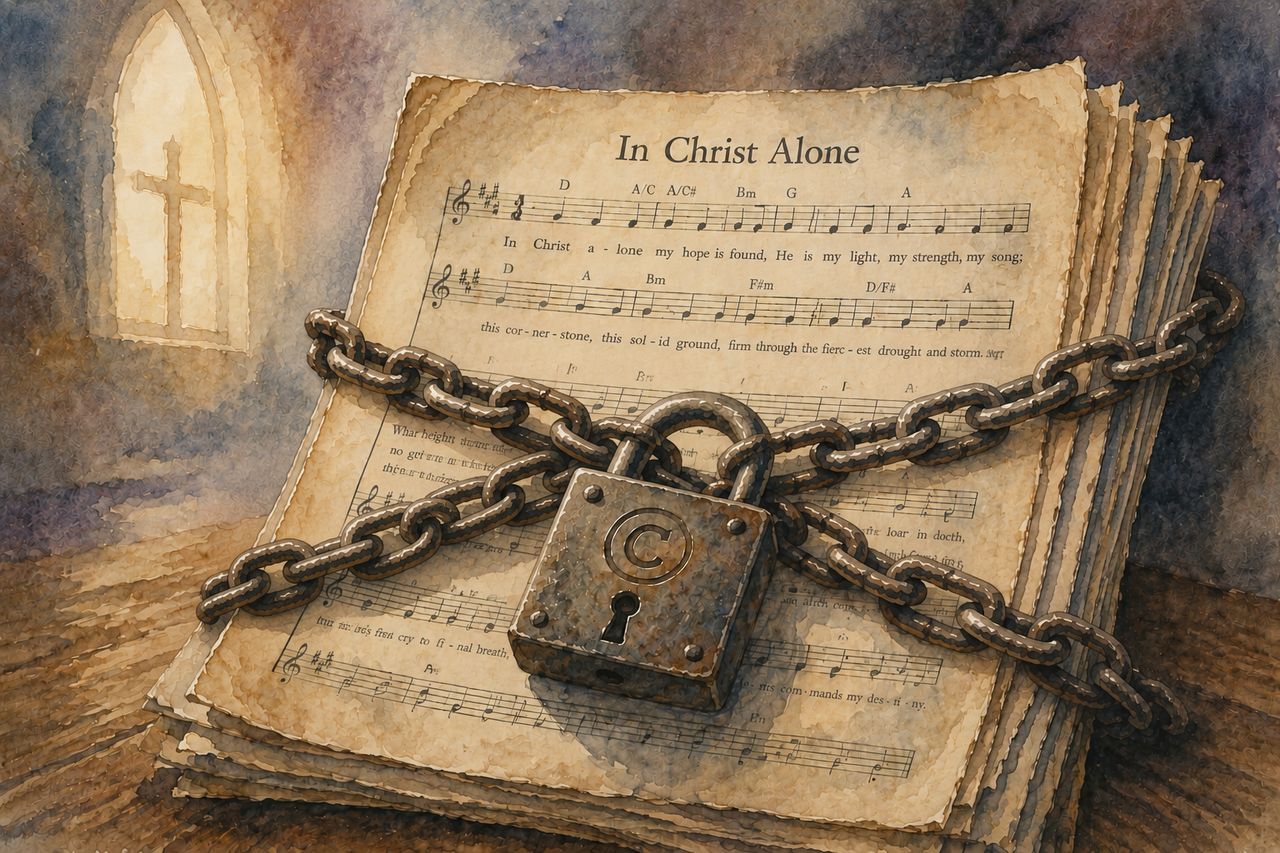
In 2013, the Presbyterian Church (USA) released a new denominational hymnal, Glory to God: The Presbyterian Hymnal. As it was being compiled, a dispute arose when the hymnal development body sought to include the famous Getty song “In Christ Alone.” The problem was simple: they wanted permission to make a slight change to the lyrics. Their request was to replace the line “the wrath of God was satisfied” with “the love of God was magnified.” They were denied by the copyright holders, and the committee ultimately did not include the hymn. This sparked a debate that soon moved beyond denominational circles, drawing coverage from many outlets and personalities including Huffington Post, The Nashville Tennessean, and Glenn Beck.[1]
Does the legal control of a hymn advance the Kingdom or hinder it? And does copyrighting sacred music glorify God?
A Perceived Victory
For some, the Gettys’ refusal to allow a derivative of their song stands as a triumph of copyright, demonstrating why Christians should retain legal control over their ministry. Copyright, they argue, preserved doctrinal purity. Without it, a central expression of penal substitution might have been altered in a major hymnal. The lesson, then, seems obvious: if you care about theological fidelity, you must own and protect your work. While that conclusion is understandable, it reveals a deeper problem: a familiar pattern in modern evangelicalism of appealing to good outcomes in order to justify questionable means. The reasoning goes like this: “If copyright prevented a bad thing from happening, then it must be a good thing; the ends justify the means.”
But Scripture is the only measure by which to assess the copyrighting of Christian materials.[2] It begins with the foundational command of Christ in Matthew 10:8 (freely you received, freely give). And as Conley Owens has argued, copyright represents one of the most direct violations of the injunction to freely give. Employing the power of governing authorities to coerce others to comply with unbiblical restrictions placed on ministry does not accord with the gospel, the commands of Christ, or the practices of the early church. The apostles defended truth through preaching, correction, and patient instruction, not through proprietary control over their writings (e.g. Acts 19). Spiritual integrity was guarded by faithfulness to the Word, not by restricting reproduction or adaptation. In other words, relying on civil monopoly to secure spiritual ends does not align with the teaching of Scripture (Jer 17:5, John 18:36, 2 Cor 10:4, 1 Cor 6:1–8).
What Might Have Been Under a Different Model
Had “In Christ Alone” been released into the public domain at its inception, the sequence of events would have unfolded differently. The denomination could have printed its preferred rendering and other churches could have retained the original language. The debate would have centered exclusively on theology rather than permission and state coercion. The church’s collective discernment (through preaching, teaching, and confessional standards) would have functioned without the shadow and shaping of legal constraints. And the authors could have rejoiced that more people were using their hymn to sing praises to Christ, savoring the numerous truths contained therein. Many more Christians, by singing that modified version, would have eventually encountered the original out of interest or love for the song, and been captured by the beauty of the line “the wrath of God was satisfied.” But that opportunity was lost in the threat of a lawsuit. Although there may have been no explicit threat of litigation, copyright inherently contains an implicit threat: “If you make a derivative without my permission, I will sue you.” That is the only option afforded by intellectual property law. If the Gettys were to argue that they would never sue anyone over copyright infringement, then the copyright statements that accompany their resources are a dishonest form of intimidation.
Thousands of hymns now in the public domain circulate freely across denominational lines. “A Mighty Fortress Is Our God,” “When I Survey the Wondrous Cross,” “Holy, Holy, Holy,” and “Amazing Grace” are translated, arranged, adapted, and republished globally. Occasionally niche adaptations appear. Yet no major theological crisis has arisen from the possibility that someone could modify a line. This is how the Church has historically handled hymnody, evaluating alterations by the word of God, not by human law.
It should be recognized that the doctrine of divine wrath does not depend on the immutability of a single copyrighted lyric. It rests on biblical texts such as Romans 3, Isaiah 53, and the broader canonical witness. If the theological integrity of penal substitution can only be preserved by denying permission to reprint a modified stanza, then the Church has bigger problems.
Legal Control and Theological Persuasion
There is also the question of effectiveness. Secular law can prevent publication of a work, but it cannot persuade those who reject a certain doctrine. Legal enforcement does not change hearts. In this case, the refusal of permission ensured the hymn’s exclusion from that denominational hymnal, but it did not alter the theological convictions of those requesting the change. It wouldn’t be surprising if many saw the media coverage, found the Gettys’ refusal to be petty and distasteful, and consequently became more sympathetic to the position of the PCUSA.
Moreover, invoking legal rights in matters of worship implicitly communicates that Christians do well to guard doctrinal precision not with Scripture and teaching, but primarily with civil authority. Whether intentionally or not, the mechanism becomes part of the public testimony and narrative.
In this instance, the controversy gained national attention. For many observers, the hymn became associated not primarily with its Christological richness but with a copyright dispute. The broader beauty of the text was overshadowed by a legal conflict, wherein Christians appealed to the arm of the flesh rather than settle their disagreement through direct charitable interactions and appeals to biblical teaching (Ps 44:3, 2 Chron 32:8). That reputational cost is difficult to quantify, but it is not negligible.
The ultimate irony is that a hymn centered on Christ’s sufficiency became entangled in the IP mechanisms of artificial scarcity[3] and restriction. In other words, the copyright holders told a watching world, “Christ is sufficient to save the soul, except for when someone might change a lyric…then we need to trust in princes.” The authors claimed a desire to maintain biblical-theological purity, yet had ignored Scripture’s clear teaching against the sale of spiritual things (see our Scripture index).
A Better Path
The good news is that change is simple: let the copyright holders dedicate the hymn to the public domain in obedience to Christ’s command to freely give. To be clear, a public domain dedication does not eliminate financial support for the writers. Voluntary donations will always be possible. The hymn would then circulate unencumbered, blessing many more millions all over the world, and truly honoring God as a decommercialized gift to his people.
Presbyterian Hymnal producers respond to misinformation: Unsuccessful copyright permission led to exclusion of ‘In Christ Alone’. See also Debating hymns, Keith Getty on What Makes ‘In Christ Alone’ Accepted and Contested, No Squishy Love. ↩︎
My biblical definition of Christian ministry is: Spirit-empowered service specifically and directly for the edification of the body of Christ. ↩︎
Artificial scarcity is the intentional restriction of access to something that could otherwise be abundant; for example, restricting a digital Bible translation with copyright even though it could be copied and shared freely at almost no cost. ↩︎