
What do Sydney Anglicans think about selling ministry? And do they live up to what they say? For those who don’t know, Anglicans in Sydney are, generally speaking, reformed, evangelical, low church, and have a strong belief in the authority of Scripture. This is unlike many other Anglicans around the world who have strayed from Scripture’s teachings.
I’ve served in a voluntary capacity in several Sydney Anglican churches, so I know them well, and I can honestly say they are no worse when it comes to this topic than any other denomination. So this article is not a dig specifically at Sydney Anglicans, I’m just addressing them first as I’m most familiar with them and want to urge them to further reform.
I’ll soon give some details about Sydney Anglican ministers who charge for their teaching, the basic gospel message, and even baptism. But first I want to examine some of their own guidelines.
Guidelines for the Remuneration of Parish Ministry Staff
One of the key principles we teach at Selling Jesus is that God supports those in ministry through the generosity of others. Rather than being a reciprocal exchange of money for ministry (selling ministry), support for ministry is given voluntarily as an act of worship. We call this “colabor”, from 3 John 1:8. A great example is how pastors are supported, through donations rather than sales.
The difference between reciprocity and colabor is rarely articulated in Christian thinking today, which is why I was pleasantly surprised when I came across something similar in a Sydney Anglican document.
In “Guidelines for the Remuneration of Parish Ministry Staff for 2024” they have an appendix called “Ministry and Money”, and it is the best inadvertent articulation of the principle of colabor that I have so far read. Let me show you what it says and why it’s important:
The first principle in the appendix is: “It is God who provides us with all that we need.” They rightly start off by acknowledging that God is the ultimate provider, and he is the one who provides for his laborers that he has sent out into his harvest field. The second principle they give is: “We are to enjoy the good things God has given us.” This is also true.
But it’s their third principle that I really want to focus on here, that “God supports those in paid ministry through the generosity of others.” As that is an excellent way to describe colabor. It has the three main components: (1) the support, on a spiritual level, is from God, (2) it is given by others as an act of worship, and (3) it is out of their voluntary generosity, and not out of compulsion.
The principle comes with explanation, which will now further be examined:
We see examples of this in the Old Testament (Numbers 18; 2 Chr 31:4), with Jesus and his disciples (Luke 10:7), and with the apostles and other gospel workers (1 Corinthians 9, Philippians 4).
The author reflects on how God has always supplied for the needs of his servants through the generosity of his people. In the Old Testament this was done through sacrifices which were offered to God in worship, and then in turn given to the Levites to support their ministry. Likewise, the author cites Luke 10:7 “the worker is worthy of his wages” in the context of receiving the hospitality of those they are ministering amongst, and Paul’s ministry provides further examples of this as well. All of these passages articulate the principle of colabor, and none of them suggest any commercialization of ministry. In line with that, the author points out that such support should not (necessarily) be insisted upon, citing the verses in 1 Corinthians 9 where Paul declares he did not exercise his right to support:
While this is not a right that gospel workers should necessarily insist upon (1 Cor 9:12,15)…
I’ve already produced an in-depth video on 1 Corinthians 9, so rather than go into that here, I’d just like to point out that the conclusion this document comes to is very close to the principle of colabor vs reciprocity. That is, if support is not to be insisted upon, then that rules out reciprocal models such as selling ministry or otherwise commercialising it.
They then go on to say:
…nevertheless the bible says –
- That God’s people should hold those in gospel ministry in high regard (1 Thess 5:12-13)
- That one way of expressing this is by ‘sharing all good things with their instructor’ (Galatians 6:6)
- That the underlying principles when it comes to financially supporting those in gospel ministry are – ‘Do not muzzle an ox while it is treading out the grain’, and ‘The worker deserves his wages’ (1 Timothy 5:18)
- That financial support is a means of expressing gospel partnership (Philippians 4:10-19)
These are all good things that we affirm. The only weakness in this document is that it leaves too much room for ambiguity. I tried to get in contact with the author, and specifically asked them: “What would insisting upon the right [to financial support] look like? And when would it be inappropriate?” But I did not receive a response.
An example to others
So, the question then is: do Sydney Anglican leaders live up to this? Or do some of them regularly insist on direct payment for ministry.
Let me share one last point from the document: “The way a gospel worker handles money is an example to others.” Many people won’t like what I have to say next, but I want you to know that it’s because of this point that I must. The example that many Christian leaders are setting for others when it comes to selling ministry is not a good one, and it needs to be corrected, for their sake, but also for the sake of younger upcoming leaders who will face the temptation to commercialise their ministry.
Ministers selling their teaching
Now, it is indisputable that many Sydney Anglican ministers sell their teaching. This isn’t to accuse anyone of greed (some authors do not even receive proceeds from their own books),[1] but to note that their teaching is, in practice, being sold. Someone cannot reasonably obtain their teaching from them without paying for it.[2] It’s being exchanged for money. This is immediately evident by going to a book publisher like Matthias Media (commonly used by Sydney Anglican authors) where anyone can see a list of teaching for sale.
Even very basic teaching is charged for, with titles including:
- Simply Christianity
- Christian Essentials
- The Christian Gospel
- The Path to Godliness
- Growing in Prayer
It might be permissible if it were only the cost of printing and delivery that is being covered, but even the ebooks—that is, the teaching itself—are sold at cost.
Selling the gospel
Now, you might be thinking: OK, sure, teaching is being sold. But that’s not the same as selling the gospel. First, such a view would be deviating from Scripture, because Scripture condemns selling all forms of ministry, not just what might be narrowly defined as “the gospel”. But for the sake of argument, yes, the basic message of the gospel is being sold. Let’s take for example, this book: The Christian Gospel, “A short account of the momentous news about Jesus Christ.” Price? $7.95 for the ebook. Who’s this book for? The author writes:
For all [those just mentioned], in practical terms, Christianity plays little or no part in the decisions and priorities of their daily lives. Is this you? If so, no matter what your age or culture, I’m writing this little book with you in mind. I want to explain to you, as simply and clearly as I can, what the Christian gospel is.[3]
So not only is the book an articulation of the basic message of the gospel, it is also written to save those who are yet to commit to Christ.[4] It might be the intention that mature believers are to buy this book for people they are evangelising, but 1) that’s not what’s presented to the public, and 2) why would selling the gospel to intermediaries be any less wrong? This is what Simon the Sorcerer wanted Peter to do. He wanted Peter to sell him the power of the Holy Spirit, not for himself, but to administer it to others (Acts 8:18-20).
If that still hasn’t convinced you that Sydney Anglicans must clarify these matters, let’s look at baptism. From the website of one Sydney Anglican church we read:
If you would like to register your interest for our next Baptism Group, please complete this online Baptism Group Registration form and one of our ministry team will contact you shortly. Please note that there is a $50 administration fee for Baptisms, made payable at the time of application via the online form. This covers the cost of the Preparation Course and applies regardless of whether you proceed to the Baptism. It also includes the cost of a new children’s bible for you to read with your child for many years to come![5]
Regardless of the excuse (even if it’s just covering administration costs) this has historically been condemned as simony. Thomas Aquinas, in the 13th century, wrote, “Whosoever shall consecrate anyone for money, let him be cut off from the priesthood.”[6] Furthermore, charging for baptism was declared unlawful in the Church of England by the Baptismal Fees Act of 1872 that notably also banned administration fees for registering the baptism.[7]
Reserved seating in church
It was only 69 years ago that St Matthews Anglican Church in Windsor was selling reserved seating for church services,[8] meaning there are Anglicans alive today whose family would have rented a pew. Pew rents were common in the 1800s and early 1900s, and often came with voting privileges.[9] The practice was so prevalent that when the NSW governor initiated funding for new churches, the act required at least one-sixth of the seating to be kept free for the poor.[10] Though the free seats were usually the least desirable. In some churches they even had closed gates on the pews to prevent anyone sitting in them before the family paying the rent arrived at church.[11] There was even a case where someone was sued by their church for not paying their pew rent.[12]
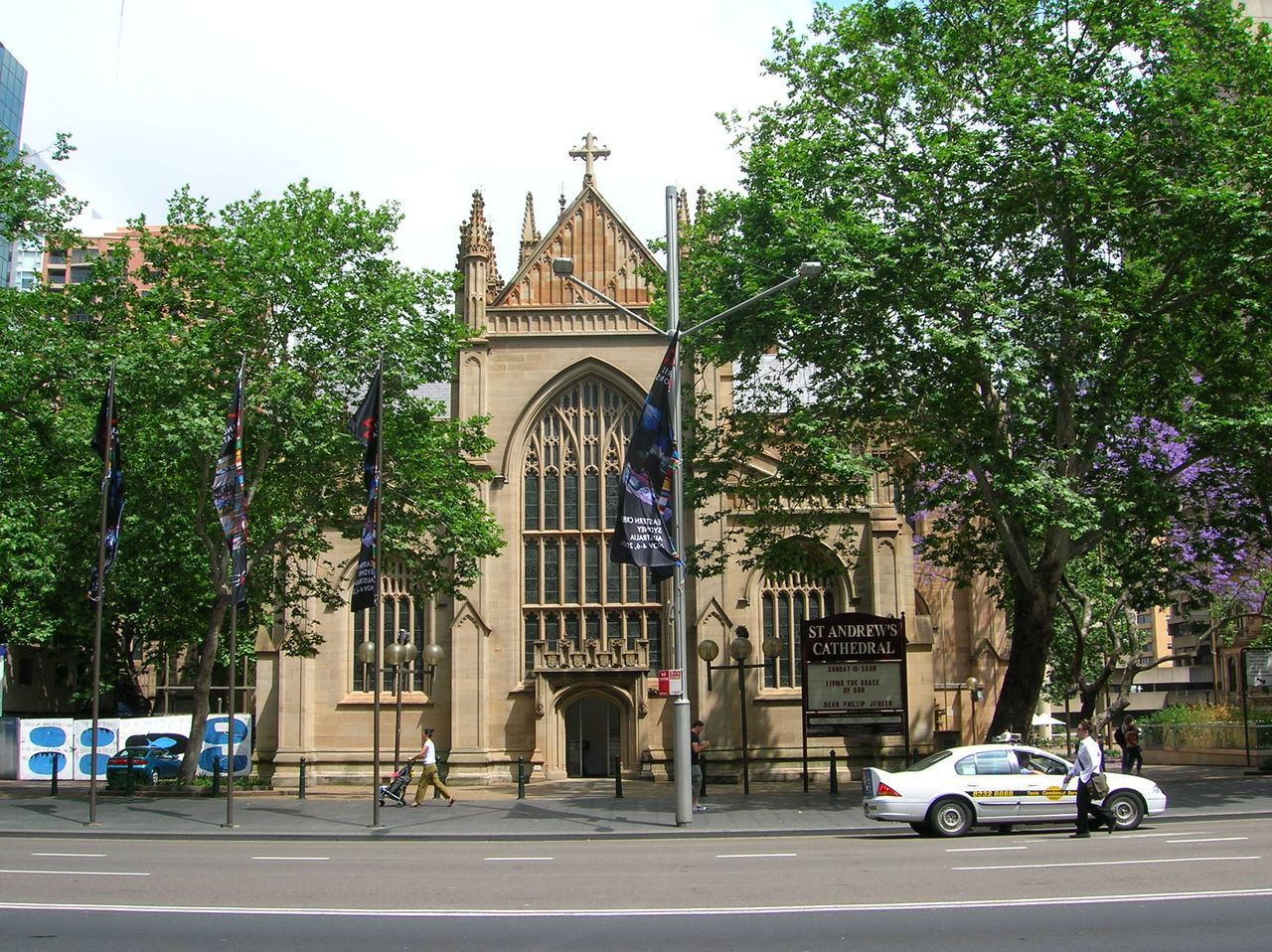
Other Sydney Anglican churches confirmed to have engaged in pew renting include St Philip’s on York St,[13] St James’ on King St,[14] St Stephen’s in Newtown,[15] St Peters in St Peters,[16] St Matthias in Paddington,[17] St Luke’s in Enmore,[18] and St John’s in Parramatta.[19] St Andrew’s Cathedral notably avoided the practice to ensure worship would be “open to all.”[20] Some ministers started to oppose the practice in the 1880s,[21] but not all, and it continued in some churches until 1956.
Zachary Barry, former minister of St Matthias’ in Paddington, wrote in the SMH in 1888 that the abolition of pew rents was “a fad and no more.”[22] He argued that funding ministry through stipends (donations) was insufficient, and so pew rents were necessary (sales). Christians before us clearly had blind spots, and we would be foolish to think we are immune.
Other forms of ministry now being sold include fees for youth group attendance (which is often the equivalent of a Bible study with some games),[23] training conferences run on church premises,[24] pastoral supervision,[25] the display of worship song lyrics, and conference sermon downloads.[26] Some forms of ministry, such as Sunday services and communion, have been spared from commercialisation, yet no justification can be found as to why they cannot be sold.
Whether you are concerned about what I’ve just presented or not, it is surely reasonable to expect the Sydney Anglican diocese to make clear what forms of ministry can be sold and what can’t. I must confess, I have ulterior motives in making this request. As I believe if anyone does attempt to determine such a thing, they’ll have to come to the inevitable conclusion that none of it should be sold, as that is what Scripture teaches.
Despite most Sydney Anglican churches embracing the commercialisation of ministry in one way or another, they are, for the most part, still wonderful churches. That’s why I hope, once they recognise this egregious sin, they will fulfil these words written about pew rents in 1892: “in the house of God at any rate the sound of buying and selling, of hiring and of leasing, shall be forever silenced.”[27] May that be true not only of pew rents, but of every form of ministry. And I’m grateful to be part of one Sydney Anglican church pursuing that.
[Updated 10 Dec 2025 with minor clarifications, including an additional paragraph on Zachary Barry to make explicit why pew rents are relevant. Updated 23 Jan 2026 to clarify that not all authors receive proceeds from their own books.]
I’m aware that authors rarely make much money, and some authors choose not to receive any proceeds from their publisher. It’s not the amount or the intent that is being addressed, but the practice of commerce itself. ↩︎
I don’t doubt that many ministers would provide a free copy of their book (or other form of ministry) if asked. But that’s not what is being presented to the public. There are no forms for requesting a free copy, and no clarity on the matter. Furthermore, our experience has shown that authors are often far less generous than might be imagined. When I asked permission to translate training material from one Anglican church, not only did they take 3½ months to get back to me, they flat out denied permission without asking further on the intended purpose. ↩︎
To be clear, the authors in question freely preach the gospel in many settings; my concern is with these particular instances of commerce. Nor is this to single any author out, as this is a systemic issue being addressed. ↩︎
They have since renovated their website, but I assume the practice still remains. I’ve chosen not to name the church as the problem is the sale of all ministry, not just the sale of baptism that this church is engaging in, as egregious as it is. ↩︎
The Summa Theologiæ of St. Thomas Aquinas, Question 100. Simony, Article 2. ↩︎
Later legislation added that it is ok to charge for baptism certificates aside from the registration of the baptism. But this is what Aquinas would have condemned as selling temporal things annexed to spiritual things (article 4). ↩︎
From the church’s website: “In 1956 the pew rental system was abolished making St Matthews the last church in Australia to retain this ancient system.” ↩︎
“The payment entitled Seatholders to sit in a specific pew (with their names on it), as well as bestowing the right to elect churchwardens and synod representatives. The management of the parish was undertaken by the wardens, and there was no Parish Council.” From St Luke’s in Enmore’s history page. This is also confirmed by the lease of land by St Philips in 1884. ↩︎
The Church Act of 1836, NSW, point 9. ↩︎
These were called “box pews”, as mentioned in Pew Disputes In Early Nineteenth Century New South Wales, by Bruce Kercher. ↩︎
St Matthias in Paddington tried to sue a church member in 1907 over pew rent (from The Albury Banner and Wodonga Express). ↩︎
Those renting pews also had administrative influence on the church, such as with the lease of land by St Philips in 1884. ↩︎
“In its early years, St James’ main source of revenue was the rental of the church pews to its regular worshippers”, from the Governor of NSW website. ↩︎
“Wealthy families would rent or buy ‘box pews’ from the church, which let a family sit together in a regular spot. The better the seat, the more you paid. The money went to the church and helped pay for maintenance. Most churches provided some “free” pews at the back for poor people and visitors, but these seats weren’t as comfortable and people couldn’t see what was happening very well.” From an Eternity news article by Marcelle Rodgers, March 20th, 2024. ↩︎
“Mrs. Chisholm and Mrs Kendall both rented pews at St. Peters Cooks River. Mrs. Chisholm is recorded as having paid £4.00 in 1864. Mrs Kendall seems to have left a debt of £1.10/- in 1867.” From a history group for the local area. ↩︎
St Matthias in Paddington tried to sue a church member in 1907 over pew rent (from The Albury Banner and Wodonga Express). ↩︎
From St Luke’s own history page. ↩︎
Records of pew rents are referenced by this article on the cemetery related to the church. ↩︎
As reported by The Sydney Morning Herald (8 May 1857): “The cathedral in one respect would not be like the other churches in Sydney, where the pews were let to those who were able to rent them, and where the high seats were given to the rich while the poor had to put up with the inferior seats. In that building the seats would be all free, and the worship of God open to all.” and also The Daily Telegraph (26 Aug 1898). ↩︎
Christianity And Its Defence In New South Wales, Circa 1880 To 1890, by W.W. Phillips, pages 153-163. ↩︎
From his letter to the editor in The Sydney Morning Herald, 29 May 1888, page 11. ↩︎
I know of at least two Sydney Anglican churches charging admission fees for regular attendance at youth group (not just special events), and I’m sure there’s many more now doing this. Fees can be as low as $2/night but the impact is the same, payment is required to learn more about Jesus. ↩︎
In other words, these don’t cost a lot to run and could easily be free for participants. I’ve helped run such trainings before at a church for free. ↩︎
While the diocese has distinguished pastoral supervision from more direct forms of discipleship, it inevitably involves spiritual ministry. As a definition in the diocese’s handbook states, pastoral supervision is “a method of doing and reflecting on ministry in which a Supervisor and one or more Supervisees covenant together to reflect critically on their ministry as a way of growing in self-awareness, ministering competence, theological understanding and Christian commitment.” ↩︎
This is often done by the conference organisers, but I’ve never heard any speakers object to their sermons being commercialised. ↩︎
Pew Rents and the New Testament: Can They Be Reconciled? by Robert Ogden, published 1892, page 39. ↩︎